


For many sites, focusing on generic keywords can be an exercise in frustration. However, having a long-tail keyword strategy for organic search can make all the difference.
What are long tail keywords?
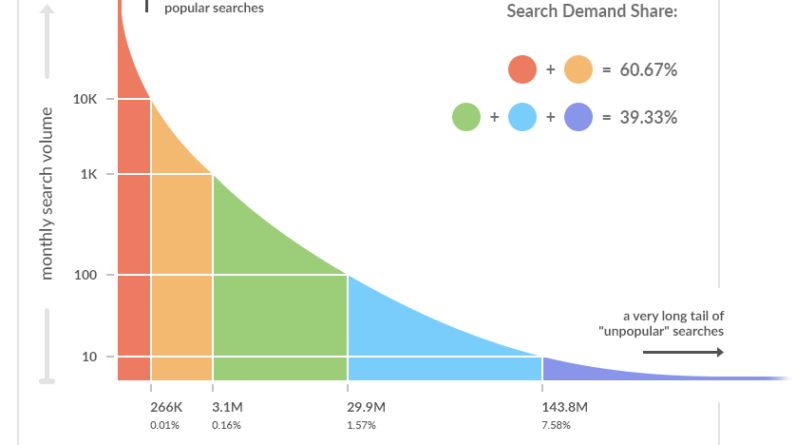
In a curve that shows the size of search demand, like the following from ahrefskeywords with the highest search demand are placed at the far left and make up the head, while keywords with low search demand go to the right in what is known as the long tail of the search
Source: ahrefs
Long-tail keywords are typically highly focused, specific queries that include a clear search intent. While head keywords are usually one or two words and extremely broad in nature, long tail keyword phrases are usually three or more words. However, it is important to note that the length of the query does not determine its queue length, but the amount of search demand for the query.
Long-tail queries often include descriptors such as size, color, gender, location, and more. They are often phrased like a question, imitating the way people speak naturally. An example of a main keyword is “suv” or even “kia suv”, while a long tail keyword is “kia sportage awd suv gray”.
While individual long-tail keywords tend to have low search volume, they are also less competitive terms than their main keyword counterparts, which everyone is trying to rank for on search engine results pages (SERPs). Long-tail phrases also tend to have a higher conversion rate, which leads to a more profitable audience for your site.
How to discover relevant long tail key phrases
The good news is that Google gives clues about the types of long-tail keywords people are searching for right on their search results pages. Finding them for ideas for your seed list is a good place to start. For example, if you sell Kias, your search might look like this.
First, do some introspection about your company’s unique value proposition. Next, start with the products or services you offer and ask yourself what makes your brand stand out from the competition. Start building an initial list of potential keywords.
Try typing your seeds into Google search and see what pops up in the autocomplete feature.

Get ideas for what people want to know about your seed term. In this case, the year is clearly important, as well as the price and whether it is a hybrid.
Another place to look for long tail keyword ideas is in the People Also Ask section directly in the search results. These can also be added to your seed list.

This data shows us that the models are important, with a focus on the functionality and reliability of all-wheel drive.
At the bottom of the SERPs, check the “Related Searches” feature for additional phrases.

Other tools like ReplyElPublic, Quora, Also askedi Semrush can provide even more ideas for long phrases that people are searching for that are related to the term you enter into the tool. Collect the most relevant phrases from all these sources and then enter them Google Keyword Planner or the keyword tool of your choice, performing appropriate keyword research.
Google Keyword Planner will provide you with data for each of the terms you enter, as well as other related long-tail keywords and accompanying search volume data. Once you’ve done your keyword research, you’ll want to create a keyword map, identifying the most relevant long-tail keywords for each page on your site. The keyword map gives you a starting point for optimizing your pages, updating and re-optimizing pages, and even potential opportunities to create new content.
Creation of content that is classified
Once you’ve figured out the long-tail keywords you want to rank for, you need to determine what type of content you want to produce. Check to see what types of content are currently ranking in the SERPs for your specific long-tail query on Google. If your search primarily produces informational content, writing a well-optimized blog post or informative article would be in your best interest. On the other hand, if your long-tail keyword phrase returns product pages or e-commerce categories, you’ll need to write copy for similar pages on your site.
This insight into what already ranks well in organic search is an excellent guide to the quality, length and type of content you need to create to compete. But keep in mind that your content should provide even more value than what’s out there while providing an excellent user experience, according to Useful content from Google guidelines
Another practice to improve your SEO copy is to re-optimize existing content on your site and sprinkle these new long-tail keyword concepts into your copy in a way that reads naturally. Don’t just use keywords; actively respond to the questions they represent.
Once you’ve optimized your content, measure your performance with Google Search Console is key Google Search Console can give you insight into the queries with which searchers arrive at your pages. These queries may be potential long-tail keywords that you want to strengthen in your copy. Paying attention to data can help you update your content in a never-ending optimization cycle.
Reasons to build an SEO strategy around long-tail keywords
SEOs and marketers often overlook a strategy for long-tail keywords that fight for top positions in the SERPs. Strategic use of long tail keywords can help you outperform your competitors by specifically focusing on answering searcher intent and optimizing your site by focusing on the long tail.
Although they may have lower search volume and generate less traffic overall, long tail queries are a powerful tool for SEO. Visitors to your page are likely to be the most relevant target audience for your business with a higher likelihood of converting or making a purchase. While traffic to your site is extremely important, getting the right kind of traffic is more valuable. Instead of obsessing over traffic as a key performance indicator, keep an eye on conversions.
Organic search ranking is a much easier game to play when optimizing for long tail keywords. Because they are less competitive, you have a better chance of increasing your rankings for those specific terms. With the thousands of variations of long tail keywords, there is a ton of untapped potential in the SERPs to earn those first page ranking positions.
Focusing on a long-tail keyword strategy in organic search can provide valuable long-term results. Remember, SEO is not a sprint. It’s a marathon. So make sure you take your time and optimize for long tail keywords that have the potential to rank and drive traffic to your website. People who search for these very specific long-tail queries are more likely to convert because they know exactly what they want and are further along in the buyer’s journey. Optimize your pages for these long-tail keywords and respond to searcher intent by giving them what they were looking for.
[ad_2]
Source link





