


sesame / DigitalVision Vectors / Getty Images
In 1993, Don Peppers and Martha Rogers introduced a new concept that became the basis for many of today’s marketing programs.
His book, “The Future of One-to-One: Building Relationships One Customer at a Time,” has become a classic benchmark for marketing and personalized sales. One industry expert summed up the book as a “unique perspective on the fundamental structural changes that technology is already bringing to the real world of business competition.”
It has taken more than a few years, but today, a highly developed integration of various technologies gives manufacturers the ability to seize the growth potential that Peppers and Rogers promised 30 years ago.
We should not be surprised by the evolution of technology. Marketing and sales technologies such as customer relationship management (CRM), marketing automation, and smarter business and contact databases are available to manufacturers who understand how important they are to lead profiling and lead qualification processes.
These technologies did not exist 30 years ago, and neither did some of today’s manufacturing production technologies. Automated material handling and multi-function production platforms were also nascent in the 1990s. Today, a contract manufacturer can integrate these ripening technologies into a highly automated plant. This has been the promise of Industry 4.0. And as we’ve seen with marketing technology, promises come true over time.
What would your world look like if you combined highly targeted and personalized marketing with highly developed production capabilities?
Taking advantage of the production technologies you know
Every manufacturer looks at ways to create competitive differentiation. It’s good to be different. Differentiation is the key driver of revenue and profit growth.
Your investments in production technology are motivated by your need to provide advantages in quality, cost, scale or competition. You could say that these investments are “table stakes” necessary to maintain your market position. Each year, you budget capital to replace and maintain your production platforms as part of your global operational excellence initiatives. The continuous evolution of production technologies means that equipment upgrades are continuous. And the pace of evolution in production technology continues as equipment vendors update their products to maintain their own competitiveness.
Although investments in production technology can be beneficial, market factors limit the effectiveness of capital investments in production technology:
Each production technology may be available to each potential buyer with sufficient capital to purchase it. This levels the competitive playing field. As production equipment prices drop (think low-cost fiber lasers from overseas), this affordability attracts new entrants into the manufacturing industry.
The question is, if you and your competitors can acquire the same production technologies, how will your business be different?
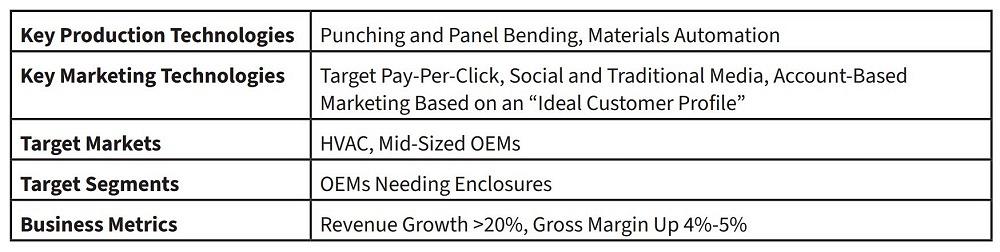
FIGURE 2. Contract manufacturer Dalsin Industries integrates one-to-one marketing with its production technologies to highlight its automated panel punching and folding capabilities. This combination has helped the company beat industry measures for year-over-year growth.
Leveraging Marketing Technologies You Should Know
One way to differentiate your company from other manufacturers is with personalized marketing. Today, you have access to contact databases, marketing automation platforms that track the performance of marketing investments, CRM platforms to monitor and manage your sales pipeline and existing customer relationships, and digital marketing to promote your business. And search engine optimization and pay-per-click programs can increase your website’s performance.
Many manufacturers do not think about marketing. They do not understand its potential benefits and are not willing to invest in it beyond the minimum. Some still confuse sales and marketing. Therefore, manufacturers who pay attention to marketing tend to outperform the overall market. And those that combine high-performance production technologies with relevant marketing technologies create a truly unique opportunity to generate revenue and profit.
A roadmap for merging technologies
As you go through this onboarding process, you won’t be able to do (or afford) everything you want. Technology will continue to mature and change, and you’ll want to use early successes to help find future investments. So you’ll need a business and technology roadmap to guide you (see Figure 1). Roadmaps are visual projections of the major steps, or initiatives, that drive both your production and your marketing investments. Its visual nature helps you communicate these priorities to your organization and allows your staff to see how their personal priorities, whether production or marketing, are part of your overall business priorities.
When designing your specific roadmap, think about what your technology roadmap does for production and marketing today and what it could do if you expanded it. Then follow these best practice steps:
Identify and prioritize your opportunities based on revenue and margin contribution to your business. You can do this by building and evaluating P&Ls for each market you serve today. Identify your best historical growth markets and the ones that drive your profits. Connect business/marketing processes and production processes. This involves selecting the marketing programs that will drive new business most effectively, based on your understanding of the specific market needs for your in-house production capabilities. If you don’t know what your target market priorities include, secondary research can be helpful, and primary research through interviews is an excellent resource. Apply the right technology to your top priorities from step 1. This step involves selecting go-to-market programs that fit your customer acquisition costs and revenue channel goals. Test and evaluate, then refine based on customer validation. No marketing program should ever be considered a “silver bullet,” and campaign testing helps you understand what type of qualified leads you should expect from each program. Two factors are important here: having established marketing metrics and understanding industry benchmarks. Set discrete financial goals for each investment. Effective marketers understand that projecting and tracking results is a necessary part of their role. When campaigns don’t work or end, it’s time to try something else. Measure your recovery and move on to your next priority. An effective go-to-market approach tests several alternatives. Once you understand what works best for generating qualified leads, spend more of your marketing investment on programs that don’t work as well.
Case study – Contract Manufacturer
The current topic of manufacturing production technology is automation. Large companies are integrating material automation technologies with production capabilities such as folding, punching and cutting as they look to scale operations. But contract manufacturers are also embracing automation. This type of integration is not only great for providing more capacity and reducing lead time, but it also helps mitigate the labor shortage that is sure to continue.
A contract manufacturer, Dalsin Industries, located in Bloomington, Minnesota, has developed a way to integrate one-to-one marketing with its production technologies to highlight its automated panel punching and bending capabilities. And that combination has helped the company beat industry measures for year-over-year growth (see Figure 2).
We developed this approach and refined it at Dalsin Industries over a couple of years. Now, in the fall of each year, we select the target markets we are most interested in for the next financial year’s business plan and budget. This process is guided by our understanding of which production technologies we want to highlight, as well as those for which we believe we can support additional demand. We also identify specific applications (such as enclosures) that we want to highlight based on customer feedback and an analysis of industry trends.
The final steps include identifying the OEMs we want to do business with (based on our ideal customer profile) and then developing a marketing plan to develop new relationships. The marketing plan contains a schedule, a budget, details of both target markets and target customers, what programs or campaigns we plan to run and the results we hope to achieve.
Focus on the front end
Manufacturers spend a lot of time looking for ways to automate and streamline their production operations. But they have to put that same energy into the front of the business.
If you believe in continuous improvement and lean operations, you should be willing to apply that same expertise to see how you go to market, create a revenue pipeline, close new customers, and manage customer relationships over time to increase long-term value. .

FIGURE 1. A business and technology roadmap is a visual projection of the major steps, or initiatives, that drive both your production and your marketing investments.
[ad_2]
Source link





