


MANILA, Philippines – When you’re online, you’ve probably come across text or images on web pages that allow you to navigate to other web pages. They are called hyperlinks.
Hyperlinks indicate to the user, or to other web applications, that more information or data about the topic can be found on the other page or online address. The more useful information a page has on a particular topic, the more likely it is to be read and receive more links.
Among digital marketers who practice search engine optimization (SEO), these are called backlinks. And they are worth their weight in gold.
Search engine giants like Google are known to use these backlinks as one of the signals to assess the importance of a page in relation to a topic. Websites and pages that receive a lot of backlinks are placed higher on search engine results pages.
News websites, especially those that regularly produce unique, credible and informative updated content, rank well in search results because they get a lot of backlinks.
Game the system by creating artificial links
In contrast, other business or marketing websites that do not regularly produce original content on a daily basis have a harder time getting these backlinks.
So how do sellers pitch?
They approach high authority sites in hopes of getting them to link back to them. Rappler, for example, because it ranks well on the results pages, has been getting a lot of these requests for years.
Over time, savvy SEO professionals have taken to playing with search algorithms to make the websites they promote more visible on search results pages. A common practice was to set up numerous sites to artificially create these backlinks.
This is not difficult to do.
The World Wide Web abounds with services that promise to automate this process of building links to your site. A quick Google search will lead you to services that even automate the website building process. These websites can also be easily populated with tools that take content from other websites and “rotate” them to look different from the original site.
The industry now refers to these unethical manipulative techniques as Black Hat SEO. And Google, of which declared mission is “to organize the world’s information and make it universally accessible and useful”, it has been at war with these black hat operators for years.
For these black hat SEO professionals, it doesn’t matter if the websites created are of low quality and very little content. What matters are the backlinks.
The search engine optimization industry refers to the backlinks created through these link building schemes as toxic backlinks. Due to the prevalence of these toxic websites on the web, Google released a series of algorithm updates early 2012 that sought to discourage or minimize the practice on their search results pages.
Attack tool
Beyond being used to promote sites and pages, this technique has also been used as an attack tool against the competition.
Stacy (not her real name), a digital marketing practitioner who used to work for an Australian SEO company, spoke to Rappler about a case in late 2021 where this technique has been used to target the competition.
The seller recalls encountering a sudden drop in traffic from search results on the product website of his client, a local retailer. To identify the cause of the drop, Stacy said they inspected several indicators. For example, did articles with backlinks still exist? Were the stories that had these links removed or were the hyperlinks broken?
This process led them to one indicator: a huge jump in backlinks from toxic domains.
“We fully believe it was their competitor paying their online marketers to improve their own rankings,” Stacy said. “It was a competitive industry and they were too targeted to be random.”
At first, Google said it only devalues low quality links accumulated by websites through these black hat link building schemes. That should have been the end of it, except that black hat operators found another way to still be relevant: using the same techniques to sabotage the traffic going to their clients’ competitors’ websites.
Industry specialists refer to this as “Negative SEO.” For years, Google has been denying that these techniques work. As recently as March 2021, John Mueller, a web trends analyst at Google, argued that “Negative SEO” is nothing more than a meme.
I don’t think the negative SEO meme will ever go away. It’s tempting to assume that someone else is causing problems, and yes, sometimes people have a lot of money, time, bad ideas. Time will tell, and I’m pretty sure it will be fine.
— 🥔 johnmu from Switzerland (personal) 🥔 (@JohnMu) March 1, 2021
Then, in October 2021, after a new update to Google’s search algorithm, Mueller admitted that in some cases, where there is a clear pattern of spammy and manipulative links by the site, the their algorithm may simply decide to distrust the entire site.
Mueller was answering a question about how “toxic backlinks” affect a website’s visibility in search results. That was your answer to the question: “For the most part, when we can recognize that something is problematic or a spam link, we’ll try to ignore it. If our systems recognize that they can’t ignore those links on the website, if they see a very strong pattern, it can happen that our algorithms say well, we’ve really lost trust in this website.”
This is the case with many spammy and low-quality signals: we’ll work to ignore irrelevant effects, but if it’s hard to find anything useful left, our algorithms may end up being skeptical of the site as a whole.
— 🥔 johnmu from Switzerland (personal) 🥔 (@JohnMu) November 1, 2021
Mueller admitted that Google tends to be conservative in its approach to this problem. “The web is very messy and Google ignores the links on it.” He said such a drop usually happens “when there is a clear pattern.”
Fighting toxic links, going after black hat operators
What should website owners do when toxic links are directed at them?
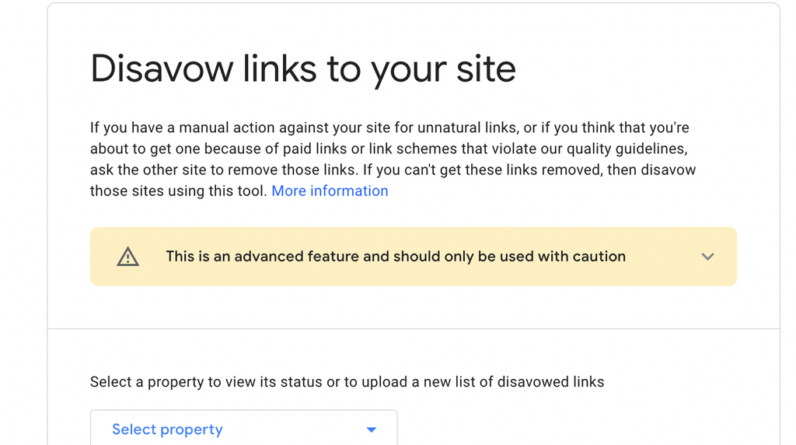
One way is to do it deny these bad linksaccording to Google and SEO professionals.
UNSAVE Screenshot of Google’s disallowance tool, which allows webmasters to request that Google ignore toxic links to a domain.
Unfortunately, not all website owners will have the staff or tools to detect, let alone fight, spammers on a regular basis.
The hard part here is sifting through the mess of backlinks and identifying which links are desirable and which are not, which can be a tedious process. It’s a tricky business and Google itself advises website administrators to use the disallowance tool with caution.
Beyond identifying toxic links, holding those responsible for sabotage can be even more difficult. As in the rest of the digital space, bad actors can hide behind anonymous accounts and proxies.
“We didn’t find out if the competitor actively solicited this attack,” Stacy said.
It is also likely, he added, that the competitor did not actively request the attack. “It could have been ‘part of the service’ to improve SEO for the competitor, without explaining the black hat tactics to the client.”
Buyer and reader, beware. – Rappler.com
[ad_2]
Source link





