


(July 6, 2023 / JNS)
When a new show about Orthodox Jews appears on Netflix, the immediate question Orthodox Jews ask is, “Is it good for Jews?” And in almost every case, we already know the answer.
From “Unorthodox” to “My Unorthodox Life”, our stories have been told by those who have left Orthodoxy. And while those who have had negative experiences or trauma have a right to tell their stories, we as Orthodox Jews are misrepresented when their stories are presented as our own. When tropes, stereotypes, misconceptions, and generalizations about Orthodox Judaism and Orthodox Jews are peddled, viewers believe them to be true, especially viewers who have never met a religious Jew before. We have no alternative to present that portrays the beauty and depth of living as observant Jews in the modern world.
When Netflix released “Jewish Matchmaking,” I could hardly believe what I was seeing. Here was Aleeza Ben Shalom, a proud Orthodox Jewish woman, wife, mother and entrepreneur, who confidently entered the scenes kissing a mezuzah. She shared Jewish values and wisdom about dating and marriage with her clients, and the world was watching. Here was a woman who was proudly observant—and presented as kind, warm, strong, and wise—a far cry from the descriptions we’ve heard before of Orthodox Jewish women as fundamentalist and downtrodden.
And the world fell in love with her. Tweets touted Aleeza Ben Shalom as the best thing about “Jewish matchmaking,” citing her non-judgmental attitude and caring personality. A fan told Aleeza that when faced with an ethical challenge, she now wonders, “What would Aleeza do?”
The importance of this kind of real, non-fictional representation on screen and the positive response to Aleeza Ben Shalom as a human being cannot be understated. If she was an actress playing a character, that would have been enough! But for the first time ever, we have a real-life Orthodox woman, wearing modest clothes and covering her head, starring in a Netflix show. Aleeza, just being Aleeza, has provided the role of the backward Orthodox woman that Netflix viewers thought they knew.
This is a start. But we need more. We need to tell more personal and human stories of Orthodox Jews. We need to show the world who we are and what we believe. However, most Orthodox Jews wouldn’t want to be the stars of a Netflix show, nor would they want cameras rolling in their homes. While film is undoubtedly the most powerful tool at our disposal, we also have another powerful communication device: social media.
After launching the #myorthodoxlife social media campaign that gained international attention (the hashtag was used in nearly 3,000 social media posts) in response to “My Unorthodox Life” in 2021, I realized that we must tell our stories as Orthodox Jews. Participants in the campaign were highly motivated to dispel the myths and stereotypes that were intended in the show by sharing their own stories. How could we continue to share with others who we really are?
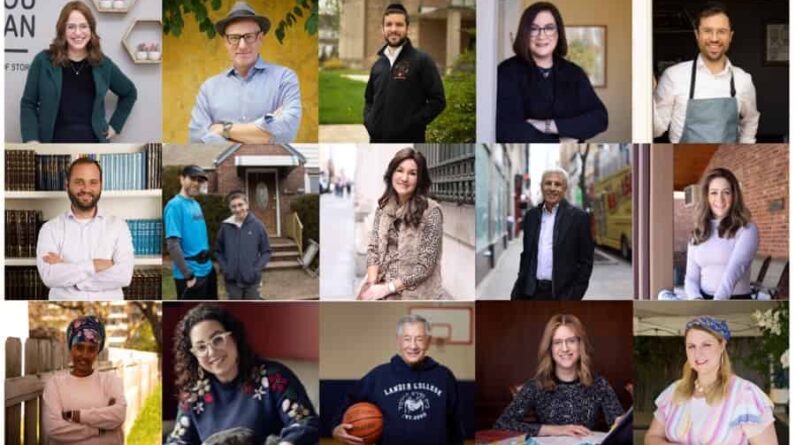
From the “Faces of Orthodoxy”. Credit: Courtesy.
With the support of the Orthodox Union, we launched the social media initiative “Faces of Orthodoxy” in 2022. Puts a human face on Orthodox Jews by telling the everyday stories of various religious Jews through portrait photographs, personal photos and newspaper-style posts. We highlight our everyday heroes of faith, not perfect people, who share their triumphs and struggles. Our followers engage with our content daily, encouraging our subjects as they share their life journeys.
The mission of “Faces of Orthodoxy” is to expose non-Jewish and non-Orthodox communities to the diversity within the Orthodox community while emphasizing the universal values we all share. We also aim to inspire Orthodox Jews to be proud of who they are, what they do and what they believe. “Faces of Orthodoxy” has become a supportive community and positive social media space that celebrates the individuality of Orthodox Jews in our communities.
One of my favorite comments from a follower was in response to our profile of David Sacks, a Torah-observant Hollywood producer. She said: “Thank you for sharing your story. There’s a narrative that if you’re bright and talented, you’re naturally not religious. Your life story completely counters that.”
And another about one of our “faces,” Shalom Goodman, who is the search engine optimization (SEO) editor at The Wall Street Journal and has a significant speech impediment: “I love following this page so I can learning more as a non-Jew. And you speak very well and I’m so glad you shared your voice. It’s so important for all groups to share a diversity of voices and experiences. Thank you for your courage.”
We hope to be sharing stories of Orthodox Jews in various careers, of various ethnicities, ages, and religious backgrounds, who serve as role models for us all—and perhaps break stereotypes along the way—as they live their lives committed to their faith.
More than ever, we need to put a human face on Orthodox Jews. We need to tell our stories. We must show the world that we share similar human struggles, overcome universal challenges, and live fulfilling lives in the modern world guided by the values and traditions of our ancient wisdom. Because if we don’t tell our stories, who will?
Subscribe to The JNS Daily Syndicate by email and never miss our top stories
By signing up, you agree to receive emails from JNS and our advertising partners

JNS serves as a hub for a thriving community of readers who appreciate the invaluable context our coverage of Israel and its Jewish world provides.
Please join our community and help support our unique brand of Jewish journalism that makes sense.
Already a member? Sign in to stop seeing this
[ad_2]
Source link





