


Artificial intelligence has taken over the SEO industry in recent months.
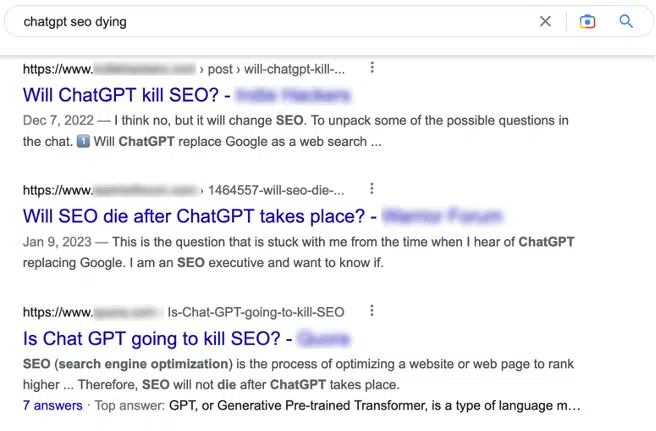
With the emergence of AI-powered tools like ChatGPT, which can understand and perform all kinds of (SEO) tasks, a perennial question is once again in many headlines: Is the SEO industry dying?
First off, if you’re impressed with ChatGPT and think it might be threatening SEO, you might be surprised to learn that, based on the tool itself, the SEO industry is going to be fine:
AI may change the way SEO is done, but it is unlikely to replace the entire profession. While AI can automate certain aspects of SEO, such as keyword analysis and technical site audits, it still requires human expertise and creativity to develop and implement effective strategies.
In addition, search engines themselves are constantly evolving and becoming more sophisticated, making them a moving target for the AI to keep up with. As such, the role of SEO professionals in keeping up with search engine algorithms will likely continue to be in demand.

Note: I really like this “moving target” point…
Second, on a more serious note: If you’ve been an SEO professional for several years, you’ll have noticed that search engine optimization has never been threatened by any technological advancement. On the contrary, always prosper when innovative tools emerge to discover new ways of doing (old) tasks and provide new opportunities.
That said, AI tools like ChatGPT can help improve the profession, giving us another tool to allow our industry to thrive.
Let’s see how ChatGPT can change SEO (and already is):
1. Help with the creation and optimization of content
Automating SEO content creation is something SEOs have been trying to do for years, and for obvious reasons: search engines have traditionally needed text to understand what a page is about, and it’s not always possible to write content by hand for every target query or search intent out there. This is especially true for large-scale e-commerce websites with millions of SKUs and product pages.
ChatGPT to the rescue? Not so fast: Using AI to write content may not be a good idea for at least two reasons:
AI-generated content will always have no personality or style (which Google already recognizes or will recognize in the future). Anyone familiar with Google’s history of finding ways to penalize any optimization tactic or content creation at scale knows that once AI-generated content becomes a problem, Google will find ways to to detect, devalue it and potentially penalize it. While automating your content strategy helps quickly trim your to-do list, using AI for content creation isn’t a good idea in the long run, just as it wasn’t a good idea in the long run automate your content creation with any type of rewriting or translation tools in the pre-AI days.
So where can we lean on AI to help with our content efforts? Tools like ChatGPT can help with many SEO content creation tasks without putting your overall SEO strategy at risk, such as:
Content topic ideas Keyword research analysis Creating content summaries (for meta tag optimization or highlight snippet optimization) Creating content summaries and outlines Content structuring, etc.
Here’s ChatGPT categorizing keyword lists by search intent, for example:

And here it helps you with structuring the content:

Similarly, you can ask the tool to rank your keyword lists by sentiment or create a semantic analysis to group your keywords. The output still requires manual review, but it’s much more efficient than performing any of these tasks by hand using nothing more than your subjective understanding of those queries.
No one hires a professional team just to do any of these tasks, so it’s more about making parts of the process more efficient (and leveraging technology to uncover new ideas that traditional keyword and audience research might get lost) than replace one full service agency.
2. Save time on small tasks
ChatGPT can perform smaller tasks to help save time. These include simple coding, basic research and some forms of data analysis.
For example, ChatGPT can quickly assemble schema code based on your instructions. Or it can suggest schema types that work based on the content you enter. It can provide clean HTML code for any text input. You can even write simple PHP tools and get data from APIs.
It’s still up to a smart developer to put many of these pieces together, fix bugs (which the tool does regularly), test the output, and adjust the code accordingly. If you’ve ever worked with development teams, you’d think, “This is what they’re already doing, but they’re relying on public and standalone code snippets,” and you’d probably be right!
In this sense, ChatGPT is just a useful assistant that can make many lives easier, but it still needs human intervention because there is always a bigger picture, a complex testing process and a long period of adjustment based on real human interaction with a page or a tool.
Search (for now)
ChatGPT cannot search, is not currently updating its own database, and does not access other search engines.
Whether or not this will change, we don’t know (one would assume it’s likely in the future), but we do know that Google has spent decades teaching its algorithm to deliver a variety of results in response to a human query. , so I don’t expect this tool to become Google’s replacement any time soon.
Capture and monitor trends
ChatGPT builds on its existing knowledge base, which is trained to understand and learn. Updating this knowledge base seems a bit of a problem because it would require more training and testing, which is not easy. Otherwise, the tool’s knowledge base would have been much more up-to-date by now.
Anyone who has been in SEO for any length of time knows that change is the one constant in our industry where your site can be filtered by something you did five years ago. As such, you wouldn’t want to rely entirely on updated data from an AI tool to make updated decisions for you.
As ChatGPT admits, it’s not good at targeting moving targets – the very nature of the SEO industry.
Think like a human being
Emotions, mistakes, getting lost and feeling confused – these are all integral parts of people’s research and purchase journeys that only a human can relate to.
Being able to understand human emotions and predict reactions is an important component of important SEO tasks like link building dissemination and creation of viral content.
Creating relatable content is also something that only a human can do, and it goes without saying that the tool can’t perform the necessary tasks like promoting your content, spreading the word, tracking leads, etc.
With AI content, you run the risk that all content on the web—its tone, format, and verbiage—will end up sounding, looking, and feeling the same. And that’s an Internet none of us want.
Without integrating with other tools like Google Analytics, Search Console, and the rest, AI also doesn’t have the ability to analyze the dozens of reasons your website might have lost traffic and propose solutions to these problems. Ironically, excessive use of AI-generated copies may end up being the cause for many of you in the future!
Final thoughts
I am sure that this is only the beginning of the application of AI both in SEO and in our daily lives. Soon we will see the days when AI-based technology integrates with other toolsets, leverages more up-to-date datasets, informs us of analytics and recommendations and updates (or even makes) about to perform SEO checks in order to make additional improvements to our overall optimization and marketing efforts.
But what happens when the AI tool learns to do what it currently can’t do?
Once again, change is the only constant in our industry, and there will be more and more ways to find out how AI-based technology can make SEO more effective and productive.
However, anyone who has been playing around with ChatGPT wondering if the SEO industry is under threat may have a poor understanding of what is effective. SEO strategy is. It requires a much deeper perspective and understanding of the big picture, target audience needs, amplifier link interests, emerging trends and opportunities than the current iteration of AI-driven technology can provide.
[ad_2]
Source link





