


The only constant in SEO is change.
Take the classic case:
Your page takes the top three spots, bringing you 10x more traffic and leads than your competitors in positions six through ten.
So post, post, post to build on past success. But two things happen:
Any SEO professional worth their salt has seen it happen.
The content of the past that used to work so well slowly erodes over time.
It no longer matches the search intent. New things have supplanted it. As the world evolves, so should our content.
No need to despair, though.
This is actually a pretty easy problem to fix. All you need is this simple three-step content optimization plan that we’ve used to resurrect past winners from the dead consistently.
Why the best quick SEO gains come from content optimization and republishing
We helped a large financial publisher increase their traffic per page by an average of 121.9% in about a year.
Around 30 different URLs were flagged as “optimization opportunities” – nerdy shorthand for “things that used to rank well, but now do a little bad.”
These are easy to find once you know where to look. And pretty easy to set up, too.
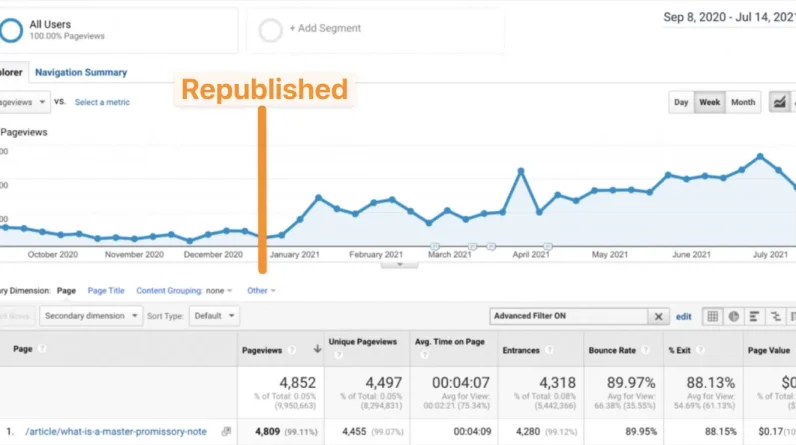
For example, an article was republished on January 1, 2021, and traffic instantly doubled.
And this one, reposted a few days earlier on December 15, 2020, resulted in a steady stream of new hits for the rest of the next year.
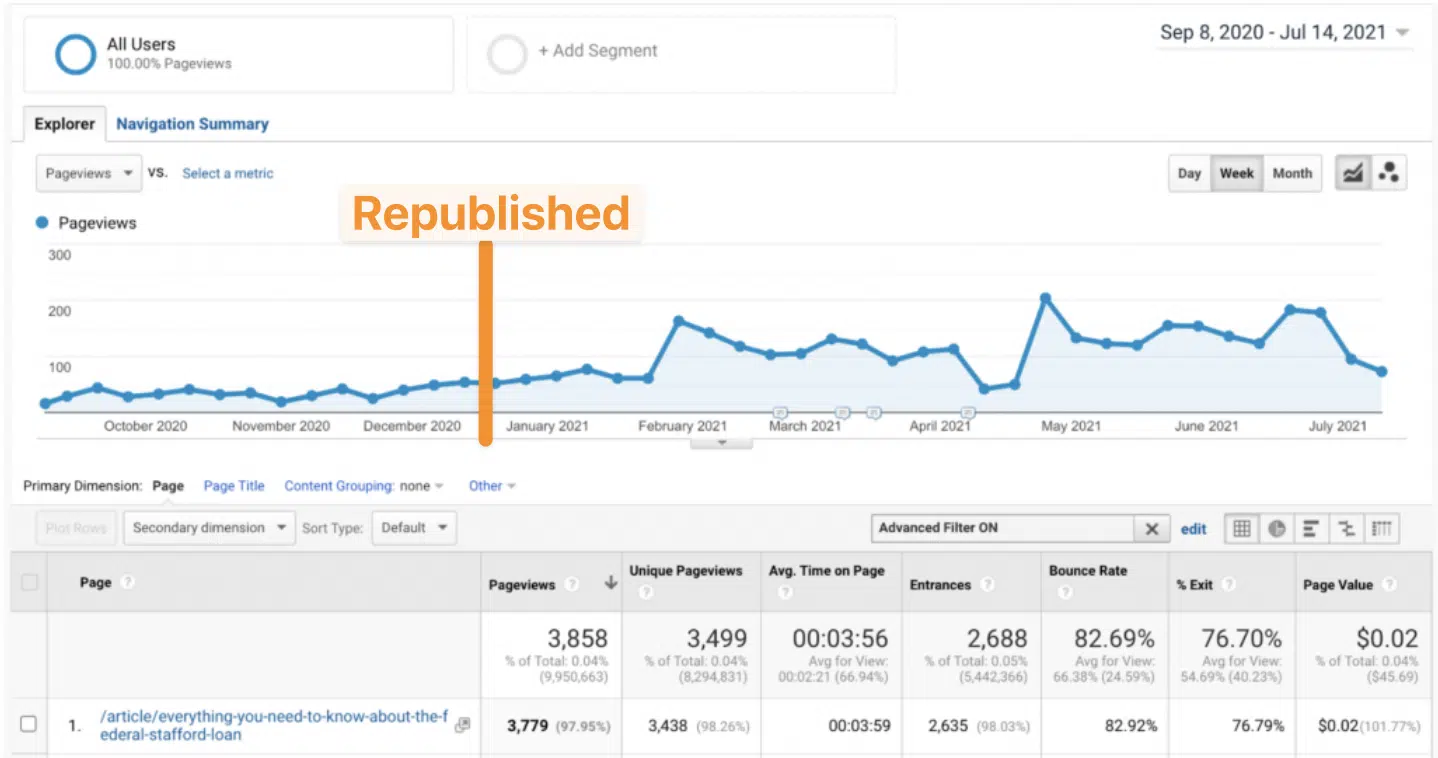
And another
This time, republished days later on January 19, 2021, it took off like Elon’s rockets.
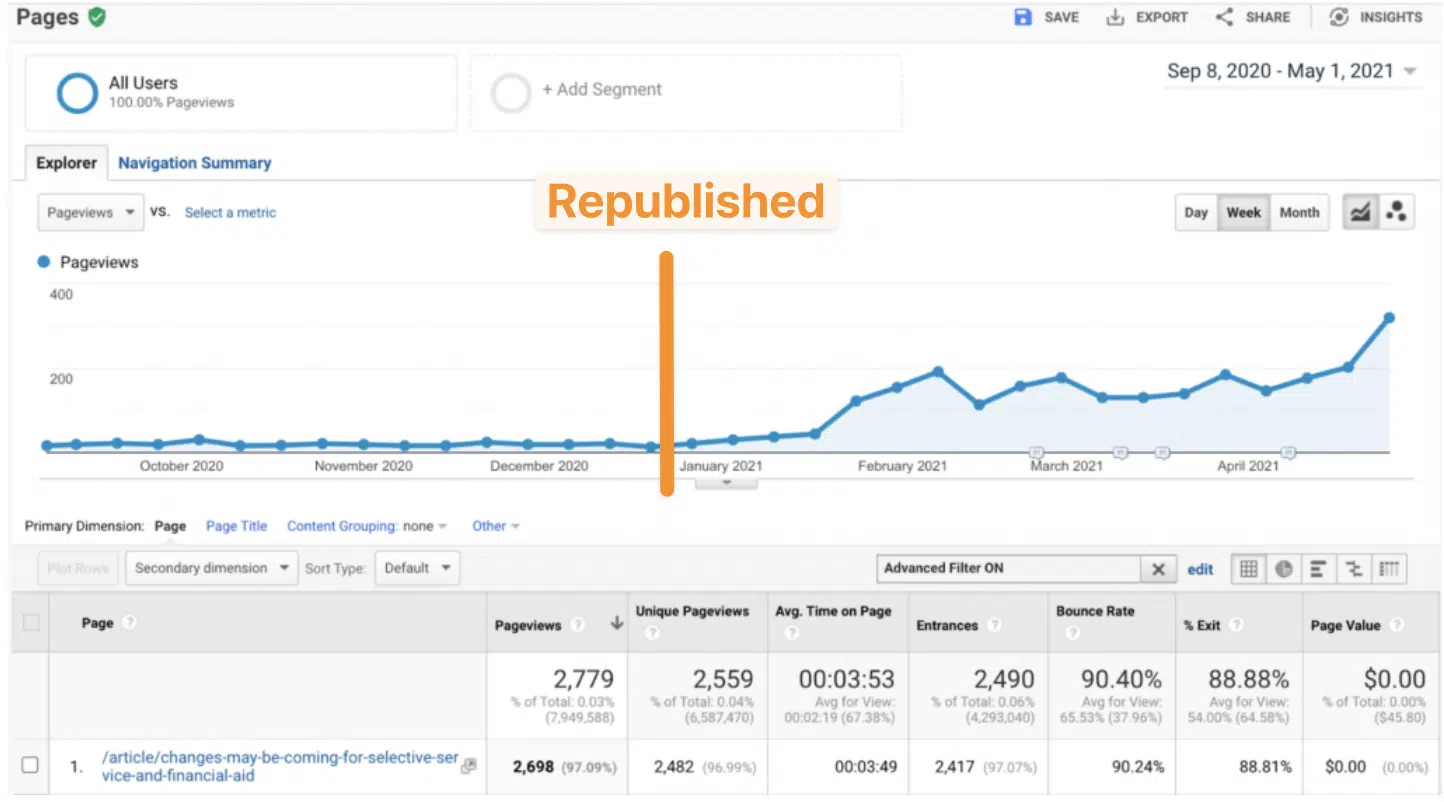
Convinced yet?
Note that this is a large site, originally founded in 1999. So it has had some success, great DR, and topical authority over the years. It has an advantage in this regard.
But that doesn’t change the main point:
Do you want long-term growth (24 months or more)? Post new content. Do you want short-term growth (< 6 months)? Republish existing content.
Now, let’s cut to the chase and go through the exact steps you can use to replicate these results.
Step 1: Identify which existing URLs are ripe for republishing
You know what they say: if it ain’t broke, don’t fix it.
Are your URLs already in the top 3-5 positions? Upgrade slightly but don’t rock the boat.
But, the stuff below the top five? We are talking now.
These are the things that have decent traction or may have dropped recently. It’s seeing some traffic, which is important. However, not enough traffic because it’s stuck in no man’s land outside of ~80% of SERP clicks.
So, open up your favorite SEO tool and let’s make a quick list.
First, open all the organic keywords your site is currently ranking for, such as:

Next, set your parameters. It could be positions 8 to 20 or 5 to 10. It doesn’t really matter. The point is the point: stuff that sees some traffic but not nearly as much as it should.
I also like to set a floor for volume to make sure we don’t worry about tiny keywords or pages, while also setting a difficulty limit to make sure we focus on the low-hanging fruit (and don’t bite off more than can chew).
This last point is particularly important. If you choose very difficult keywords, optimizing and republishing your content alone may not be good enough. You will probably still need high quality links and more to get into the top five sooner rather than later.
These exact floor or cap numbers are somewhat arbitrary depending on how competitive your space is and how strong your site is. Larger/older sites should be higher in both, while smaller/newer sites should be lower.
But let’s go with the example of “100” for minimum volume and “30” for maximum keyword difficulty (KD).
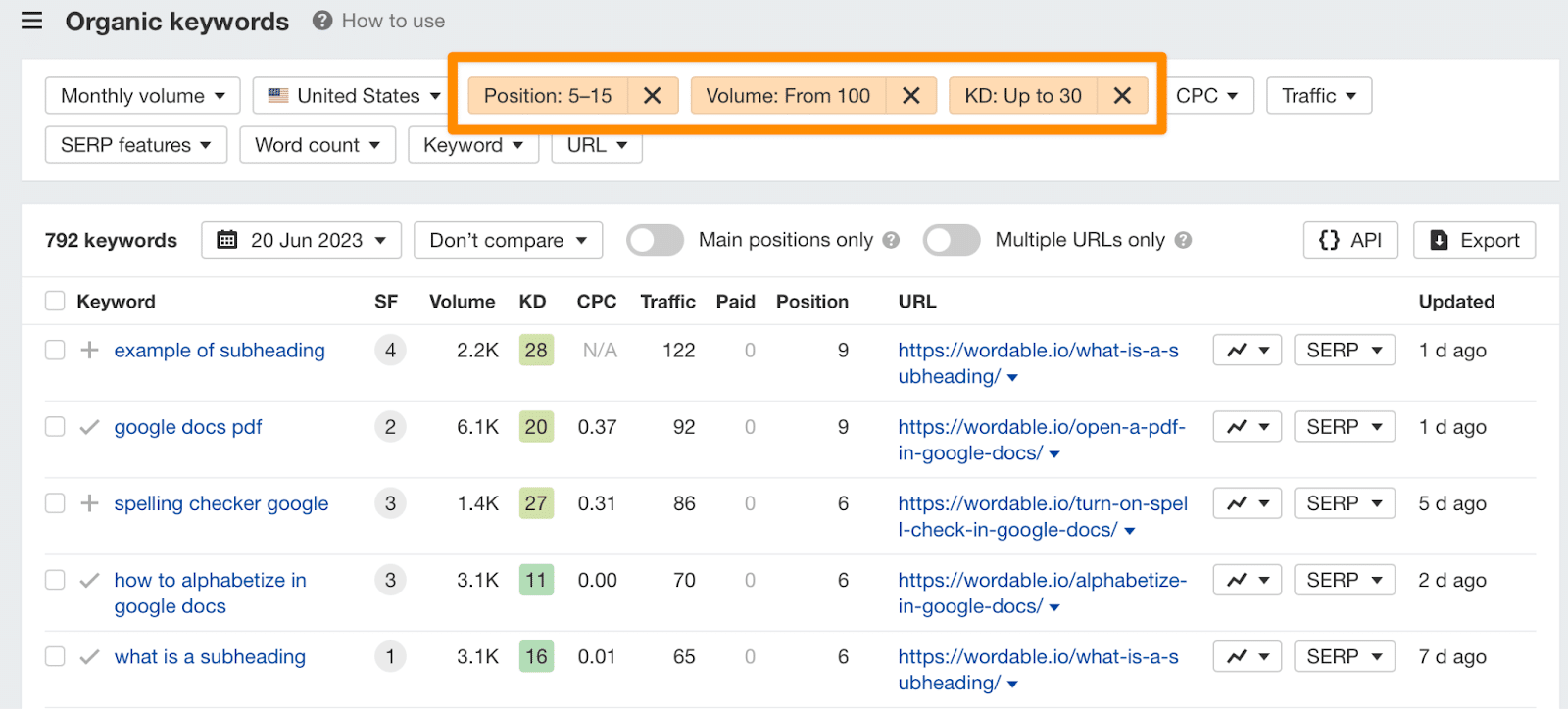
Now we are getting somewhere.
About 90 seconds of work just generated a list of your low-level SEO fruit.
So now let’s separate the wheat from the chaff. (I had to look it up too.)
We want to identify ourselves good candidates for republication of the bad ones We will measure twice and cut once in the next section.
Get the daily search newsletter marketers trust.
Step 2: Prioritize 20% of your existing content will give you an 80% lift ASAP
Good news and bad news.
This simple step above can generate hundreds (or more) of URLs on larger sites. So you’ll have to do some manual work, ignoring or cutting or ignoring irrelevant posts or pages.
Generally speaking, it makes sense to prioritize based on:
Past results (obviously always prioritize your top drivers of sales or leads first). Business intent (so prioritize your BOFU > over your MOFU > and then over your TOFU). Top traffic users (think: TOFU on steroids). Major traffic drops (compare this period, such as month or quarter, to the previous year).
Your actual mileage may vary, because a publisher should prioritize different types of posts or pages for a B2B SaaS brand versus B2C ecomm versus a local services business.
What you are looking for at this stage is a simple Pareto principle. What are the 20% of URLs that will give you an 80% faster return?
For example, digging into this article on captions quickly shows us that there are many more variations of keywords that we’re picking up.
Many indeed! With high volumes and low KD! So now we mark this as a priority too!

Step 3: Determine what specifically needs to be updated about the content
It’s important to note that we don’t just update content for the sake of updating it here.
This is no about simply updating the “Updated on…” date string in WordPress to fool the SEO gods and call it a day.
Instead, this step is about figuring out how we’re going to actually improve the content. We want you to rank higher and move the needle on business KPIs.
So, once you have a few URLs to prioritize, it’s time to do some work.
Unfortunately, content tools still hurt SEO, while SEO tools still hurt content. I’m also including the AI here, which is still years away from making a real dent.
This means that you have to put in some effort. Start by clicking on each URL and read it. Then open some of the SERPs you are currently ranking for, look at the results and read them too.
Now, I know what you’re thinking.
“Wait wait wait. Nobody said anything about using their brains and experience here. No fancy AI hints or anything? Gasp!”
This is very easy, though.
This is what you’re looking for:
How is your content organized, relative to what is currently performing best in each SERP? Is there a search intent mismatch, say you’re trying to rank a landing page with lots of informative blog posts? Or is there overlapping search intent across multiple queries? Is your content already structured as what works best? Are you experiencing any keyword cannibalization, where the wrong page URLs are currently ranking for the wrong queries? Are there open gaps in your topic coverage?
Let’s see how to do this last example first.
Some specialized content optimization software helps reduce the workload here. Enter your MarketMuse, your Clearscope Phrase, et al.
Open the article in question, drop the query you’re analyzing, and let them automatically scan the top performing pages.
The output of Frase, for example, will initially look something like this. Start with obvious areas like word count, headers, and number of images, which can quickly give you a simple measure of whether your content structure meets or exceeds the average SERP benchmark.

Then look for semantic keyword coverage. Basically, when people search for X, what are the tangentially related Ys and Zs that they also want to read?
Again, everything is relative here. So you shouldn’t focus so much on a “100%” score per se. This is not high school. Instead, you want to at least meet or exceed the competition.
These specialized tools will also help you easily compare semantic or competitor topic coverage, so you can quickly identify where you’re doing well…
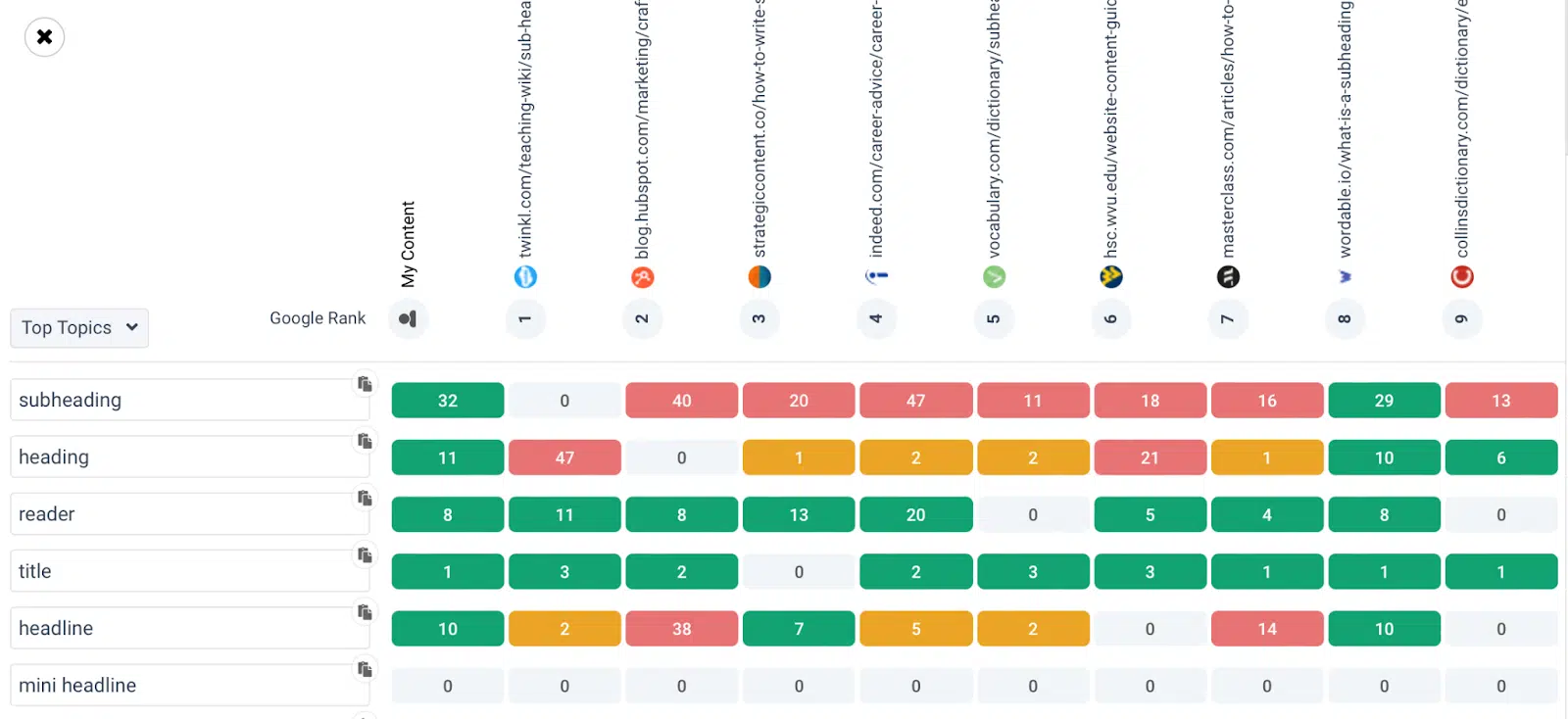
…but most importantly, where do you have gaps!
In the above example, notice that “mini headlines” are missing from all directions. perfect Now we know what to add or update to our existing content.
Obviously, this is a very simple and straightforward example. But the process is the same.
What, specifically, in the content needs updating? (Perhaps outdated information, no longer relevant, etc.) Where are you doing well, both structurally and content-wise, and can you build on them? Where are you not doing well, in relation to the competition? What needs to be improved? Where are the remaining gaps or holes that you can potentially jump in front of the competition and outflank them before their stuff also becomes obsolete?
The last is key to preparing as much of your work as possible.
For example, we noticed that adding a video to one of these optimized articles reduced the bounce rate by -11.94% almost overnight.

That last point is to say that you’re not just reposting content to put it on par with your competitors.
It’s all about getting ahead of them, destroying a competitive moat around you, and consolidating your next ranking gains for as long as possible.
Optimize your content for the long term
Posting fresh content is what grows your site, traffic, and overall SEO presence in the long run.
But that’s the key word here: long term.
Anything you post this year probably won’t move the needle until next year at the earliest.
Unless, of course, you update and improve your existing content.
It’s almost always the highest leverage activity for generating short-term SEO results. The good news is that it’s also pretty easy.
Pool all of your existing content that’s performing pretty well but could be better (position five or lower) 80/20 based on past results, business intent, peak traffic potential, or biggest traffic drops to provide the boost greater in lesser amount. of time Mercilessly benchmark your content against the competition to discover how to not just match them, but outperform them and outperform them in the long run.
These steps, along with good content planning and production processes, allow you to publish, surpass, and surpass your competitors before they even realize what’s happened.
The views expressed in this article are those of the guest author and not necessarily Search Engine Land. Staff authors are listed here.
[ad_2]
Source link





