


Everyone is talking about keyword groups. At its core, it’s pretty simple: group related keywords together. Sounds easy, right?
Some free tools walk you through some natural language processing (NLP) basics that help deduplicate and find semantic similarities between keywords. There’s nothing wrong with starting there, but they are inevitably limited. Google, on the other hand, has infinitely more data to feed into its algorithms, including on-page data and links to provide more context than basic keyword manipulation.
To really understand how Google sees the world, you need to collect SERP data to see which pages are ranking for which terms. At scale, by comparing how many URLs overlap the top 10 results, you get a very clear picture of which SERPs are related. This method has recently been popularized by Keyword Insights, also available in Nozzle, Cluster AI and others.
I’m continually amazed when I find keywords that I would have grouped manually, but Google doesn’t show overlapping URLs, and vice versa. Whether or not Google is “right” in these cases is irrelevant – it’s Google’s world and we just live in it.
Here are the results when you search for “SEO agencies” and “SEO companies” next to the removed ads, and you can see that eight of the top 10 are the same!

Manually finding these overlapping pages is nearly impossible to do at scale, but trivial for a good tool. For years, there have been various tools that help curate keyword lists but don’t go deep. There’s even a big new kid on the block that offers basic grouping, but its 2,000 keyword limit is disappointing.
Auto-grouping keywords is great, but that’s where most tools end: a list of keywords, maybe search volume and/or ranking. Here is a wish list of 10 types of data that would be very valuable in the context of keyword groups, most of which have not been available until now.
URL Classification Refine by PAA Frequently Asked Questions SERP Features Search Intent Ranking Position Part of Voice Entities Categories
1. Ranking of URLs/pages
Existing tools don’t show you exactly which pages are shared among all the keywords in the cluster, making it very difficult to know what Google is rewarding. Also, knowing the number of URLs provides significant insight into cluster strength/tightness. As in the example above, sharing eight out of 10 URLs is a very tight cluster, where only 3-4 overlapping pages are moderately tight.
Most tools also force you to decide before you start how many overlapping URLs to count, which is hard to know before you see the data. You should be able to dynamically change this value as you explore and without having to pay to run the grouping process again.
If you have any experience with content writing tools, the best results for a single keyword are often sampled for you to see. It is much more effective to clear the URL ranking for ALL KEYWORDS in the cluster!
Viewing detailed information about your headings, outline, and text statistics such as word count/grade level can be a helpful guide.

2. Refine by
A criminally overlooked source for relevant topic information is hidden right at the top of every SERP, helpfully labeled with the hidden H1 tag, “Filters and Topics.”
After a few traditional tabs like Images, News, Maps (search-to-search changes), Google links to related topics, usually preceding or appending the topic to the current keyword phrase. They are generally easy to identify manually and can also be differentiated by HTML/CSS classes.

3 and 4. People also ask (PAA) and frequently asked questions (FAQ)
People also asking questions is a gold mine for content creators, as Google gives you the blueprint to respond to your content. PAAs are also much more volatile than traditional search results, so by aggregating them over time rather than the one-time scraping that most tools use, you can identify which questions come up most often . In our example above, even though the SERPs were almost identical, there were no overlapping questions.
First, we have the top 10 questions for that specific cluster over the last 30 days. The SERP count is the total number of SERPs they appeared in and the keyword count is the number of unique keywords that showed the question.
Much like the PAA, below are the questions that Google deemed relevant enough to the topic to provide a much more visual real space to the site by implementing the correct schema.org markup.

5. SERP characteristics
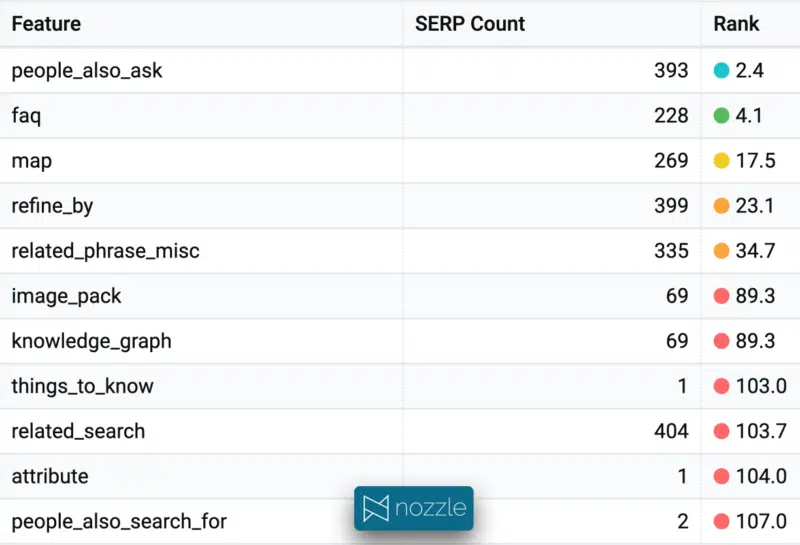
The presence or absence of SERP features specific to a cluster will affect your content strategy. PAA and FAQs typically get very high SERP visibility (for this cluster, ranking position 2.5 and 4.2, respectively), so adding the right markup and answering the right questions can generate significant traffic if the you can capture Maps show 65% of the time, indicating some fractured intent. Things_to_know is only visible in a single SERP, but can represent an opportunity for growth if you optimize.
6. Search intent
Search intent influences your entire strategy, so knowing the overall intent of the cluster, including mixed intent, is crucial to a good strategy. Search intent should also be available by result, in addition to an overall global score, to help identify opportunities to rank multiple pages in a single SERP. It’s also helpful to have data that reports this intent, such as Google Ads metrics.
7. Ranking positions
Reporting your current ranking position is vital. If you’re not currently ranking at all, there may be some low-hanging fruit where you simply have a content gap and with enough subject authority, you could rank just by posting. Likewise, if you’re ranked 8-15, you could potentially increase your traffic 10x with just one additional optimization.
Bonus points if you can see more than just the ranking, including newer metrics like pixel depth and percentage above the fold.
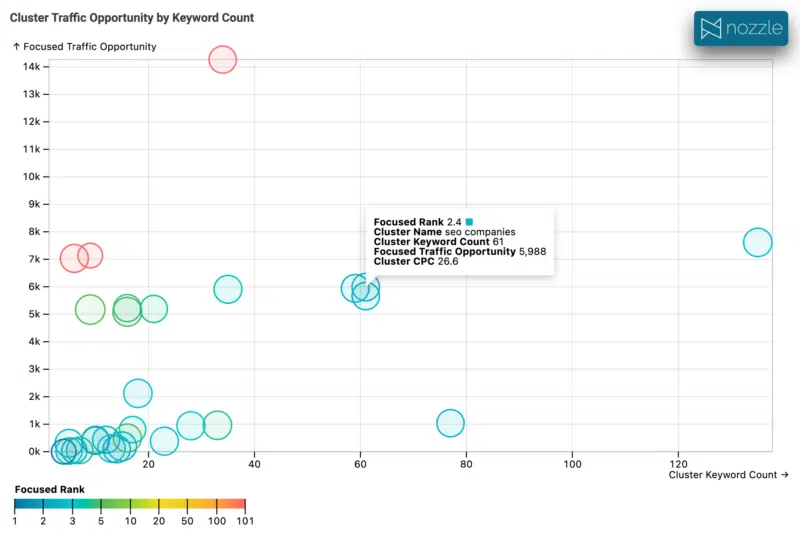
Having the range available doesn’t mean much if you can’t visualize it in a meaningful way to identify opportunities.
This shows the number of keywords in a cluster compared to search volume, with CPC as the radius of the bubble and rank as the color of the bubble. It’s easy to quickly identify groups that match your criteria to drill down for more details.
8. Competitive Overview/Share of Voice
Seeing your own rank is great, but it’s even better if you can spy on your competitors with the same data. Switching between domains gives you god-like powers to dominate your competition.
Because each cluster is different, there may be a different set of competitors in each, so make sure you can report share of voice per cluster.
9. Entities
Google has long since stopped viewing the web using exact match keywords. It is more about semantic similarities, which can be represented by entities extracted from the page content using natural language processing (NLP).
For more information, I recommend reading Timothy Warren’s article on SEL, “Entity SEO: The definitive guide.” Although there are many open source APIs and tools like spacious to extract data from text, I prefer to use Google APIand have a demonstration, as shown below, that identifies important parts of the text.
salience: the importance of the entity for the text.
Sentiment Score: from -1 to 1, with -1 being the most negative, 0 being neutral and 1 being the most positive.
Magnitude of feeling: indicates how much emotional content is in the document.

As a content writer targeting a keyword cluster, hopefully you’ve evolved beyond keyword density. However, it’s still important to make sure you’re properly targeting entities that Google knows and cares about.
Now let’s say we’re writing for Bruce Clay and we’ve decided to target this example cluster “SEO companies”. Typically, the workflow would involve the writer scanning a few important pages and then updating an existing page. With entities, we have a new way to approach content optimization. We can use the same NLP to extract entities from our mapped page and then compare them to the entities in the cluster.
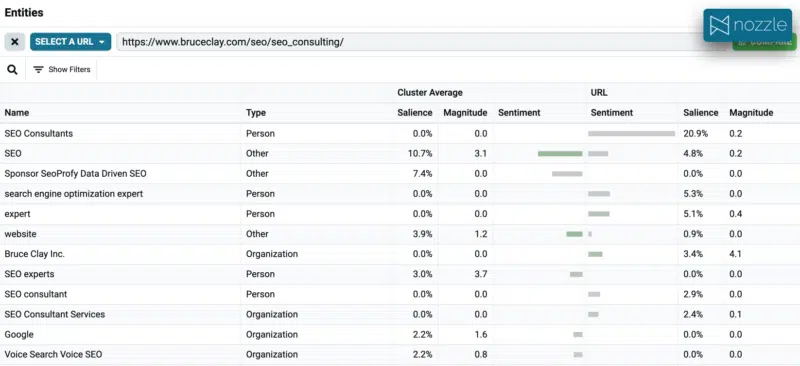
In this case, it is very clear that there is a complete mismatch. Assuming the page you’re comparing already ranks for other clusters, this is a strong signal that you need to create new content to target that cluster.
10. Categorization of contents
Similar to our approach to entities, we can also categorize our content and, by comparing it to the cluster, we can identify mismatches.
Google has one Classification API with nearly 1,100 categories that work in multiple languages. Unsurprisingly, SEO is the leading category for matching URLs in this cluster, but category 4 is “Product Reviews and Price Comparisons.”
With this level of confidence, this doesn’t mean you should run out and add a comparison table to your page, but it’s worth considering whether this would add value to your audience.

conclusion
Until now, you’ve had to stitch together different tools to see even a fraction of this data. Today, nozzle is launching our keyword clustering tool Product hunt, with all this data at your fingertips. Come and try it out with your keywords for free!
[ad_2]
Source link





