


LinkedIn has developed a new AI image detector that is said to be able to catch 99.6% of fake profile pictures, with a false positive rate of 1%. According to anecdotal evidence, their new detector actually works.
Fake LinkedIn profiles
There are many reasons why people create fake LinkedIn profiles.
For some in the affiliate search marketing community, one of the reasons for fake profiles is the perception that Google will trust a site if article authors link to a LinkedIn profile in their bio. author
This idea stems from Google’s push that content should have what is known as EEAT, Experience, Expertise, Authoritativeness and Trustworthiness.
For others, the motivation is to create a more reliable looking website for their website visitors.
This is not meant to condone these practices, I discourage them.
This is just to explain that the practice is happening and why it is happening.
The advent of the ability to create profile pictures with AI has made it easier to create fake profiles, exponentially compounding an already huge problem.
Reports on fake LinkedIn profiles published in 2022 noted that LinkedIn detected and removed 21 million fake accounts in the first half of 2022.
Anecdotal evidence shared by an affiliate marketer who deployed fake LinkedIn profiles confirms that LinkedIn’s AI image detector has greatly improved its ability to catch fake accounts.
According to LinkedIn:
“We are constantly working to improve and increase the effectiveness of our anti-abuse defenses to protect the experiences of our members and customers. And as part of our ongoing work, we have partnered with academia to maintain a stay ahead of new types of abuse linked to fake accounts that take advantage of rapidly evolving technologies like generative artificial intelligence.”
Fake accounts hard to spot
LinkedIn constantly updates its systems to detect various types of unwanted activity, including fake profiles, account takeovers, and content policy violations.
The introduction of AI-generated images has made it almost impossible to spot fake images if you don’t know what to look for.
LinkedIn identifies “artifacts” that are the hallmark of fake AI profile pictures.
Most people don’t know how to spot AI images, so it’s easy for people to mistake a fake account for a real one.
LinkedIn shared:
“With the rise of synthetic AI-generated media and text-to-image media, fake profiles have become more sophisticated.
And we’ve found that most members are generally unable to visually distinguish real faces from synthetically generated ones…
How LinkedIn captures AI-generated content
A characteristic of artificially created images is that they all share similar patterns, what LinkedIn calls structural differences.
Real images share no structural components.
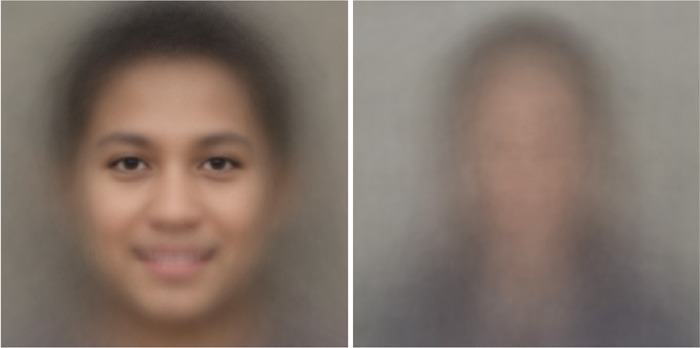
LinkedIn shared an example of a composite of 400 artificial images and 400 real images.
The composition of the fake images shows that the areas around the eyes and nose are usually very similar.
The composite of the actual images shares nothing in common with any of the other images, so the composite is blurry.
Screenshot of LinkedIn image
The results of his research are impressive.
Share on LinkedIn:
“True Positive Rate (TPR) is the percentage of synthetic photos that are correctly classified as synthetic.
False positive rate (FPR) is the percentage of real photos that are incorrectly classified as synthetic.
Our approach is able to detect 99.6% (TPR) of StyleGAN, StyleGAN2, and StyleGAN3 synthetic faces, while misclassifying only 1% (FPR) of real LinkedIn profile photos as synthetic.
For the benchmark results in our research paper, we chose an FPR target of 1%, because for real-world applications in a large professional network, it is important that AI-generated image detection models capture most synthetic images, although rarely. classifying a real image as synthetic”.
How effective is LinkedIn’s AI detector in the real world?
The affiliate marketer with the fake LinkedIn profiles shared that LinkedIn was able to catch 100% of their fake LinkedIn profiles.
They shared their experience with me:
“As an affiliate marketer, having LinkedIn profiles for my fake persona was a great way to build credibility for my authors.
It was especially useful for HARO link building, as journalists tend to link more often to sites with people with a LinkedIn profile.
Over the past few months, 90% of my profiles have been suspended by LinkedIn.
Unfortunately, I now have to find another method to add credibility to my authors and make them seem legitimate.”
LinkedIn continues to improve its ability to catch fake profiles. The ability to create a fake profile became even more difficult.
Read the original announcement:
New approaches to detect AI-generated profile photos
Featured image by Shutterstock/Meilun
[ad_2]
Source link





