


People do business with brands they know, like and trust. The larger the investment, the more important these factors are.
Building relationships and gaining trust are keys to achieving lasting customer relationships. Here’s how to achieve this with great location-specific SEO content.
(Although the studies referenced in this article focus primarily on real estate brands, this information will help location-based businesses.)
What kind of local content is worth your time and effort?
Everyone knows at least five real estate agents or local brands. Just ask a real estate question in a local Facebook or Twitter group, and you’ll be bombarded with agents offering their services.
How often do these agents get bogged down in their marketing efforts, pushing content but not engaging in conversations with prospects, actually earning those relationships? How many of them are trustworthy?
Typically, real estate websites (and many home service brands) are OK content sources, offering generic, regurgitated information.
Users receive the same listings of properties, products or services and calls to action as all other sites in the SERP.
Real estate has always been incredibly competitive. Recent changes in interest rates and house prices have made this even more complex.
We spend a lot of time testing campaigns at our agency to learn what works and help keep our clients’ phones ringing without wasting time on strategies that don’t convert. One thing we know for sure is that you have to be where your customers are.
One of the best ways to stand out and grab the attention of both customers and Google is to have content that sets you apart from the competition.
Our first challenge: What content is worth your time and effort, and what doesn’t really matter?
Two of our top performers are landing pages and blog posts.
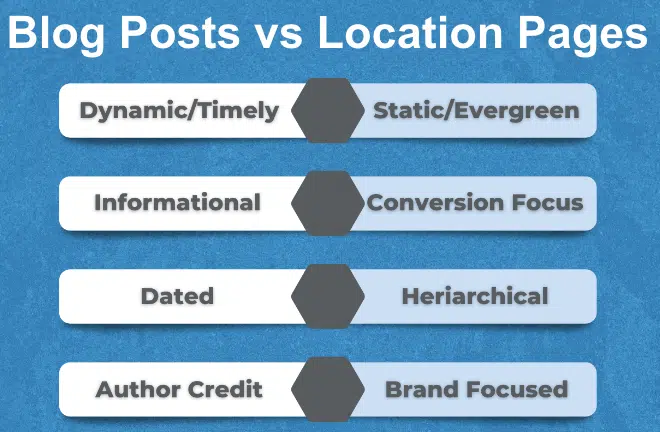
People often overlook the value of the distinct differences between the two. They are not the same, and you want to use both for their unique benefits
Location page: Long-lasting and informative content about the area, including general information, top destinations, activities, points of interest and popular neighborhoods, all of which show you as an authority in that area.
Blog entry: Unlike landing page content, blog posts should be specific, timely, and relevant. Write for the audience you want to sell to. Show your audience that you are the local authority on what’s happening in the area and what hot topics are important. Provide immediate value to both locals and visitors.
Most real estate website location pages are simply automated listings for that area, just like any other real estate website location page. You can do better.
Creating featured landing pages
A great location page provides valuable evergreen information about an area. You are selling the community here, not just a house.
Add demographic information, area schools, services, cultural opportunities, and anything else that might be of interest to people researching the area.
Let them know if it’s urban or rural and talk about the unique personality of the town or community. What sets this location apart from others?
Location pages give you the opportunity to become an authority in that area.
This helps build trust with your audience when it’s time to choose their location and move forward with buying a home (or whatever service you provide in the area).
It also prevents them from leaving your site to find that information elsewhere.
Helping your buyers narrow down where they do and don’t want to live saves you time when you’re getting ready to show them properties.
Bonus benefit: You can also link to your blog posts focused on specific area information pages to provide additional value to site visitors.

Writing great blog posts
Great blog posts perform well in search and help site traffic/conversion.
We’ve found value in creating content digests before creating new content to ensure we stick to our original content goals and cover all our bases.
Look at location-based queries in Search Console and use this data to strategize your blog content.
We’ve had success with “best of” and “best of” lists for neighborhoods and communities, area guides that review area restaurants or fun activities, and timely information such as festivals and holiday events.
Make sure you use great images and current SEO best practices.
We started creating blog content for a client late last year. Here are the results so far.

Unbranded location-based queries increased substantially when we started increasing the local area blog content. How is this relevant to your real estate business?
It’s helping your audience learn about the brand, like the content they’re being served, and trust that brand as a reputable source of information in the local community.
Who do you think they will call when the time comes to help them find the perfect buyer for their home?
Get the daily search newsletter marketers trust.
Work with existing content
Instead of publishing a new blog post every week that will lose relevance almost immediately and end up in the blogroll graveyard, a client uses an evergreen article with an interactive map about local events that is updated weekly for their specific city.
This draws everyone into the local community, further increasing brand awareness, liking and trust factor.
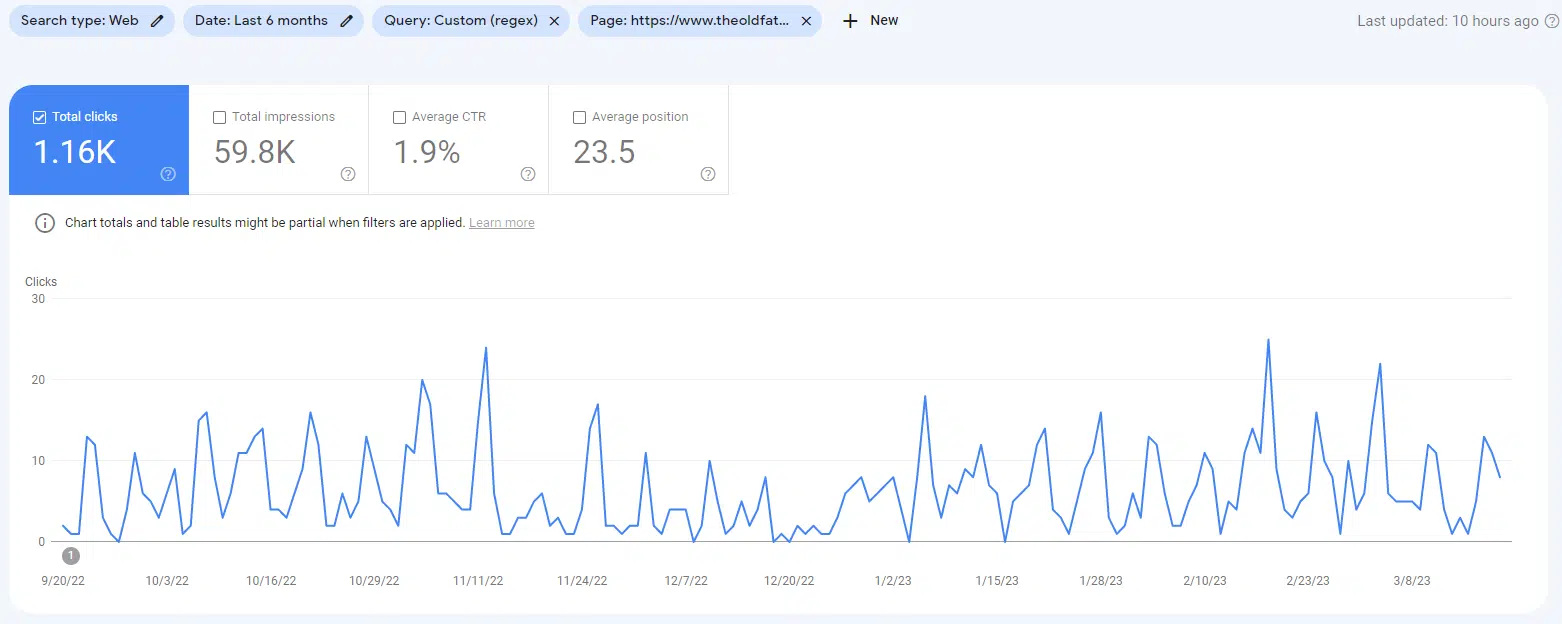
This blog post is currently the top performing URL on your site. It’s well-ranked, consistently performing, and has become a local authority on “things to do” for this city.
Is it leading to direct real estate conversions? No.
But it’s also not the first visit to your homepage, that Facebook post, or your feed of generic listings.
Investments as large as real estate and many home service offerings rarely convert on the first click.
Take the time to nurture your audience and build a strong, authoritative reputation in your community.
Over time, you’ll get personal referrals from community members, which will carry much more weight with potential buyers.
Please wait to create new pages
Before you freak out, I’m not saying never create new content. I’m saying you might not be ready for it yet.
If you have the website equivalent of an 80s bathroom in need of a makeover, new pages will help you just as much as new hand towels will help that bathroom.
Creating new content is a waste of time if your house is not in order. It’s no use putting in a great kitchen if there’s no hallway to the front door.
Create solid and reliable ways for the content you create to be truly accessible, usable and useful.
Make those structural repairs and make sure your existing property is where you want it to be. Clean up existing content on your site before you worry about new content.
Use analytics to see what’s working well on your site and what you can improve.
Don’t be afraid to update, edit, merge, unpost, or delete posts or pages to make sure your content that works gets the attention it deserves.
This scares people away until they increase their rankings and traffic to their site. Just like organizing a home, don’t be afraid to declutter!
Update, measure, evaluate, adjust, measure, repeat
The only constant in SEO is change. Expect to adjust the structure and content of your site as things change, just as you would update or redecorate a house.
Remember the blue and dusty pink color scheme that was so hot 30 years ago? Or how almost every kitchen in America seemed to have geese as their primary source of decoration?
What worked in 1993 will not work the same way in 2023.
Website content will never be “set it and forget it”. You must continuously track and measure the results of your efforts.
Assess success, make changes, track and measure. This cycle will ensure success in both the SERPs and your conversion rates
Now you’re ready for new content
Make sure you have a plan laid out. Create a content summary for each page or post to ensure you prioritize efficiently and don’t leave anything out.
Where are the gaps? What can you create to add value and complement your existing work? Where is your competition that outperforms you? Where do you have a competitive advantage?
You want to be everywhere where they are and also where they are not.
This is similar to our agency’s framework for planning new pages and blog posts. Create a content brief that best suits your brand’s individual needs and skills.

Embed videos
Adding videos to both pages and posts is a great way to increase visibility and increase conversions.
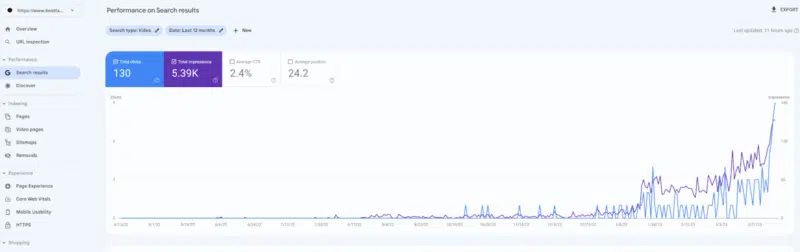
Video is a great way to get an edge over the competition. This is not where you want to be cheap and cut corners.
Be in touch
Don’t forget to stay on top of your past clients.
Only 53% of home sellers used the same agent to buy their next home after a previous sale, according to the National Association of Realtors.
The biggest gap?
Aging demographics are moving further away from their agents, not realizing that they can still provide great service from a distance.
Stay in touch and foster strong relationships using email marketing, a great CRM and social media to stay on top of your customers.
Get multiple benefits from your content by repurposing it for blog posts, emails and social profiles.
what not to do
Don’t rely too much on the AI. Let AI tools help you create content, but don’t give them the keys.
Remember, AI is only as smart as the information it’s fed. ChatGPT and other AI platforms are not always accurate.
We’ve seen cases where ChatGPT completely fabricated information to fill in the blanks in queries.
Always check information before posting. Be sure to remove misspellings, inaccurate information, or anything else that doesn’t serve your audience.
Remember that your competitors receive the same information. What you do with that information is where you will stand out or fall behind.
The views expressed in this article are those of the guest author and not necessarily Search Engine Land. Staff authors are listed here.
[ad_2]
Source link





