


Since its growing popularity around 2015, headless CMS has been a buzzword for many organizations.
This web management concept was intended to reduce friction between content managers and development teams and empower digital marketers to improve their access to tackle SEO initiatives.
So what is this new(ish) concept that has digital marketing teams bugging web developers? Can it really improve the way we do SEO?
What is a headless CMS?
Simply put, a headless CMS is a content management system that separates the process of creating and managing content from how it is presented on websites or apps.
It gives marketers more flexibility in delivering content to different devices and platforms, resulting in faster load times and the ability to create personalized experiences.
How headless CMS works in practice
Imagine having a React JS site where your content changes have to go through your development team. Then you have to wait for their sprint to go into production. How long does this usually take you?
Headless CMS platforms help solve this problem for organizations by removing this development barrier.
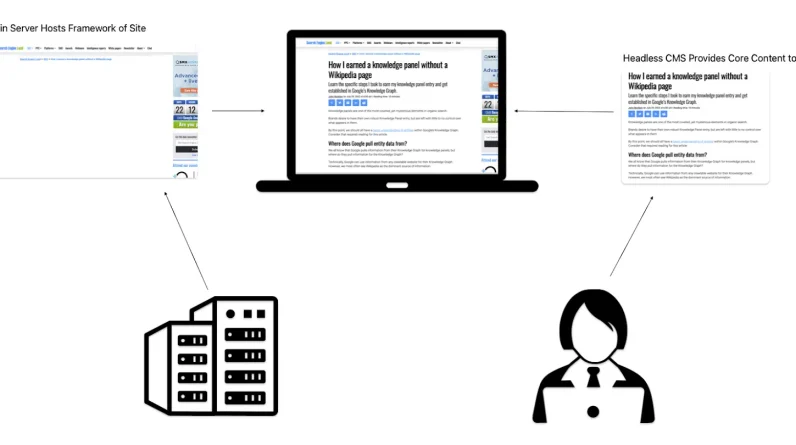
With a headless CMS setup, content marketers can publish new content and edit existing content from a regular CMS like WordPress or even a custom CMS.
Any content added to the headless CMS sends that content to the main website via API integration. The development team creates sections to populate the content.
How a Headless CMS Benefits Organizations and SEO
Headless CMS platforms have been providing significant efficiency solutions since their adoption. Some of the most common benefits for organizations and SEOs include:
Ability to scale content production
With a fully decoupled CMS, SEOs can focus on optimizing content without worrying about traditional CMS restrictions.
They can easily collaborate with content creators, streamline workflows, and quickly scale content production across multiple platforms and channels.
Improve dev/SEO relationships
The separation of the headless CMS and the core web platform fosters a more harmonious working environment.
SEOs can efficiently optimize content for search engine visibility without interrupting the development process.
In addition, headless CMS platforms often offer SEO-friendly features and integrations, such as structured data support and customizable URLs, that allow SEOs to seamlessly implement their strategies.
By streamlining the content creation and optimization workflow, Headless CMS allows both SEOs and developers to work together more effectively, resulting in improved search rankings, improved user experiences, and ultimately , a stronger online presence.
Improved web security
Headless CMS significantly improves web security by decoupling the presentation layer from the back-end infrastructure.
A headless CMS does not rely on built-in templates or themes, unlike traditional CMS solutions. Instead, it provides content through an API, which allows developers to build front-end applications using any technology stack.
This separation of concerns ensures that sensitive backend systems such as databases and server infrastructure are protected from direct exposure to the web.
Faster loading speeds
Because the front end is no longer tightly coupled to the CMS, developers can create lightweight and efficient web applications.
Headless CMS platforms can deliver content directly to the user interface by leveraging APIs, reducing the complexity and overhead associated with traditional CMS architectures.
Get the daily search newsletter marketers trust.
How Google Thinks About Headless CMS
Google is agnostic to which CMS you choose to use, according to John Mueller, Google’s senior search analyst. In a 2022 video on YouTube, Mueller stated that Google does not look for specific CMS signals to use in its algorithm.
In theory, this principle could also apply to headless CMS, meaning it will have no direct positive or negative impact on your SEO efforts. Headless CMS is just another tool for creating web content.
Best practices for SEO with headless CMS
Make sure the schema, metadata, and URL structure are transferred
If your headless CMS uses a plugin to handle schema, titles and meta descriptions, and URL structure, make sure that this information is carried over to the compiled site.
Your development team can pull these data points through the API to ensure they compile correctly.
Validate that your content is mobile friendly
While the main site may be mobile-friendly, sometimes adding certain images may not translate well once the site is built.
Always make sure to double-check your content before publishing.
Compile the content on the web page before retrieving it
Using fetch and render tests, ensure that your page content is included in retrieval and has minimal changes between retrieval and rendering.
Although Google uses rendered content in its algorithm, it’s always best to make sure your website offers server-side rendering.
You have a new content update XML sitemap
While most CMS platforms have systems for creating dynamic sitemaps, they may not inherently translate to CMS systems without one.
Work with your development team to ensure that any new or updated content is dynamically reflected in the XML sitemap.
Improve your SEO performance with a headless CMS
Adopting a headless CMS can benefit organizations, including improved SEO performance.
By understanding what a headless CMS is and how it works in practice, organizations can harness its power to scale content production, foster better collaboration between developers and SEO professionals, improve web security, and achieve faster faster loading.
The views expressed in this article are those of the guest author and not necessarily Search Engine Land. Staff authors are listed here.
[ad_2]
Source link





