


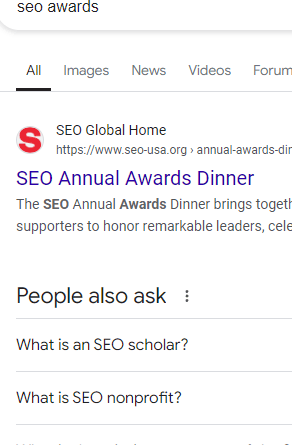
People always complain that there’s something wrong with Google’s search results, but what’s wrong with search results for queries with the acronym “SEO” is in a class by itself and has must be seen to be believed.
Anomalies in search results
An anomaly is something that departs from the norm or from what is expected. Most of the time when there is something wrong with the search engine results pages (SERPs), the anomaly is explainable. For example, queries that combine a geographic element with a relatively long phrase tend to generate strange results. Another factor in strange search results is when there simply isn’t enough data about a specific combination of words, which sometimes leads to offensive search results.
What is happening with a particular group of keyword phrases related to the word “SEO” is none of these anomalies. It’s a real anomaly.
Here are the keywords that Google is (probably) getting wrong:
SEO Program What is an SEO Program? SEO New York (City) SEO NYC Conference SEO Events SEO Awards SEO Education SEO-USA.Org
The site that ranks for all of these SEO search queries (and probably more) is a site called SEO-USA.org. The SEO acronym for this website stands for Sponsors for Educational Opportunity. It’s not a spam site, it’s a legitimate non-profit website that has been around since 1963. The non-profit’s goal is to provide counseling to underserved youth to help them to access colleges and universities. That program evolved into SEO Scholars, an eight-year academic program for talented young people to help them through high school and college.
“SEO Fellows create a more equitable society by closing the academic opportunity gap for motivated young people, setting the standard for academics, mentorship, community, peer support, and a powerful, lifelong network “.
SEO-USA.org is not relevant to SEO
The acronym SEO is very relevant to the context of online marketing. A Google search for “SEO” brings up suggestions that are relevant to SEO in the search marketing sense.
Google Trends shows that the phrase SEO Scholars and SEO Scholars Application are not very searched for in the United States, with the majority of searches occurring in New York. But SEO-USA.org is the best ranked for the group of keywords listed above in other areas outside of New York.
Screenshot of the SERPs for the keyword phrase “SEO Awards”
It is somewhat obvious that SEO-USA.org is not relevant to the most commonly understood meaning of the acronym SEO.
Could backlinks be the reason?
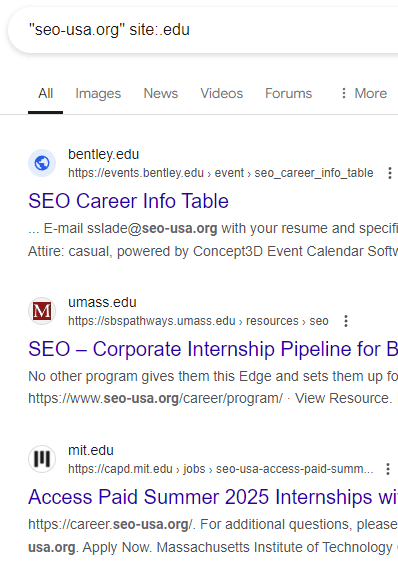
The reason SEO-USA.org is ranking for all these phrases may be because of the backlinks. A search of the domain name but restricted to .edu sites shows nearly seventy .edu websites that link to the SEO-USA.org domain name.
Here’s the advanced search showing numerous .edu sites that link to or mention SEO-USA.org:
site “seo-usa.org”:.edu”
Site screenshot: Search .EDU
There are also a large number of high-quality sites with dot org domains that also link to SEO-USA.org, which can be seen using the advanced search below:
“seo-usa.org” site:.org -site:seo-usa.org”
At first glance, it seems clear that backlinks are why SEO-USA.org ranks for irrelevant keywords.
But of course, the most obvious answer is not always the right answer. There’s more to the picture.
Why links probably don’t explain rankings
If links were the reason for SEO-USA.org’s ranking, you would assume that virtually every SEO-related keyword would be filled with .edu and .org websites, but that is not the case.
I’ve been doing SEO for about 25 years now, and I remember the days when sites with the highest PageRank used to rank for pretty much anything. Also, dot edu links were considered powerful because SEOs were able to rank quite well with them.
Google’s algorithms improved and the effect of .edu links began to diminish because the context of a link began to count more. The words in the title element and the words in the surrounding text influenced the links. I also know this from my experience.
Another major change in Google’s link ranking algorithms was to decrease the effect of the number of links. It used to be that an avalanche of links was enough to help a site rank above the most authoritative sites. I also know this from my experience.
But the effect of a large number of links also changed in many ways, as hundreds of links on a domain stopped being counted as hundreds of links and began to count as a single link. The position of a link within a page also mattered more, there were many changes that reduced the power of links so that fewer and fewer links mattered for the wrong reasons.
I’m a little skeptical that links are the reason SEO-USA.org ranks.
What is the answer?
For some reason, a relevancy factor is not in play, allowing the (probably) irrelevant SEO-USA.org site to rank for keywords it probably shouldn’t rank for.
I think that’s a hint, a reason why this site ranks where it shouldn’t. It is escaping because something is missing that would normally be there to prevent it.
There may be a factor related to reliability that allows this site to escape. This is just speculation. Do you have any ideas?
Featured image by Shutterstock/SS 360
[ad_2]
Source link





