


If you’re chasing trends right now to try and increase your traffic, and by that I mean pick the tactic of the week, how to use generative AI or large language models (LLM) without researching their feasibility or whether they match your strategy and business – it will probably come back to bite you.
The downsides of trend hunting: Staying true to your brand
In business, there is a long-standing concept that people like Simon Sinek have brought into the conversation. When you go up against someone else in your industry and want to “win” against them, you’re bound to lose.
Business is not a finite battle, but we often act as if it is. The goal of a business is to continue operating, not necessarily to “win” against our competitors.
Apple never batted an eye at Microsoft’s Zune, which could be a better product than theirs. Apple was simply trying to do everything it could to help its customers live their best lives. A few months after the Zune was released, Apple released the iPhone, which made this entire product vertical almost obsolete. However, it seems that this was not Apple’s main goal when creating the iPhone.
In the best world as a business, you’re playing an endless game, only looking to improve against your old self – constantly iterating your product or service to be better than before.
Many companies or individuals feel that they need to chase trends because “everyone else is doing it”, which is inherently comparative: you want, if not to be better than everyone else, at least to be the same.
Following trends this way often leads to unplanned action, neglecting how it fits into your marketing mix, whether your ideal customers spend time there, and other important considerations for business strategy and tactics.
All this hasty decision-making to “join the bandwagon” can lead to a sunk cost fallacy for the business later on.
And jumping on the bandwagon of something like using AI or LLM bots to completely write your content for you; this is a path that could actively hurt your business, not only in the long term but also in the short term, because of the effort. Google is putting content detection that is search engine first instead of people first.
Dig deeper: How to survive and thrive in a world of useful Google content
Considerations when using ChatGPT
As a business owner, I can tell you that I only use ChatGPT one way: to create Excel, Colab and Google Sheets formulas.
I do not touch the content in any way, shape or form with an AI or LLM model. And I’ll tell you why.
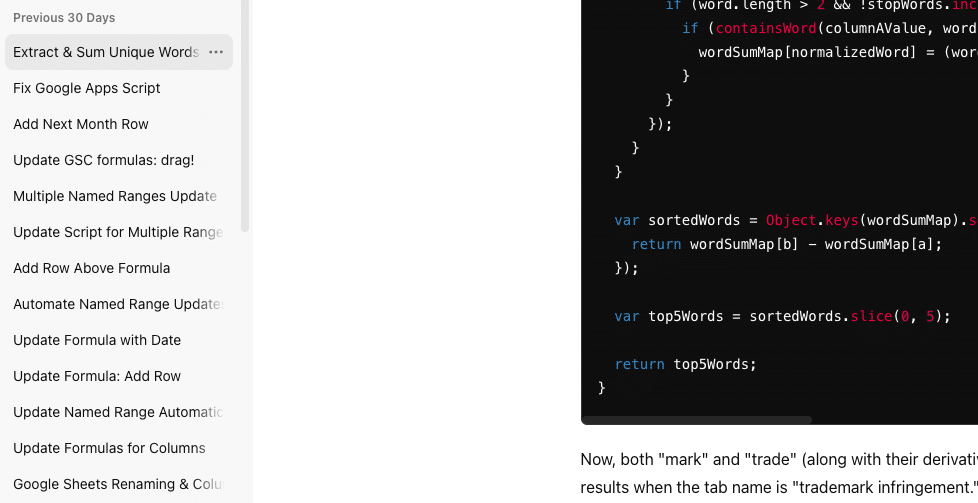 A screenshot of the author’s ChatGPT queries over the last 30 days
Tone of voice and brand consistency
Consumers absolutely buy the “Because.” We care about things like supply chain transparency, carbon footprint offset, and more. We care about “thinking different”.
This “why,” when done right, is the foundation of your brand. And that’s a gold standard you always want to refer to.
If you’re pulling content directly from a message in your favorite AI platform, you’re probably not going to retrieve something that looks like your brand, and editing it to sound like your brand will take a lot longer than it would take to do it Write this article yourself first.
While I haven’t worked with a brand-driven AI or LLM model myself, I’d be skeptical that even this grounded content sounds like your brand. Nuances in brand tone are sometimes hard to codify into a formula, a yes/no or yes/else statement.
Content consistency can also be patchy from topic to topic with ChatGPT and LLM because it depends on the quality level of information already published on the web and whether or not that model has seen that content.
If you’re working on a niche or specialized topic, or even something subjective, like how a camera’s specs affect the art of photography, you can end up with a drastically inconsistent article because there’s no internet consensus about this.
Get the daily search newsletter marketers trust.
Business email address Subscribe
Processing…
Check the terms.
Repetition and information gain
AI and LLMs inherently cannot create new information unless you’ve written your own, and you can add new content to the corpus, such as your sales or support transcripts.
Most people using tools like this probably don’t pay that much money and go that deep when using AI; it’s being used as a time-saving tool, so why spend so much initial time on it?
If you’re using an open source web model, you’re using the same information that’s already on the web (or the percentage that the tool has scraped), repurposed, copied and pasted in a slightly different way with some trickery thrown in. for a little spice.
In many ways, this completely defeats the overall purpose of your website content: to provide information relevant to your specific, potential or current users or customers.
With algorithm updates over the past 18 months, we have a sense of how Google is trying to weed out unhelpful, duplicate, or near-duplicate content.
This has been reinforced with the little panda feature in recently leaked documentation, which, while seemingly separate from HCU’s algorithm changes, indicates that the focus on unique content has been there as an explicit factor for some time and a continuing factor even after Panda has been fully integrated into the main algorithm.
When you create content for your website and play the infinite game, you want to create something that is uniquely beneficial to your customers.
If they themselves have told you that they are looking for an axoy answer, even better. However, the likelihood that a tool like ChatGPT can generate something that actually directly answers this question with 100% accurate information is slim.
EAT
When you use a tool to create content, for example, if you use it to ghostwrite for a busy subject matter expert and ask the SME to review it, you’ve already created a bias in the content itself.
It is possible that if you gave the same report to the SME to write up when they had time, they would have a completely different approach to the topic. However, since you enter the headings or the model creates them for you, the benefit of this other direction can be lost entirely.
Furthermore, an AI- or LLM-generated article is unlikely to provoke original thought in the SME when they review it; then how can this article be considered authoritative?
It is simply a regurgitation of known facts and standard recommendations, probably without perspective or angle. This angle often helps establish authority in a space, and by using an AI-generated content base or LLM, you may be removing this unique perspective entirely.
Dig deeper: How relying on LLMs can lead to SEO disaster
Really think about why you want to use an AI or LLM
Many businesses feel pressured to write all their content or publish a blog post a week, a day, or an hour, or feel they need to have content for every variation of the best/cheapest/newest/most featured .
Instead of focusing on volume and feeling the pressure to use AI to publish X number of articles a week, focus on what is truly valuable to your customers and your business.
[ad_2]
Source link





