



29 May 2024 13:18:00
A total of more than 2,500 pages of internal documents, the “Google API Content Warehouse”, used to familiarize Google employees with data, APIs and modules have been leaked. This has revealed the real situation of how Google was using search user information and Chrome data. SEO (Search Engine Optimization) industry experts who have reviewed the contents have stated that most of the information contained is fairly new as of March 2024.
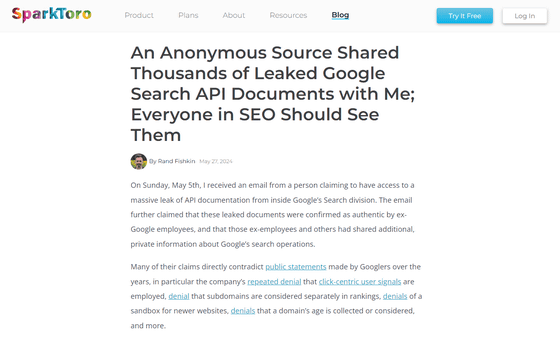
An anonymous source shared with me thousands of leaked Google Search API documents; Everyone in SEO should see them – SparkToro
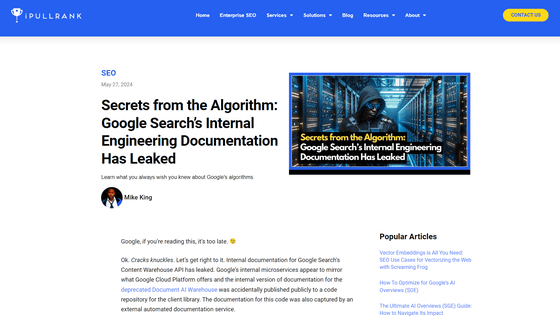
Algorithm Secrets: Google Search’s internal engineering documentation leaked
Major Google Search document leak reveals the inner workings of the ranking algorithm
https://searchengineland.com/google-search-document-leak-ranking-442617
The leaked internal documents were shared with “anonymous parties” by Rand Fishkin of SparkToro , a company that develops and provides website analytics tools. Content was reviewed by Fishkin and Mike King, founder and CEO of iPullRank an SEO company, and confirmed that while some of the information contained was outdated, most of it was up to date as of March 2024.
The “anonymous person” who shared the information with Fishkin revealed that he is Erfan Azimi, CEO of EA Eagle Digital a marketing agency specializing in SEO.
Erfan Azimi: Google Ranking Factors Leaked (Public Statement) – Rand Fishkin, Mike King – YouTube
This internal document was published to a public repository on GitHub by a bot named “yoshi-code-bot” on March 13, 2024. It has been noted that this was due to a malfunction and that rather than a ” intentional information leak”. ,” was “accidentally discovered to be public.”
The way search engines display search results and the order in which their algorithms work is very important to SEO. When the source code of Russia’s largest search engine, Yandex, was leaked in 2023, it was said that the information could be used as a reference for Google’s SEO because Yandex’s search results had many similarities to Google’s .
Russia’s Largest Search Engine ‘Yandex’ Source Code Leak Reveals What Determines Search Ranking – GIGAZINE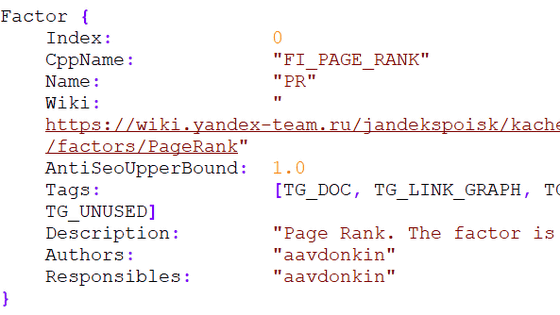
A summary of some of the extensive documents is as follows:
The document describes 2,596 modules and 14,014 attributes.
– There is a description of the factors that are taken into account in the ranking of the search results, but there is no specific description of how each factor is weighted.
Content may be downgraded for factors such as “links that do not match the target,” “users dissatisfied with the SERP (Search Results Display),” “product reviews,” “location,” “exact match domain ” and “pornography”. .’
Google keeps track of all changes made to the pages it has indexed, but when analyzing links it only looks at the last 20 changes.
“PageRank” still plays an important role in Google rankings
Google measures clicks using various metrics such as “badClicks”, “goodClicks”, “lastLongestClicks” and “unsquashedClicks”, and most importantly clicks that result.
Longer content may be truncated, but shorter content is scored between 0 and 512 based on originality.
– Content called “YMYL (Your Money Your Life)”, such as health and news, will also receive a score.
Branding is the most important factor in getting to the top of search rankings
Google stores information about content authors and tries to determine who is the author of a particular document.
– Uses “siteAuthority”, a feature hinted after 2011 Panda update but was later denied
– There is a module called “ChromeInTotal” that uses Chrome data for search ranking.
The presence of the “isElectionAuthority” and “isCovidLocalAuthority” modules that whitelist specific domains related to elections and COVID-19.
There is a “smallPersonalSite” module for small sites and blogs, but it’s not clear how much weight it has in the rankings.
– The “titlematchScore” function is designed to measure how closely the page title matches the content query.
Google has previously explained that it does not use Chrome data to rank pages, but in fact, as mentioned above, there is a module that uses Chrome data. King has criticized Google, saying: “‘Lie’ is a harsh word, but it’s the only accurate word used in this case.”
Additionally, the news site Android Headlines, which covered this story, commented: “Google has yet to comment, but I will probably do my best to remove the information, and I wouldn’t be surprised if this article was removed within of the next few days.’
Massive Google leak: Internal documents reveal hidden truths about search algorithm
[ad_2]
Source link





