



At its annual I/O developer conference, Google unveiled plans to bring generative AI directly into Google Search.
Additionally, Google announced an expansion of Search Generative Experience (SGE), designed to reinvent how people discover and consume information.
Upcoming updates include:
Adjustable overviews to simplify language or provide more detail Multi-step reasoning to handle complex, nuanced queries Built-in planning capabilities for tasks like meal prep and vacations AI-organized search results pages to explore ideas and inspiration Query visual search using uploaded videos and images
Liz Reid, Google’s head of search, says in a announcement:
“Now, with generative AI, search can do more than you ever imagined. So you can ask what’s on your mind or what you need to do, from research to planning to brainstorming, and Google will take care of the work.”
What’s new in Google Search and SGE
New Gemini model
A custom Gemini language model is central to Google’s AI-powered search revamp.
Google’s ad says:
“All of this is made possible by a new custom Gemini model for Google Search. It brings together Gemini’s advanced capabilities, including multi-step reasoning, planning and multimodality, with our best-in-class search systems .
AI overviews generate quick answers to your queries by gathering information from multiple sources.
Google reports that people have already used AI Overviews billions of times through Search Labs.
Overview of AI in US search results
Google is incorporating AI overviews from Search Labs into its general search results pages.
That means hundreds of millions of US searchers will have access to general AI views this week, and more than a billion by the end of the year.
Image credit: blog.google/products/search/generative-ai-google-search-may-2024/, May 2024.
Searchers will soon be able to adjust the language and level of detail of AI overviews to suit their needs and understanding of the topic.
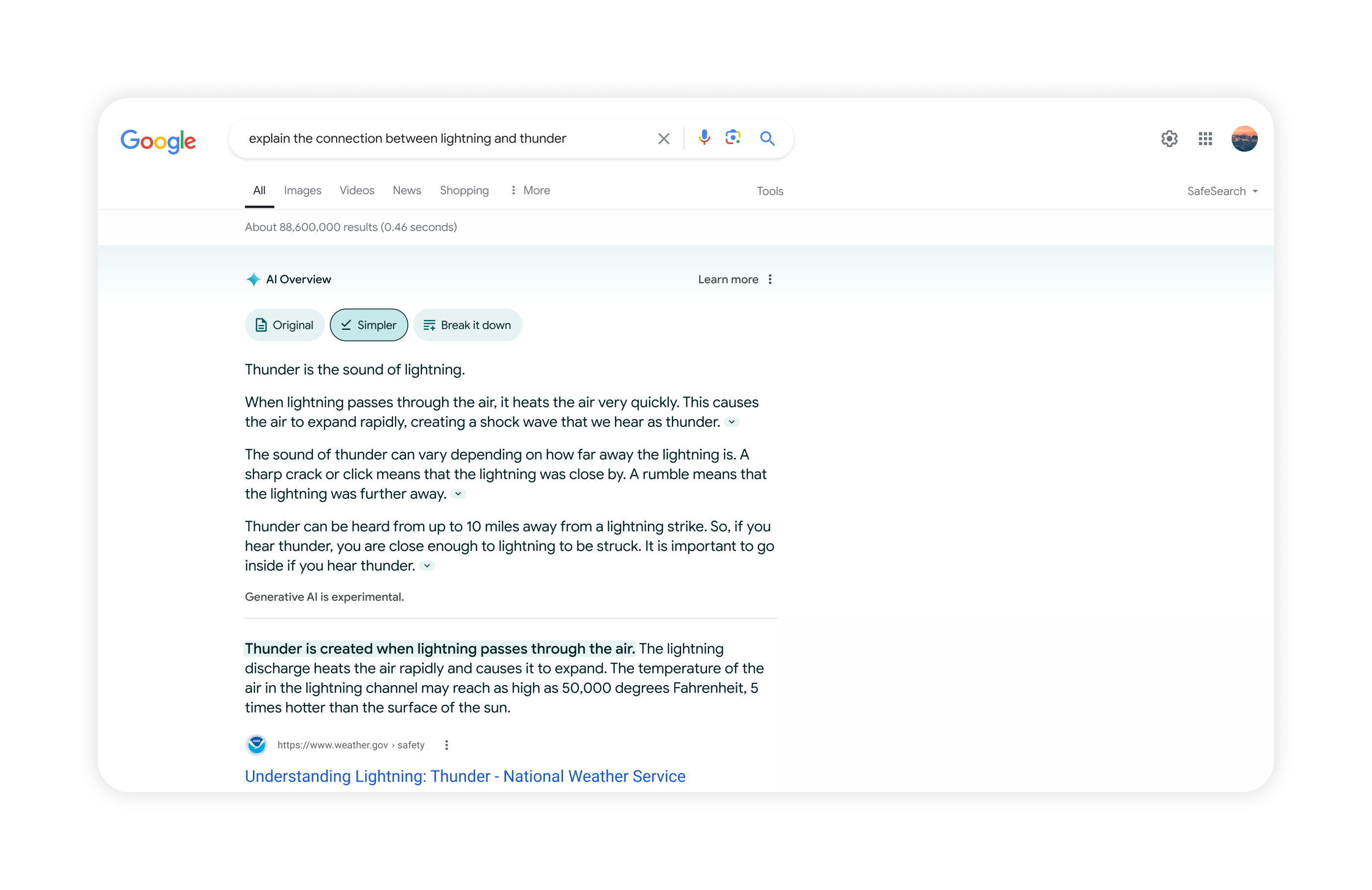 Image credit: blog.google/products/search/generative-ai-google-search-may-2024/, May 2024.
Complex questions and planning skills
SGE’s multi-step reasoning capabilities will allow you to ask complex questions and receive detailed answers.
For example, you could ask, “Find the best yoga or pilates studios in Boston and show details about their introductory offers and walking time from Beacon Hill,” and you’ll get a full answer.
 Image credit: blog.google/products/search/generative-ai-google-search-may-2024/, May 2024.
In addition to answering complex queries, SGE will offer assistance in planning various aspects of life, such as planning meals and vacations.
You can request a custom meal plan by searching for something like “create a 3-day meal plan for a group that’s easy to prepare.” You will receive a customized plan with recipes from all over the web.
Results organized by AI and visual search
Google is introducing AI-curated results pages that categorize useful results under unique AI-generated headings that feature different perspectives and content types.
This feature will initially be available for dinner and recipes, with plans to expand to movies, music, books, hotels, shopping and more.
SGE will also allow users to ask questions through video content. This visual search capability can save you time describing problems or typing queries as you can record a video.
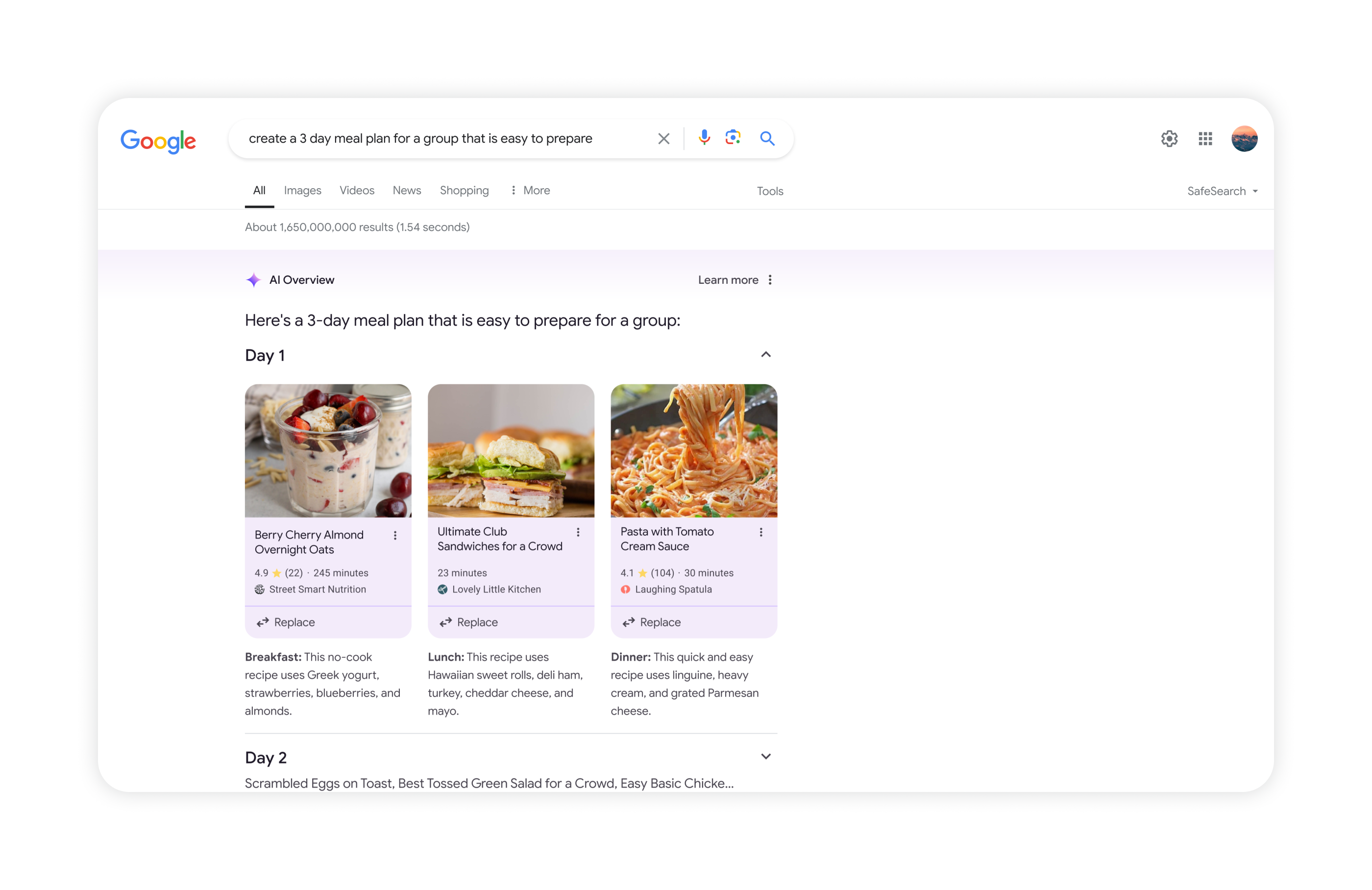 Image credit: blog.google/products/search/generative-ai-google-search-may-2024/, May 2024.
What does this mean for businesses?
While Google touts SGE as a way to improve search quality, the rise of AI-generated content could impact businesses and publishers that rely on Google Search traffic.
AI overviews take up a lot of screen real estate and could bury traditional “blue link” web results, significantly limiting click-through rates.
Data from ZipTie and Search Engine Journal contributor Bart Goralewicz indicate that SGE displays cover more than 80% of search queries in most verticals.
Furthermore, under SGE’s unique ranking system, only 47% of the top 10 traditional web results appear as sources that feed AI overview generation.
Bart Goralewicz, founder of Onely, says:
“SGE operates on a completely different level compared to traditional search. If you want to appear in Google SGE, you will need to develop a different strategy adapted to this new environment. It’s a whole new game.”
ZipTie’s Tomasz Rudzki warns:
“Google SGE is the most controversial and anxiety-inducing change to search,” he commented. With so much changing week-to-week, businesses relying on organic search must carefully monitor SGE developments.”
How to optimize your site for SGE
As AI search accelerates, SEO professionals and content creators face new challenges to optimize discoverability.
Consider implementing these tactics to increase visibility in search results.
Structure content explicitly as direct questions and answers.
With general AI views that answer queries directly, optimizing your content in a question-and-answer format can increase the likelihood that Google’s AI models will appear.
Create topic overview pages that cover initial research through final decisions.
Google AI Search can handle complex multi-step queries. Creating comprehensive overall content that covers the entire journey from initial research to final purchase decisions could position these pages as top sources for Google AI.
Look for featured status on high-authority information and question sites.
The studies found that sites like Quora and Reddit are frequently cited in Google’s AI overviews. Having industry expert-level authoritative content featured on these high-profile Q&A platforms could increase visibility in AI search results.
Maximize technical SEO to improve page content crawlability.
Like traditional web crawlers powered by search, Google’s AI models are still based on crawling the content of a site. Ensuring optimal technical SEO for crawlers to access and properly render all page content is crucial for it to appear in AI overviews.
Search volume tracking for queries showing AI overview.
Identifying queries that currently trigger general AI views can reveal content gaps and opportunities for optimization. Tracking the search volume of these queries allows you to prioritize efforts on high-value terms and topics that Google already enhances with AI results.
looking ahead
As Google moves forward with its AI-centric search vision, disruptions could reshape digital economies and information ecosystems.
Companies must acclimate their strategies to an AI-driven search landscape.
We’ll be following these developments closely at Search Engine Journal with the goal of offering strategies to help make your content discoverable in SGE.
[ad_2]
Source link





