


Google’s local search results have changed quite a bit since the beginning of 2024. As with the rise of Reddit and other forums, Google is trying to provide users with more relevant and relatable content, and in the local space, that means showing to the most localized users. content
Specifically, we’ve seen a major shift in the pages Google shows for searches it believes have local intent. We are now seeing an influx of localized service area pages showing up in the SERPs instead of generic, non-location specific pages and homepages.
Take this example of what the SERP looked like in Altamonte, Florida in November 2023 [personal injury lawyer] – mostly generic pages, a home page and even a Wikipedia article.
As of March, that same SERP is almost exclusively filled with service area pages for the specific city I’m searching from.
With this clear shift to more localized SERPs, businesses should invest in both improving their current service area pages and creating new service area pages targeting the cities or towns where they want to generate more organic leads.
How to optimize local pages to gain more local traffic
All pages in the service area should target your most important keyword patterns, along with the long-tail supporting keywords you want to rank for in those areas (i.e. “[service] in [city]”).
You should also add examples of “near me” type phrases to help the page show up in “near me” searches, which we’ve tested and found still works well in organic search.
You should write about your most important services on each page and link to generic service pages if needed to provide more context. Don’t sleep on internal links from these service area pages to help Google and users navigate your most important content.
For example, you may want to link to all service area pages on your Google Business Profile (GBP) landing page, your home page, and relevant service pages. If you have more than one GBP landing page, please link to the service area pages closest to that GBP location.
Dig Deeper: Local SEO in 2024: 6 Simple Ways to Master Local Search
Does duplicate content work for service area pages?
Many people worry about duplicate content when creating many service area pages. There are many unique ways to talk about your most important services.
In reality, duplicate content isn’t really a problem, as Google probably won’t penalize your site for having it, and it actually works when it comes to ranking service area pages in multiple locations.
The only downside to this tactic is that it probably won’t work well in competitive markets. How can this be combated?
Provide unique, real value that people in the local area will connect with on every page. This can look very different depending on your industry. In general, you can provide local value by adding some or all of these elements to your service area pages.
Let’s take a look at some ways to add relevant local content to service area pages to make them unique and useful to users:
Customer reviews
I cannot understate the power of user generated reviews. Highlighting city-specific reviews on service area pages can be a game-changer.
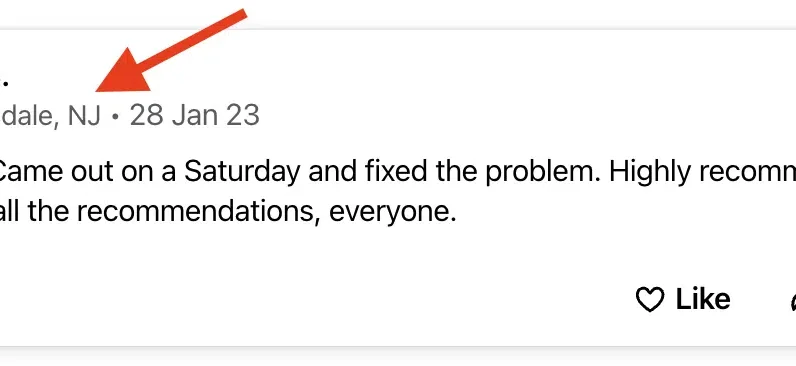
You can get these reviews directly from Google or other third-party sites where people already leave reviews. Sites like Yelp and NextDoor add a reviewer’s location to the review itself. You just have to manually fetch a few for SAP.
If a reviewer from Google or elsewhere mentions your city directly in the review, that would be even better!
Long-form customer testimonials are also a great way to highlight a job well done by a happy customer in a particular city. Bonus if you can get video testimonials – they’re golden!
Dig Deeper: How to get reviews for local SEO: The must-do list
Practical cases and works done
Using case studies of completed jobs or clients served in your area is a great strategy to add distinctive content to your service area pages. Showcase the exceptional work your company does locally.
People love to see examples of the work you’ve done, and providing that directly on the page they’re likely to land on is a great way to instill confidence and show expertise right away. In your case study, you might include:
The problem the customer had. Your plan to fix this problem. Specific steps you took to fix the problem. Any problems you had along the way and how you overcame them. The final results.
Dig Deeper: How to create local content that builds trust and drives sales
Unique photos + videos
In addition to case studies, add photos/videos of completed jobs or clients you’ve worked with in the area.
Users love to consume before and after photos for anything related to home service, so give people what they want right on your service area pages. This is also a good way to show your expertise.
If you have employees or technicians dedicated to a specific service area, with their permission, add their photos directly to this page. This:
Create more unique content for the page. It allows customers to put a face to the name and makes your brand more “real”. It provides a small level of comfort and security, knowing who will be showing up at your home or meeting you.
To instill even more trust, you can also add photos taken by real customers to these pages. Photos taken by customers can be an important decision-making factor in certain industries, according to BrightLocal Local Business Trust and Discovery Report 2023.
Consumers also rated company photos and staff photos as important factors in helping them make a decision about whether they trust a company enough to call or book a service.
There’s no one type of photo that rules them all, so having as much variety as possible on each page can help convert more users into customers.
City-specific statistics
You can also add statistics of your business data related to that particular city. This provides unique, real-world data that Google hasn’t seen before, which is a great way to differentiate yourself from the competition. You can add data about:
Number of jobs you’ve done in the city. Number of homes you have sold or rented in this city. Number of resolved cases for customers in this city.
Cost data
“Cost” keywords are a great way to get more traffic to your service area pages. Not only are keywords related to “cost” highly searched for, but we’ve also found that they convert well.
Adding cost/price data directly to service area pages is a great way to rank these types of searches in your service area. You can say it like, “How much is it [service] in [city]”.
Related businesses in the city
We’ve seen that adding related businesses in your local area helps increase local traffic on service area pages. Over time, these pages gain traction in the SERPs and can be very useful to the user.
For example, a real estate agent selling a home will likely recommend several home service companies to the new home owner. It makes sense that they recommend local roofers, lawn care companies, HVAC experts, etc. Since they’re likely already making these recommendations to customers anyway, why not add them directly to your service area pages?
This can also be a great way to build relationships with other small businesses in your community. You probably already know some of them and would refer business to them, so add them to your site.
If you don’t know anyone, research the “best” companies adjacent to your area and contact them. Create a real-world connection, then add them to your website when you’re confident. Also, let them know you did this.
So what exactly should you add to the SAP about them? Add your company name, name, address, phone number and website of the primary point of contact. Make it easy for users to contact you.
Get the daily search newsletter marketers trust.
Prioritize which cities you create service area pages for
Let’s say you’re a business with multiple locations, especially one that operates in multiple states. In this case, there are likely many cities for which you want to create service area pages, but only a finite amount of time and resources.
Some things to consider when determining which cities to write content for are:
Check the GBP data

Check the GBP Insights Search Terms report to see if your listing is receiving any explicit keyword searches outside of the city where you are physically located. If you get these types of searches, this is a good indicator that you will get organic traffic for a SAP for that city.
Competition in the area
If there are fewer competitors in a specific city, you can likely rank there with less effort than in a crowded city. Check Google to see which businesses are physically located in that area, then check the organic SERPs to see which service area pages, if any, are already ranking for your target terms.
How far customers are willing to drive
Another thing to consider is the value of each sale. A sale can mean thousands of dollars for high net worth firms like personal injury attorneys. So investing the time to create a service area page in a low-competition area might only result in one case, but that case could be worth a ton.
Yes, service area pages do convert
Sometimes customers wonder if service area pages will convert. In my experience, the more localized a page is, the further down the funnel users tend to be.
The right mix of CROs can produce leads like crazy. Even before the change in local SERPs, service area pages were one of the top converting pages on many of my local business clients’ sites.
Now, the trend is picking up and I’m seeing service area pages drive more on-site conversions than ever before. Especially for multi-location businesses that operate in multiple states, service area pages can be a game-changer and save you money in the long run because you won’t be forced to run ads all the time in your areas on duty.
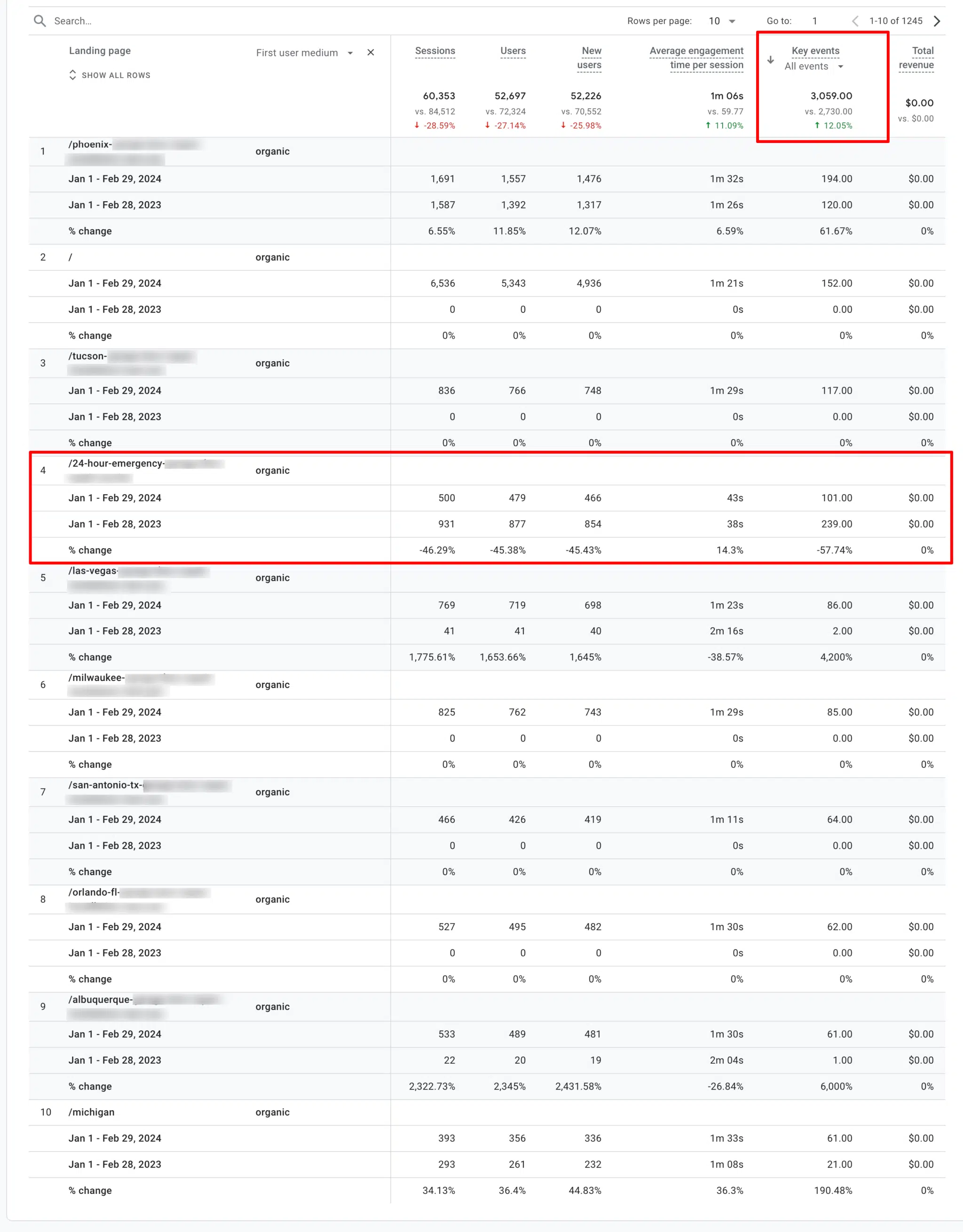
Take this example, where on-site conversions from organic traffic are up 7% year over year, largely thanks to service area pages, even though organic traffic is down across the board.
Note that the 24/7 Emergency page, which is a nationally targeted page, saw a year-over-year decrease in traffic and conversions, as did most of its generic pages.
Dig deeper: Local SEO success: How to track rankings, conversions, and calls
The views expressed in this article are those of the guest author and not necessarily Search Engine Land. Staff authors are listed here.
[ad_2]
Source link





