



What if you could get your ads in front of your ideal customers for a fraction of the price?
LinkedIn Ads is known for its high costs compared to other platforms.
However, there is a way to target a B2B audience similar to Meta, where advertising costs are significantly lower.
But that assumes two things are true:
You’ve got the basics in place: a great offer and landing page backed by audience research, a simple campaign structure, strong creative and conversion tracking. In other words, you approach advertising as a marketer and not as a media buyer. You are willing to make the trade-off for cheaper acquisition costs. While you won’t have the precise targeting of LinkedIn, just because your target audience is browsing Instagram doesn’t mean they stop being who they are professionally. You may not cater to them in the same environment, but they still have those needs and will pay attention to something interesting enough.
If the cost of advertising on LinkedIn is prohibitive or you can’t meet the minimum requirements for some of the targeting settings, and you meet the above two criteria, you may want to consider this move.
HOT TAKE: Meta Ads can work incredibly well for B2B 👷
Think about it, the same people you can find on LinkedIn are on Facebook and Instagram.. 📱
It’s about putting the right message in front of the right person ❕
— Menachem Ani (@MenachemAni) February 29, 2024
I find there’s really no need to complicate the creative, as simple banner ads work well in B2B. Perhaps it’s because business consumers are often looking for something to help them get ahead or work more easily.
It’s different when you’re trying to get someone to book a dentist appointment or learn about an insurance plan, where you have to convince them to call.
But in B2B, you’re selling something that will make someone’s life easier without friction. It takes an investment on their part, but the B2B audience is open to it.
You can use video like you do with B2C lead generation and e-commerce, but it’s not necessary to go for high production values.

It’s more about getting the right message in front of the right consumer. They’re on a different platform, but they’re still your target audience. And if you talk to them, they will take action.
Depending on the type of person you’re trying to reach, it can be as simple as having the right message.
B2B clients are always skeptical when I mention FB. Ultimately, you’re marketing to people, and people are on Facebook. I’ve even made it work for industrial customers!
— Harrison Jack Hepp (@HarrisonJHepp) February 29, 2024
We have a client agency that sells home organization products, so we try to reach contractors, developers, interior designers and other professionals. Sometimes I find that even a good iPhone photo of the product with the right message will work better than a studio shot.
Dig Deeper: Meta advertising: 5 best practices for 2024
Why B2B lead generation on Meta is easier than you think
Particularly for B2B lead generation, you likely have assets that can be quickly re-used by resizing and making some modifications.
Think about what’s important to the person you’re selling to and how your product will make their life easier. Try to talk about it in your creative and ad copy.
If this sounds like a basic B2B marketing strategy, that’s because it is. It’s critical work that successful B2B brands do before increasing ad spend.
Can I run B2B ads on Meta with a smaller budget?
If you’re considering this strategy because you have a smaller budget, I recommend that you consider dynamic creative: an ad unit with multiple ads and let the system mix and match rather than multiple stand-alone ads. I find this often works best.
Get the daily search newsletter marketers trust.
With e-commerce and B2C lead generation, we tend to do a lot of broad targeting. I find the most success in B2B when we use customer lists and create lookalikes to target them, as well as when we use interests and detailed Meta targeting.
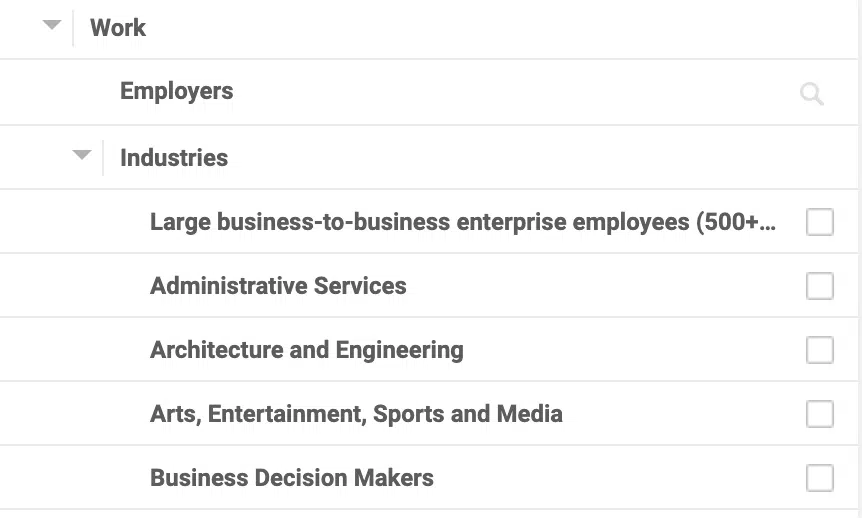
We just launched a campaign for a client who sells patio equipment, so we’re targeting people who work in municipalities and schools. Similar to LinkedIn, although not as detailed or granular, Meta has the option to target people based on:
Where they work. What is your role? What industry are they in?
So it’s just a matter of combing it and building enough of an audience. We prefer not to create multiple ad sets for each and group them into one large audience, which we feel works well and brings quality leads.
You’ll probably get more spam leads than if you came to LinkedIn. But overall, it’s still cheaper to do it on Meta, even after accounting for that difference.
We also post ads for a company that rents large office machinery with monthly service, toner, etc. With this, we’re targeting people who work in residences or as office administrators, so it’s based on their role or the type of company they work for.
But we’re also looking at interests that might be related.
Are there any industry publications that people in this line of work tend to subscribe to? If so, set the company in this post as an interest.
100%! People are people. All channels are always worth trying!
— Melissa L Mackey (@beyondthepaid) February 29, 2024
At its core, targeting professional audiences on Meta is only about customer look, prospect list look, interests, and profession-based targeting.
My audience targeting guidelines
Here are some additional guidelines I follow when running B2B lead generation campaigns on Facebook and Instagram. Your mileage may vary, so test if necessary.
If you’re a regional business, you’ll want to layer in specific locations. I prefer not to use embedded contact forms because they tend to return more unwanted contacts. We typically send traffic to a dedicated landing page and put a lot of effort into making that page convert well by speaking a similar language to the ad creative. If you use embedded forms, add questions to add friction to the form and qualify leads. Make sure all of your ads have UTM parameters included in the landing page URL so that when a lead arrives, you know which campaign and ad it came from. Feed this lead data back into HubSpot, SalesForce, or whatever CRM you use so you can see where you’re getting the most valuable leads that turn into sales. Consider adding unconverted website visitors, or video viewers and page users to your audience selection. This way, you can target anyone who shows enough interest to interact with your media, but not enough to convert.
New ways to target B2B audiences in Meta
Everything I’ve shared so far has come through the lens of using standard conversion campaigns with a lead focus.
Now, you can also use custom campaigns with potential targets, which is how you buy Advantage+ to generate leads. It removes a bit of traditional advertiser control, but it’s worth a try, especially with bigger budgets.
You can also create a campaign with a call goal if you don’t want to train submissions as your primary conversions.
If you do things over the phone, use it with a call tracking number so the CTA leads to a call and you can track where your inquiries are coming from. The system will also track this and optimize it for the best calls if you feed it the right data.
Meta has also boosted Advantage+ audiences, which essentially borrow from Google’s Performance Max, as they are converted into audience suggestions (signals).
The system will use that as a base, but it will go further and find who it thinks is the target consumer of what you are selling.
Try before you invest
I understand the skepticism about using Meta Ads for B2B lead generation advertising.
Still, the principle behind my advice remains the same: people who browse LinkedIn don’t stop being (insert profession here) when they start browsing Facebook or Instagram.
As with everything related to ads, I advise you to test things for yourself before canceling them.
If you don’t have a dedicated budget for experiments, use a small portion of your allotted budget just to get your feet wet. You might not reach statistical significance, but you’ll probably see if there’s something worth exploring further.
Psychologically speaking, you may even have a better chance of getting them to pay attention on a platform where their guard doesn’t have to be up due to the prevalence of low-quality offers and products.
The views expressed in this article are those of the guest author and not necessarily Search Engine Land. Staff authors are listed here.
[ad_2]
Source link





