


A new LinkedIn report identifies the critical skills professionals must develop to remain competitive in today’s workforce.
Communication, customer service, leadership and adaptability top the list, reflecting a growing emphasis on unique human capabilities that AI cannot replicate.
“People skills will become more central to individual career growth,” predicts LinkedIn VP Aneesh Raman. “And people-to-people collaboration will become more central to the company’s growth.”
The annual ranking is based on data from LinkedIn’s 1 billion users in 200 countries and regions.
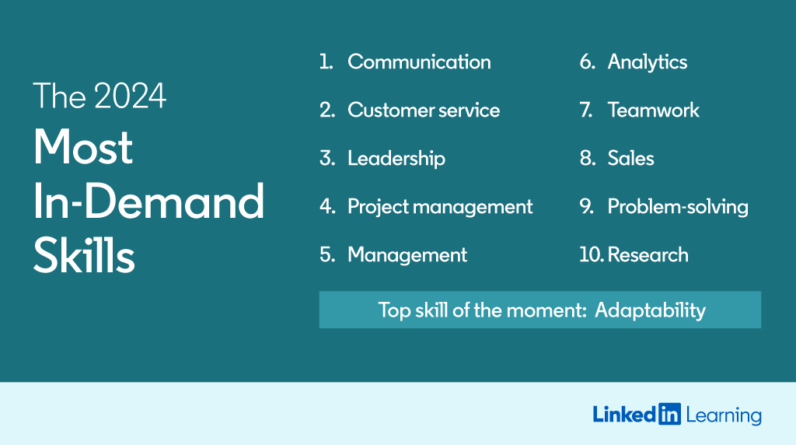
The 10 most in-demand skills for 2024
Screenshot from: LinkedIn, April 2024.
Communication Customer Service Leadership Project Management Analytics Management Teamwork Sales Problem Solving Research
In addition to the top 10 list, LinkedIn identified adaptability as the “skill of the moment” due to its remarkable year-over-year growth in demand.
“Given that AI has changed work so profoundly over the past year, we highlight adaptability as the top ‘skill of the moment’ with the greatest increase in demand,” said LinkedIn’s global head of content strategy , Dan Brodnitz. “It is imperative that teams remain stable and impactful as the pace of change accelerates.”
By 2030, 65% of job skills are expected to change, compared to just 25% in 2015. Today, more than half of LinkedIn users have roles at risk of being disrupted by AI .
To help people develop critical soft skills, LinkedIn is offering free access to relevant learning courses until May 31, 2024. Find links to each course on the LinkedIn page. report.
The importance of showcasing skills on LinkedIn
According to a new LinkedIn blog entryAs skills-based hiring becomes the norm, clearly listing your capabilities on your LinkedIn profile has never been more important.
“Increasingly, skills, as much as schooling, previous companies, job titles and work experience, are what get you a new job,” writes LinkedIn’s Bruce M. Anderson.
Nearly half of recruiters explicitly use members’ listed skills to fill open positions.
LinkedIn data shows that people with at least one skill listed receive up to twice the number of profile views, connection requests, and messages compared to those with no skills listed.
LinkedIn recommends including up to 50 skills spanning hard technical skills and soft people skills.
Job seekers are encouraged to focus on skills that are frequently mentioned in job postings for their desired roles and industries.
“God is in the details,” advises Anderson. “Where appropriate, list specific skills rather than generic skills or blanket terms.”
For example, instead of just “communication,” list public speaking, executive communications, writing, and other specialized communication skills.
However, it takes more than just listing skills. LinkedIn recommends asking colleagues and managers to vouch for the skills listed.
Additionally, users can create a “Projects” section detailing how they have applied specific skills and supporting claims with media such as case studies, blog posts, and presentations.
“It’s also a good idea to add new skills periodically,” Anderson says, pointing to data showing that members updated their skills 11 percent more often when they were hired or promoted.
To sum up
As AI automates more technical roles, clearly articulating one’s full portfolio of skills on LinkedIn has become vital career currency. Those most adept at constantly updating their skills, and skillfully marketing them, will remain the most employable in 2024 and beyond.
Frequently asked questions
How can adaptability improve the value of an SEO expert in the face of AI advances?
LinkedIn sees adaptability as the most essential skill because the workplace is changing rapidly due to advances in artificial intelligence (AI). For SEO professionals, adaptability means a smooth transition to using new technologies and dealing with search engine algorithm updates.
It involves changing strategies flexibly when needed and staying competitive in the SEO industry.
As AI continues to transform job roles, SEO specialists who can quickly learn and implement new techniques will continue to bring value to their clients and remain prominent and successful in the marketplace.
In the context of SEO, how important is it to continually update your skill set on professional platforms like LinkedIn?
Displaying a broad and expanding skill set helps SEO experts better appeal to potential clients or employers, putting more emphasis on hiring people based on their specific skills.
Highlighting specialist SEO skills such as technical website optimization and building high-quality backlinks, along with endorsements and examples of past projects, builds credibility. It shows that you are dedicated to keeping up with the latest best practices in the ever-evolving field of SEO.
Why should SEO experts focus on soft skills like leadership and teamwork, as indicated by LinkedIn?
LinkedIn’s report shows a growing emphasis on soft skills, such as leadership and teamwork, that are difficult for AI to replicate.
For SEO experts, honing these skills is vital for successful project management, cross-functional collaborations, and leading SEO teams or initiatives.
Soft skills complement technical skills, enabling SEO professionals to navigate client relationships and foster an environment of continuous improvement.
[ad_2]
Source link





