


BrightEdge research shows that traffic is driving towards perplexity and where opportunities lie to optimize traffic, especially for e-commerce.
What is Perplexity AI?
Perplexity is a self-described answer engine founded by researchers and engineers from OpenAI, Facebook, Quora, Microsoft, and Databricks. It is backed by many of Silicon Valley’s most influential investors and engineers, which has helped propel it as one of the leading innovators in next-wave AI search engines.
Perplexity contains an index that is ranked by its own version of PageRank. It’s a combination of a search engine and a chatbot, with the chatbot part serving as an interface for receiving queries and the AI part on the backend. But it retains the functionality of a chatbot as it can perform tasks like writing an essay.
What sets Perplexity.ai apart from competitors, as will be shown below, is that Perplexity displays a large amount of citations on websites.
Increased traffic
One of the key insights from the BrightEdge research is that Perplexity.ai has seen a 40% increase in referral traffic since January, indicating that users are interested in trying something different than the usual ten blue links.
Using their proprietary BrightEdge Generative Analyzer, they were able to detect AI search experiences that showed users are okay with an AI search engine.
The bottom line here is that the search marketing industry is back to where it was over two decades ago when Google came along. SEOs like myself and others were testing to see which activities were useful and which were not.
Most of the people searching got into it when the technology was relatively mature and don’t know what it’s like to face the unknown or even how to do it. The only difference between then and now is that today we know about research papers and patents. We had no idea then until about 2005.
BrightEdge’s report reflected on this transition period:
“For marketers, who rely on organic search strategies to reach customers, new AI search engines like Perplexity and ChatGPT signal a tectonic shift in the way brands market and sell their products. However, the new “These AI-driven platforms often undergo dynamic changes, making it difficult to track and adapt to them.”
In an ad-supported model, organic search results compete with advertising for the most valuable search queries, but that’s not the case with Perplexity. BrightEdge sees Perplexity as an opportunity for search marketers because it’s an ad-free model that sends organic search traffic.
Overlay with Google Search Generative Experience (SGE)
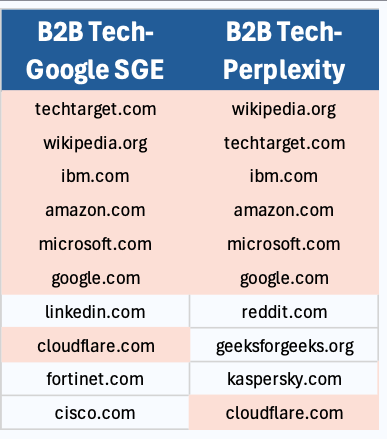
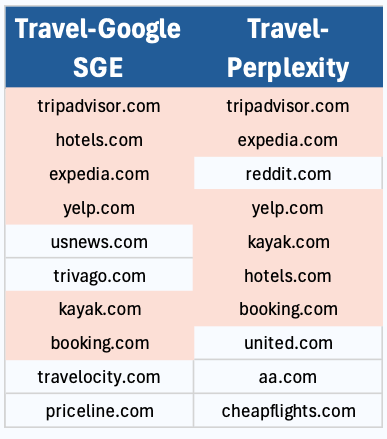
An interesting data point that surfaced in BrightEdge’s research is that there was “significant” overlap between Perplexity’s search results and Google’s SGE results. Perhaps unsurprisingly, the strongest overlap was in health-related search queries, likely because there are a limited number of sites that are qualified to create content on health and medical topics.
But what may seem discouraging is that Reddit appears in most search query topics except for health and finance, two YMYL (your money/your life) topics.
Overlay on B2B search results
Another area of overlap with Google’s SGE is Perplexity’s tendency to rank authoritative sites in topics such as health and education and local search and review sites in relation to Restaurants and travel. Big brands like Yelp and TripAdvisor are winners at Perplexity.
Overlay on travel search results
Yahoo, MarketWatch, and CNN are frequently seen in finance-related search queries.
There is less overlap in e-commerce queries aside from Wikipedia and Amazon, which both search engines rank.
According to BrightEdge:
“Google uses Quora and Consumer Reporters for third-party product information, while Perplexity refers to Reddit. In general, Perplexity is more likely to refer to product sites, while Google SGE will also include informational resources such as ‘lifestyle and news’.
This is good news for e-commerce sites that sell real products, a real bright spot.
BrightEdge cites the following opportunities with Perplexity:
Perplexity’s search growth share is increasing at a rate of 39% per month. Perplexity’s search results return an average of 5.28 website citations. Perplexity AI shows more citations for travel and restaurant queries than Google SGE. BrightEdge encourages search marketers to take advantage of AI-powered search engine optimization opportunities.
Jim Yu, founder and executive chairman of BrightEdge, said:
“Optimizing emerging search platforms is essential for marketers because their impact will be seismic: just 1% of the global organic search market equates to approximately $1.2 billion in ad revenue per year… AI-first engines are steadily gaining ground and opening up their own areas of expertise, leading the marketing community to dominate multiple fundamental search platforms.
There’s too much revenue at stake to stay behind, which is why we’re keeping a close eye on the development of these engines and all things search AI, from traffic and query trends to the quality of results and far more”.
Learn more about optimizing Perplexity in BrightEdge:
The Ultimate Guide to Perplexity
Featured image by Shutterstock/rafapress
[ad_2]
Source link





