


Whether you call it artificial intelligence, automation, machine learning, or similar terms, PPC advertising platforms are adopting and standardizing it. This is especially true on Meta platforms.
With its recent rebranding of automated ad products under the Advantage and Advantage+ suite of tools, Meta is encouraging advertisers to turn the keys to AI in nearly every facet of campaign management, from budgeting to creative development .
As a result, automation and Advantage+ will be very important as we discuss best practices for advertising on the Meta platform in 2024.
With these recommendations, I hope to equip you with the basics to adopt AI strategically as you set up your campaigns to grow and scale without handing control over to automation.
1. Simplify your account structure
Maximizing the efficiency of Meta advertising starts with setting up your campaigns to allow for optimal growth and budget distribution. This means creating fewer campaigns and opting for Campaign Budget Advantage (formerly known as Campaign Budget Optimization).
A more streamlined and optimal account structure starts with consolidating all campaigns with the same goal and conversion event into a single campaign. Instead of multiple campaigns with the same goal, use one campaign with multiple ad sets.
This will help overall efficiency by reducing overlap within the auction. It also allocates your budget to the ad sets that have the best chance of generating the lowest cost-per-action (CPA) and the highest volume.
This strategy is based on changing the Advantage campaign budget, automatically allocating spend between ad sets based on performance. Advantage campaign budgeting reduces manual budget guesswork. It also makes CPAs efficient by spending your marketing budget where it will do you the most good.
There is one possible exception to this simplified campaign structure that might merit an exception to this recommendation. Consider whether you are prospecting or retargeting.
If you have prospecting ad sets (with large audiences) in the same campaign as retargeting audiences (with small ad sets), Meta might be spending too little on retargeting. It’s a good idea to split your retargeting audiences into a separate campaign. But it’s only necessary if you have a strong business case for spending a certain amount on retargeting audiences
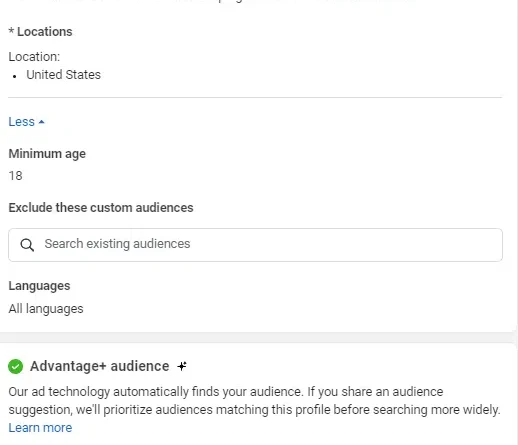
One of the biggest changes to Meta advertising best practices over the past 18 months has been the viability of a wider audience. To that end, Meta has made the new Advantage+ audience product the default choice for new ad sets created.
But what is it, exactly?
Think of Advantage+ Audience as a dynamic AI-powered audience that changes who serves ads based on performance. Instead of using fixed targeting (interests, behaviors, demographics), where Meta will not more Targeting people in certain categories, Advantage+ Audience expands and changes your audience based on your goal.
Advantage+ Audience is divided into two sections: Audience Controls (required) and Audience Suggestion (optional).
Audience controls they allow you to enter any segmentation that needs to define your audience. This is limited to location, age, language, and any custom audiences you want to exclude
Audience suggestion allows you to add standard targeting criteria such as interests and behaviors. The difference here is that Meta will not necessarily target only these segments. You are giving Meta guidance instead of requirements.
I have been using Audience Advantage+ since its launch. I think it’s a powerful option that can help you get better results overall.
However, I recommend testing it in a campaign alongside a separate audience created with your original detailed targeting options. You can also include a conversion-based lookalike audience, as this type of audience has made a surprising comeback in terms of viability.
Having multiple audiences in a unified campaign with the Advantage campaign budget will increase efficiency and potential for scale.
Get the daily search newsletter marketers trust.
3. Adopt creative improvements (if possible)
One of the biggest and most frequent updates to Meta’s automated toolset has to be the creative enhancement options.
These enhancements, now known as (you guessed it) Creative Advantage+, allow Meta to automatically optimize the appearance of your ads. Possible tweaks include:
Adjusting the brightness and contrast of the image.
Application of artistic filters: Sharpen, adjust the color temperature, or add a vignette or radial blur.
Variable aspect ratio: Show the original or cropped version of the image.
Add templates to feed images.
Adding tags: Highlight a useful aspect of your business on your Facebook page, such as likes or ratings.
Show relevant comments from Facebook and Instagram.
Text combinations: Display copy as body text, headlines, or descriptions.
music: Select a song to accompany the ads based on its content.
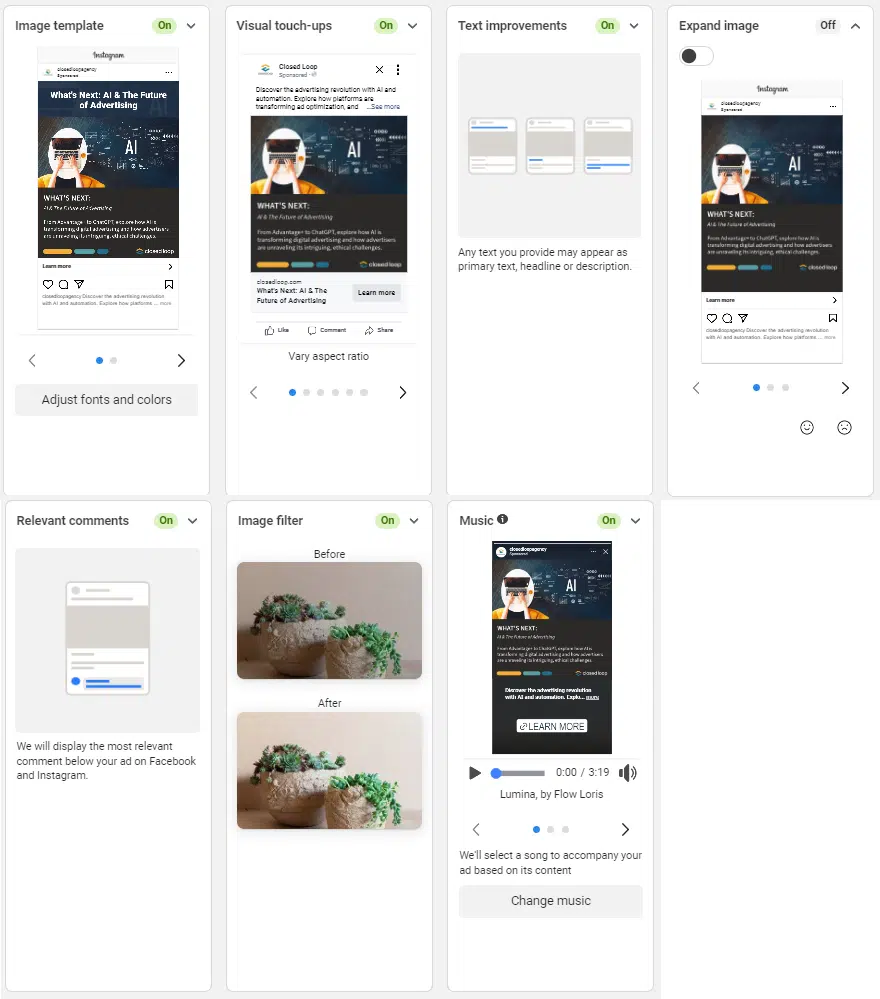
Meta will likely automatically apply most, if not all, of these improvements to ad creative by default. I encourage you to review and evaluate them with your creative and brand teams.
Some can drastically alter the look of your creativity. Especially:
Image templates (although you can edit the fonts and colors). music Expansion of the image.
However, these improvements can improve the results of the campaigns I’ve managed when done correctly. I’ve found the image template (when executed with brand-appropriate colors and fonts) and text enhancements to be particularly useful.
Advantage+ creative is definitely worth a try, as long as you do it in a brand-safe way. Not only can it improve click-through rates (CTRs) and creative engagement, but it can also prevent creative burnout.
4. Take advantage of new lead generation features
Meta is slowly rolling out two major changes to lead generation forms that could be huge for users: conditional logic and rich creative.
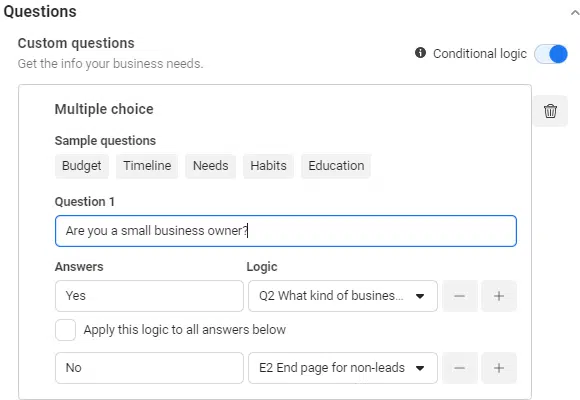
Conditional logic helps solve one of the biggest complaints most Meta lead generation advertisers have: quality.
It allows advertisers to schedule contact forms to lead respondents to different questions and landing pages based on their answers to personalized questions. This allows advertisers to pre-screen potential customers and redirect them if responses suggest they may not be qualified.
Conditional logic also allows advertisers to set up specific landing pages aligned with responses, resulting in different destinations or calls to action (CTAs) based on responses.
Rich creative Lead forms allow for more visual and customizable forms with several additional sections. Instead of starting with a quick introduction before jumping right into the questions, advertisers can include different optional sections:
Benefits: Add two or three unique benefits of your offering that support your overall vision.
How it works: Tell potential customers how to sign up or get started or list the benefits of using your product or service.
Products: Tell potential customers about your products, services, courses or plans.
Incentives: Motivate potential customers to give you their information by enticing them with a free trial or consultation.
These sections can increase engagement. They can also improve conversion rates by providing more details before the lead is sent.
5. Experiment with Advantage+ internships
Meta has allowed advertisers to use automatic placements for quite some time. Advantage+ locations are the latest evolution of this tool. Allows Meta to serve ads and allocate budget to multiple locations on the Meta Network.
Many advertisers still think that ads are primarily served in Facebook and Instagram news feeds. But with the addition of so many other ad placements like Reels, Stories, Marketplace, and more, there are actually a lot of places to run your ads.
I used to be skeptical about automatic placements and it’s still not perfect. However, it has gotten much better at helping advertisers manage their cost per 1,000 impressions (CPM) and get better results by diversifying where their ads will be served.
If you’re an advertiser that primarily runs lead generation or conversion-optimized campaigns, I’d suggest giving Advantage+ placements a try. You are likely to see better CPM efficiency and improved conversion rates.
If you’re an advertiser running top-of-funnel campaigns optimized for reach or brand awareness, you might want to be a little more careful. While I’m sure you’ll get better CPM efficiency, you may start to see your ad serving favor placements that may not be as premium as others.
Ultimately, Advantage+ placements will always be optimized based on what your goal is. You should see better results from both a CPA perspective and a media efficiency perspective. As a result, it’s worth a try.
Takeaway food
Automation is here to stay. It’s likely to become an even bigger and more integral part of creating and managing campaigns as time goes on. And as much as Meta wants advertisers to hand over the keys, you still need to know how to use these tools effectively by applying human oversight.
Successful advertisers will be able to find the middle ground between full meta automation and clinging to the last bit of control they have. The key is to find balance.
Account simplification and budget optimization are imperative in today’s Meta environment. Placement targeting, creative, and automation have developed to the point where they can be useful if tested and executed intelligently. But you may not be ready to put them on autopilot just yet.
The bottom line is that the future will involve more automation and machine learning.
As a result, advertisers would be wise to start testing and incorporating these tools now. You will probably be surprised how smart the Meta algorithm is and how it can help you improve your performance.
Dig deeper: Building a winning Facebook and Instagram strategy for 2024
The views expressed in this article are those of the guest author and not necessarily Search Engine Land. Staff authors are listed here.
[ad_2]
Source link





