


While honest websites experienced the ups and downs of Google’s March 2024 update, SEOs and recipe bloggers noticed AI spam sites rising to the top of the search results. search An example yesterday ranked for more than 217 thousand queries, 14.9 thousand of which are in the top 10, and this number has increased a day later. Here’s what’s happening and how spammers continue to beat Google.
Increase in March 2024
The site being ranked is a subdomain. The main domain has been around since the summer of 2020. The spam subdomain was first detected by the Internet Archive on November 30, 2022, coincidentally the launch date of ChatGPT. The subdomain was half-finished and essentially inactive until March 2024, when it quickly expanded and immediately began ranking for thousands of search queries.
On Wednesday, March 20, the site ranked 14.9 thousand search queries in the top 10. Thursday, March 21, the site had 15.6 thousand in the top 10. Even though Google has just concluded its spam update, this particular site (and others like it) continue to rank. for thousands of search queries and Google seems powerless to stop them.
Food writer reacts to AI spam
A food writer and cookbook author, Robin Donovan (Instagram), brought the AI site to my attention, telling me that others in a private Facebook group were livid about the rise of AI sites for recipe search queries.
It is very obvious that the content is generated with AI, even the images that accompany the articles are 100% AI. So it’s especially damaging for those with experience, expertise and authority to see AI content obviously outrank them.
Robin was understandably upset:
“How the hell is this the best content? Meanwhile, bloggers who are professionally trained chefs, recipe developers, cookbook authors, and others with decades of training and experience are seeing their sites decimated by these updates. Sites that have been building for years with well-researched and well-written articles (written by humans!), professionally developed and carefully tested recipes, photos that have been spent hours preparing and shooting.
They’ve done all the things Google has told them to do for years: write your own content, take your own photos, develop unique, high-quality recipes, be an expert in your subject area, and have credentials to show for it. oh no Don’t try to game the system, be genuine, create USEFUL content. For what?”
Details on how spam sites look
1. Hosted on Squarespace
The spam site is on a subdomain and both the subdomain and the main site are hosted on Squarespace. Why Squarespace? Just a guess, but maybe this infrastructure tends to look legit to Google (or maybe it doesn’t play a role).
2. All images are colorful and simple
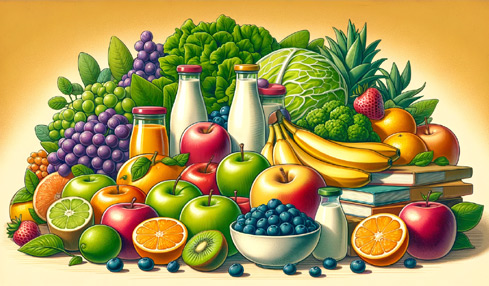
All images are AI-generated, created in a flat, colorful style similar to what you might see in an infographic, indicating that a templated prompt was used to create the thousands of images that accompany the articles
Images are an important component of articles. Each article includes about seven images related to the general topic of the article. Each item contains the colors of a rainbow. I don’t know if the images are intentionally bright and colorful, but using strong colors is a good strategic choice for images because they come up in SERPs, Google Discover, and Google SGE.
I uploaded one of the images to ChatGPT and asked it to generate a request based on the image to create a new one with the same style.
Here’s an example of an AI generated image in the same style as the AI spam sites:
Example of an AI generated image used by a spam site
3. All articles follow a rigid template
Articles follow a template structure, which varies by article type. Article topics range from comparisons, local destination travel, lifestyle, recipes, health benefits of certain foods, and more.
Health-related articles follow this template structure:
a. Introduction
It presents the topic concept being discussed and its relevance to a specific health-related topic. The conceptual theme can be a specific food, a type of diet, etc.
b. Health benefits
After the introduction, they all discuss the health benefits associated with the concept topic.
c. fundamentals
This section addresses the basic concepts of the health topic being addressed (oral health, diabetes…), the importance of nutrition and common problems or diseases associated with the health topic.
d. Nutritional guidance and key nutrients
e. Dietary choices and impact on health
f. Lifestyle tips and advice
g. A summary of the benefits
4. Underlying Request for AI-Generated Articles
I was curious what a message generating this content would look like, so I asked ChatGPT to create one.
Here is a general guideline that could have been used to create the health and diet articles:
“Write an article that explores the connection between [concept of dietary choice] i [specific health focus]following the following template:
a. Introduction: Start by introducing the concept of [concept of dietary choice]its definition and why it is relevant [specific health focus].
Discuss its growing popularity and how it aligns with contemporary health and lifestyle trends.
b. Health benefits:
Learn more about the overall health benefits associated with it [concept of dietary choice]focusing on their potential for improvement [specific health focus].
c. Fundamentals of [Health Topic]:
Provide background on the [specific health focus]including essential anatomy, the importance of nutrition, and prevalent conditions that affect this aspect of health.
d. Key nutrients and their impact:
Detail the crucial nutrients that play an important role [specific health focus], including their sources and the health benefits they provide. Highlight the importance of certain vitamins, minerals and other compounds.
e. Influence of dietary choices:
Analyze how specific dietary choices influence [concept of dietary choice] can impact [specific health focus], positively or negatively. Recommend beneficial foods and advise against certain types that can cause harm [specific health focus].
f. Practical advice for diet and lifestyle:
Offer practical suggestions for integrating beneficial foods into the diet and making lifestyle adjustments to support [specific health focus]. This can include advice on meal preparation, portion control and balancing different types of food.
g. A prompt to use to generate a conclusion:
Conclude the article by summarizing how to adopt [concept of dietary choice] can contribute to improvement [specific health focus].
Emphasize the balance and variety of nutrients this approach provides and its potential benefits beyond [specific health focus]. Make sure the article provides a comprehensive overview that is informative and engaging, targeting readers interested in understanding the relationship between [concept of dietary choice] i [specific health focus].”
5. Content tested by AI Checker Tools
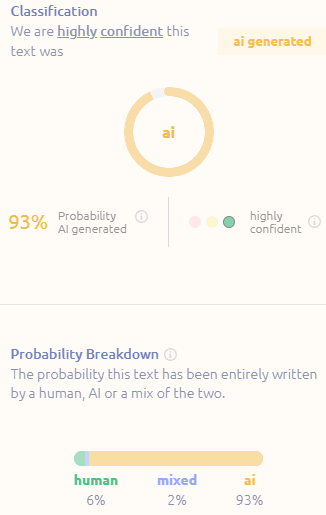
The strangest thing about these items is that every item I tested with GPTZero AI Content Detector scored 100% as AI generated. The Originality content checker.AI offered similar scores.
Screenshot of GPTZero Score
Screenshot of Originality.AI score
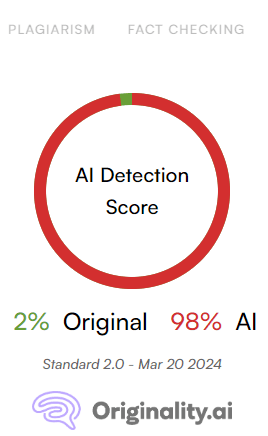
Squarespace’s templates are professional, and the articles themselves have a dry style that’s informative, but lacks signs of human authorship, such as expressions of knowledge or expertise and a complete absence of colloquialisms. All tested items failed AI detection tests.
6. How are AI spam sites classified?
My hypothesis is that the reason these spammy sites rank is that they are taking advantage of a loophole in Google’s algorithms that allows new content to get an initial boost, which Google’s John Mueller has described as Google testing the website or web pages. This happens all the time and people get excited when they post a new site and see it rank almost immediately.
What is happening with this AI generated website is that it publishes massive amounts of web pages every day and these pages get a boost to the top of the search engine results pages (SERPs) within the first 24 to 48 hours . Then they start to drop out of the top ten and eventually into the second pages of the SERPs. But at that time there are new pages that start this journey from the initial impulse, every day. This is a classic old school strategy known as rotate and burn.
John Mueller has discussed in the past why Google ranks new websites at the top of search results.
Explained:
“Particularly with brand new websites, one of the difficulties we have is that we may not have a lot of signals for those websites, so we have to make estimates.
And depending on how we estimate, it can sometimes mean that we initially show that website a little more prominently than what the signals tell us in the end.
… But this can go both ways. It can go in the direction of showing you very visibly in the beginning.
And it may also be that you may be shown less prominently at first, and as we understand your website and how it fits in with the rest of the web, we can adjust that.
…Sometimes new websites also appear which we try to pick up very quickly”.
7. AI spam is a longstanding problem with Google
Google has had a long-standing problem with AI-generated sites dominating certain search results, and this isn’t the first time Google has been overwhelmed by spam, especially for relatively long phrases. This spam site is not unique and not an outlier. There are many others alike that follow the same ranking methods.
What makes this example remarkable is that it was published at the same time that Google released a spam update, and it continued to rank at the top of the SERPs for hundreds of thousands of search queries (with 15 .6 thousand queries currently among the first 10).
The AI spam site has now appeared on the other side of the spam update and is giving Google its nose. It’s a humiliating and demoralizing experience for the thousands of honest and seasoned bloggers who are overwhelmed by content that lacks credibility, experience and authority; these articles do not even list the authors.
Featured image by Shutterstock/ViDI Studio
[ad_2]
Source link





