



In response to growing demand from consumers and regulators to protect online privacy, in January 2020 Google announced plans to phase out support for third-party cookies in your Chrome browser by 2022. Cookies, the tool used to collect and share data about user behavior as they move around the open web, are the foundation of the adtech ecosystem and provide the that drive most behaviors and audience orientation. Google’s decision to remove the cookie put an effective clock on the current state of digital advertising.
To prepare for this transition, marketers have worked to find alternatives to replace the third-party data that cookies previously provided for their targeting efforts and to develop new marketing strategies that do not rely on the monitoring of user behavior on the open web.
In this article, we’ll share some fundamental changes that the end of cookies will likely bring to digital marketing and paid search. We’ll give you some tips and tactics to ensure your brand’s marketing efforts are relevant and effective in the post-cookie world.
Understand the basics of data
Before you can understand the changes that a cookie-free future is likely to bring, you need to understand the distribution of data. Here are five types of data:
Observed data: Some first- and second-party data, as well as all third-party data, fall into the broad category of observed data, meaning that it was collected without direct user involvement.
First party data:
Any information you collect directly from your users, such as email addresses and any demographic or personal data a user provides when they fill out a form or submit a request through your website. This also includes data collected about your website users, such as what they click, read or buy. Google’s changes will not affect this type of data collection.
Second Party Data:
Second-party data occurs when two organizations agree to share their first-party data with each other privately. Google’s decision to remove cookies will also not affect these agreements. In some regions, however, the European Union GDPR (GDPR)the California Consumer Privacy Act (CCPA)or similar regulations may limit the ability to share data privately between companies.
Third party data:
Data collected by a company or entity with which the consumer has not had any direct interaction. This data is often collected by websites that use third-party cookies to collect user data and return it to a technology provider or other entity that aggregates, sells or uses it. This type of data feeds much of the digital advertising ecosystem, and it’s also the data most at risk from the changes Google is making to the Chrome browser.
Walled gardens: Google, Facebook, Amazon and similar platforms maintain their own data ecosystems, sometimes called walled gardens. These environments are closed and non-transparent, meaning the only way marketers have access to their data is through advertising tools like Google Ads..
How will the absence of third-party cookies affect PPC campaigns?
While keyword-based PPC advertising will not be affected, there will be an impact on programmatic display advertising.
With the absence of third-party cookies, audiences will be less precise, making audience-based targeting and smart bidding strategies even less transparent as the walled garden walls go up from Google.
Remarketing is the main tool in the PPC toolkit that is likely to be more difficult in a cookie-free future, at least at first. Cookies allow marketers to tag specific users and collect data from third parties on the sites they visit. This, in turn, allows marketers to target these users with ads based on their history, behavior and interests. This process will need to evolve, as this type of user tracking is exactly what Google’s changes are intended to eliminate.
Today, digital services and experiences are highly personalized for users. Advertisers can fall victim to the personalization gap, failing to deliver the personalized experience customers expect from native advertising and content.
To replace cookies, Google plans to migrate its advertising clients to a new interest-based model.Themes.’ This will allow advertisers to serve relevant ads based on interest-based categories of topics selected from a publicly visible list.
How to prepare for the future without cookies
Create your own data: Without cookie-based targeting and the option to easily remarket to potential customers, you’ll need to create your own data feed.
Make sure your website is set up to collect the data you need, whether it’s emails, phone numbers, purchase history or on-page behavior, so you can continue to connect with and reach your customers with messages and opportunities without cookie-based targeting.
Take advantage of search intelligence: By removing cookies, Google will become even more of a walled garden. Leveraging data observed directly from search engines using platforms like Athena can help you design PPC campaigns without relying on the Google platform.
Expand customization options: There is more than one way to personalize digital experiences. If you have your own data resources, on-site personalization offers an alternative to further engage existing customers without relying on third-party cookies.
Consider alternative personalization experiences
While targeting based on audience identity and behavior may soon no longer be possible, leveraging tools like time- and location-based messaging can help provide a similar sense of user personalization.
Combining these tactics with contextual targeting will drive new customers to your site and provide them with a personalized, cookie-free experience.
Crush the puzzle without cookies
Data is a scarce resource, and it will be even more so when third-party cookies are phased out. At Adthena, we collect observed data directly from search engine results pages.
We use this unique data, artificial intelligence and machine learning to help our clients develop a search marketing strategy driven by meaningful but anonymous data.
Here are some examples of how Adthena has helped customers solve key challenges without cookies:
Challenge 1: Relying too much on public data
To move around relying on audience data to personalize experiences, a leading US insurance company used location-based messaging to provide a similar sense of user personalization.
Using Adthena’s Local view, gained access to an interactive 50-state view of their competitive search landscape. This allowed them to successfully build their strategy based on regional market variations.
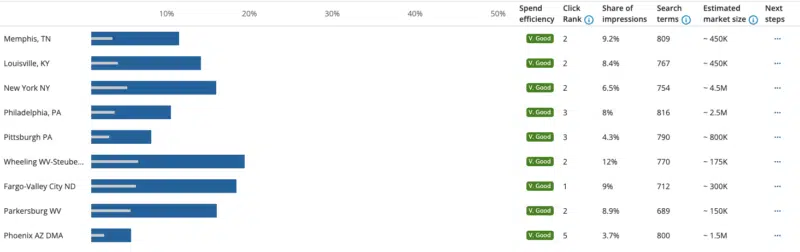
Adthena’s local view provides an interactive view of any city, state or designated market area (DMA). See Local View in action. Take the self-guided tour of Local view.
Challenge 2: You don’t know how to target new customers right now
Using Adthena’s Strategic advantage solution, an American credit card provider reacted quickly to new competitors in their market and optimized their keyword lists based on the most profitable terms in their market.
Using our data, the company was able to target more consumers and increase conversions with a conversion value of over $2 for every $1 spent on Google Ads.
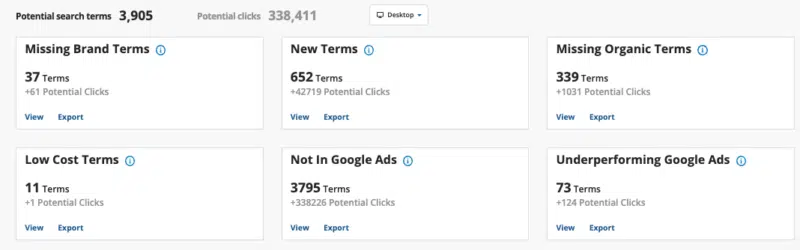
With Adthena’s search term solution, you can identify terms your competitors are appearing on that you haven’t in the last seven days, see which terms have the most competitors appearing on them, and the potential volume and estimated cost.
Take the self-guided tour of Search Terms
Challenge 3: Compliance changes impact the ability to grow effectively
Financial services group Legal and General wanted to go beyond product-level marketing and improve its overall brand position. Using Adthena’s search intelligence, they benchmarked market share, categorized competitors and unified their messaging to gain traction in areas of opportunity.
The result was a +140% increase in search visits, a +160% increase in search conversions and a +60% increase in category market share, placing them in the top ten for retirement
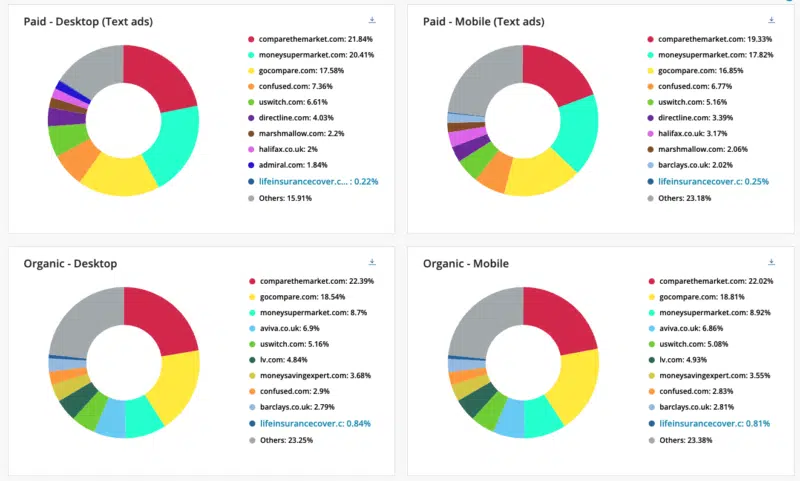
Adthena’s Market share provides visibility into competitor market share and spend and performance metrics that contextualize what drives each competitor’s market share. With this insight, you can easily compare yourself to your main competitors, review your market position by category or identify room for growth.
Take the self-guided tour of Market share.
Prepare NOW for the post-cookie world
To prepare for the cookie-free future, creating your own data becomes essential. Make sure your websites are equipped to collect essential information directly from users. Leveraging search intelligence and exploring personalization alternatives are vital strategies for successfully navigating the cookie-free landscape.
Adthena can be a valuable ally in this transition. Through observed data, artificial intelligence and machine learning, Adthena helps develop search marketing strategies driven by meaningful but anonymous data.
As we prepare for a future without third-party cookies, Adthena is ready to help you make strategic and informed decisions, ensuring you stay ahead in the competitive world of paid search.
Talk to one of our search consultants to learn more about Adthena and how it can power your journey in the post-cookie digital landscape.
[ad_2]
Source link





