


SEO is not what it used to be.
Search engines are changing faster than they have in the last decade, thanks in part to the help of artificial intelligence tools like OpenAI’s GPT-3.
The unfortunate aspect of these new tools is that they are further proliferating the overabundance of spammy content and link building on the web.
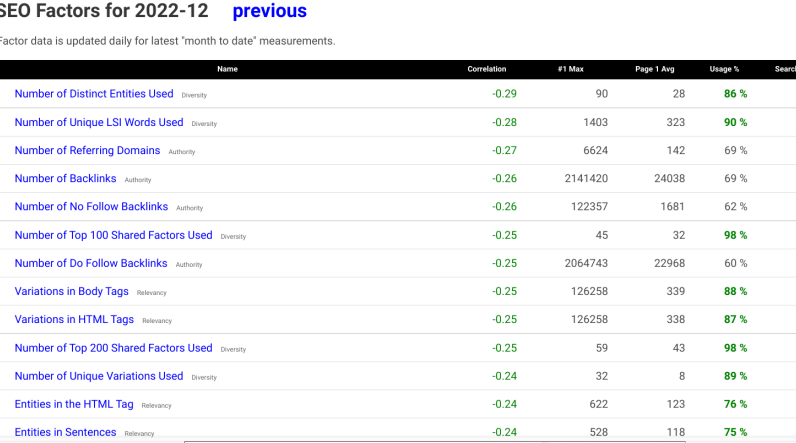
And while link building remains a highly correlated Google ranking factor, its importance among hundreds of other ranking factors continues to decline.
It’s the perfect match between feet: AI content and AI search engines that understand natural language processing.
As a weighted algorithm, many other factors go into both technical and content SEO.
As link building declines, what other factors will remain or emerge as important focal points of your own SEO strategy?
In this article, we’ll look at what link building is and why its power is fading before exploring alternative tactics you can use to increase your website’s authority and increase your organic traffic.
We’ll also offer some tips on how to best implement these strategies so you can start seeing results right away.
What is Link Building in Search Engine Optimization?
Link building for SEO can be defined as the process of exchanging or acquiring links from external sources to your own website.
It aims to build relationships with other websites and businesses, thereby increasing your web visibility and improving your overall internet presence.
For more information, feel free to check out our seo guide for beginners to link building.
Why the power of link building is waning in SEO
Link building was once an important factor in Google’s algorithm and had a huge impact on website rankings.
However, with the introduction of machine learning algorithms and more sophisticated search engines, link building has become less relevant as a ranking factor.
Top Google Ranking Factors by Spearman Correlation.
Most search engine algorithms today are geared toward semantic analysis, including automatic understanding of natural language processing, of content rather than incoming links.
Search engines are getting better at understanding the context and quality of content without relying on links.
This change begs the question: What should webmasters and digital marketers do now that backlinks are less important?
Alternative tactics to increase keyword rankings without backlinks
As the power of link building in SEO fades, it’s important to explore alternative tactics that help increase your keyword rankings without relying on backlinks.
In this section, we’ll look at some of the key strategies and tactics you can use to increase your website authority and organic traffic, even when link building isn’t a viable option.
From optimizing your content for search engines to leveraging social media channels, there are many options available to those looking to increase their SERPs without the need for external links.
Let’s take a closer look at what these methods involve and how best to implement them.
Create quality content
Google loves to reiterate the need to regularly create, update and improve the quality of website content.
Doing so means not only making your website content more entertaining, controversial and informative. It means improving the flow, natural breaks, the inclusion of interactive elements, images, headers and video.
This leads to our next point.
Includes video
High-quality video means your brand has a budget and is likely more legitimate.
While direct YouTube links may not be of much help, a significant following on the platform can generate significant amounts of traffic and increase your credibility. I’m sure this trend will only expand in the future.
Optimize your on-page content for search engines
Search engine optimization (SEO) is the process of making your website and its content more visible, discoverable and easy to understand by search engine crawlers or robots.
This can be achieved through a variety of methods, including creating unique URLs, optimizing meta descriptions and titles, using keywords strategically, and making sure your content is organized logically.
Internal link signals
Internal links are an important part of SEO because they help search engines better understand the structure and hierarchy of your website.
Internal linking has become an increasingly important part of SEO as link building has become less reliable and effective. Internal linking helps search engines understand the structure and hierarchy of a website, as well as providing a means for webmasters to gain visibility without the need for additional inbound links.
How internal linking is used can have a huge impact on how search engine crawlers crawl and index websites. This is especially true because most search engines assign more relevance to pages that have a higher number of internal links.
Internal links can be used to reduce reliance on backlinks, while helping to improve user experience and navigation.
Take advantage of social networks
Social media is becoming increasingly important for websites looking to maximize their visibility on search engine results pages (SERPs). Search engines are now able to read social media chatter and extract key data points to improve keyword rankings.
Search engines take social signals into account when ranking websites, which means that leveraging multiple social media channels can help boost your SERP ranking.
They do this using natural language processing (NLP) algorithms and machine learning tools that scan posts, comments, likes and other social interactions to determine what content is most relevant to a particular query.
It is important to note that social media signals are not as strong as inbound links, but they are still an effective way to increase visibility and drive website traffic.
ChatGPT considerations
ChatGPT is a natural language processing tool that is gaining a lot of popularity among digital marketers. This technology uses machine learning algorithms to process text data and generate more nuanced content, answers and conversations than traditional search engines.
The promise of search chat based on machine learning and artificial intelligence is that you won’t even show little blue links. This fact not only changes the way we think Traditional and technical SEO, but the way search engines display your content. Authority will matter, but links are likely to be an even smaller component.
Conclusion
As new search engine algorithms have taken over, the power of link building has diminished significantly. However, there are still ways to increase website traffic and keyword rankings without relying on backlinks.
By creating quality content, including video, leveraging internal linking and using social media channels, webmasters can increase their website authority and organic traffic even when link building is no longer an option .
With careful implementation and optimization, you can ensure that your site remains relevant despite the changing SEO landscape.

Nate Nead
Nate Nead is the CEO and managing member of Nead, LLC, a consulting firm that provides strategic advisory services in multiple disciplines, including finance, marketing, and software development. For over a decade, Nate had provided strategic guidance on M&A, capital acquisition, technology and marketing solutions for some of the best-known online brands. He and his team advise both Fortune 500 and SMB clients. The team is based in Seattle, Washington; El Paso, Texas and West Palm Beach, Florida.
[ad_2]
Source link





