


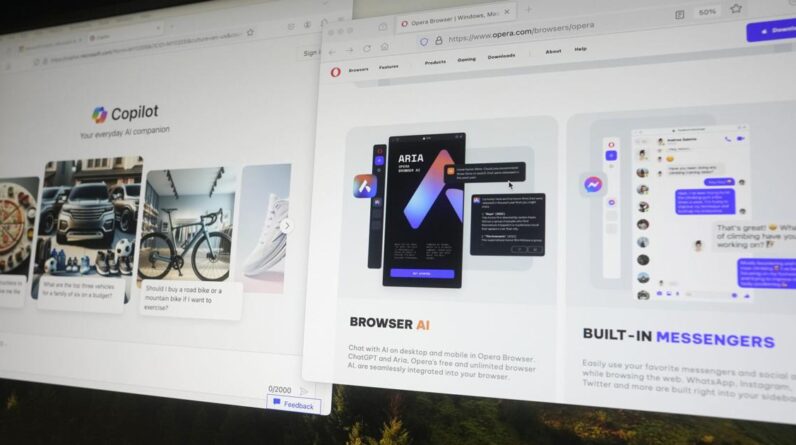
The rise of generative AI chatbots, such as Copilot and Opera, seen here, are giving people new and different ways to search for information.
LONDON — It’s not just you. Many people think that Google searches are getting worse. And the rise of generative AI chatbots is giving people new and different ways to search for information.
Although Google has been the one-stop shop for decades (after all, we commonly call searches “googling”), its domain has long attracted a large amount of sponsored or spam links and junk content fueled by “search engine optimization” techniques. This brings down the really useful results.
A recent study by German researchers suggests that the quality of Google, Bing and DuckDuckGo results is declining. Google says its results are of significantly better quality than its rivals, citing third-party measures.
Now, chatbots powered by generative artificial intelligence, including Google itself, are poised to change how search works. But they have their own problems: Because the technology is so new, there are concerns about the accuracy and reliability of AI chatbots.
If you want to try AI mode, here’s a tutorial:
WHERE CAN I FIND AI SEARCH TOOLS?
Google users need look no further. The company launched its own AI chatbot assistant, known as Bard, last year, but recently retired that name and replaced it with a similar service, Gemini.
Bard users are now redirected to the Gemini site, which can be accessed directly from desktop or mobile browsers.
The Gemini app also launched in the U.S. this month and is rolling out in Japanese, Korean and English worldwide, except for Britain, Switzerland and Europe, according to an update notice, indicating that more countries and languages ”coming soon”.
Google has also been testing a new search offering called “Generative Search Experience” that replaces links with an AI-generated snapshot of key information. But it’s limited to US users who sign up through its experimental Labs site.
Microsoft’s Bing search engine has provided generative AI search powered by OpenAI’s ChatGPT technology for about a year, first under the name Bing Chat, now renamed Copilot.
On the Bing search home page, click the Chat or Copilot button below the search window and you’ll get a conversational interface where you type your question. There is also a Copilot app.
A lot of startup AI search sites have sprung up, but they’re not that easy to find. A standard Google search isn’t all that helpful, but searches on Copilot and Bard turned up several names, including Perplexity, HuggingChat, You.comComo , Andi , Find , Exa and AskAI
DO I HAVE TO REGISTER OR PAY FOR THEM?
Most of these services have free versions. They usually limit the number of queries you can make, but offer premium tiers that provide smarter AI and more features.
Gemini users, for example, can pay $20 for the advanced version, which includes access to its “most capable” model, the Ultra 1.0.
Gemini users must be signed in to their Google Accounts and be at least 13 years old, 18 in Europe or Canada. Copilot users do not need to sign in to a Microsoft account and can access the service through Bing search or the Copilot home pages.
Home sites are largely free and do not require setting up an account. Many also have premium tiers.
HOW TO DO AN AI SEARCH?
Instead of typing in a series of keywords, AI queries should be conversational, for example, “Is Taylor Swift the most successful female musician?” or “Where are some good places to travel in Europe this summer?”
Perplexity advises using “natural, everyday language.” Phind says it’s best to ask “full, detailed questions” that start with, for example, “what is” or “how.”
If you’re not satisfied with an answer, some sites allow you to ask follow-up questions to focus on the information you need. Some ask suggested or related questions.
Microsoft Copilot lets you choose three different chat styles: creative, balanced, or precise.
HOW ARE THE RESULTS?
Unlike Google search results that provide a list of links, including sponsored ones, AI chatbots spit out a readable summary of the information, sometimes with a few key links as footnotes. The answers will vary, sometimes greatly, by location.
They can shine when you’re looking for an obscure factoid, such as a detail about a European Union policy.
Answers from Phind.com they were among the most readable and delivered consistently in narrative form. But the site has mysteriously gone offline at times.
Try a simple query: What is the average temperature in London during the second half of February? — produced a similar range of results in most locations: 7-9 degrees Celsius (45-48 Fahrenheit).
Andi strangely provided the current weather conditions for New York, although he used the correct city during another subsequent attempt.
Another search, the names and tenures of CEOs of British luxury car maker Aston Martin, is the kind of information available online, but it takes a bit of work to pull together.
Most sites found names from the last decade or two. AskAI provided a list dating back to 1947, along with the top three “authoritative sources”, but no links.
WHAT ARE THE DISADVANTAGES?
While chatbots may appear authoritative because they produce responses that appear to be written by a confident human, they are not always correct. AI chatbots are notorious for delivering deceptively convincing answers, called “hallucinations.” HuggingChat warns: “Generated content may be inaccurate or false,” and Gemini says it could “display inaccurate information, including about individuals.”
These AI systems scan large amounts of information pulled from the web, known as large language models, and then use algorithms to come up with consistent answers, but not all of them reveal how they arrived at their answers.
Some AI chatbots reveal the models their algorithms have been trained on. Others provide little or no detail. The best advice is to try more than one and compare the results, and always check the sources.
For example, at one point Komo insisted that the population of Canada in 1991 was one million people, and stuck to that wrong number even after I followed up to ask if I was sure He cited a Wikipedia page, which revealed that the figure came from a table for the country’s indigenous population. It found the correct number when I searched again later.
[ad_2]
Source link





