


Years ago, Google ranked organic results by exactly matching search queries with text on a web page. Search engine optimization involved creating multiple pages that contained all kinds of keyword variations.
The result was an avalanche of inferior content placed at or near the top of long-tail queries.
Search engines no longer rely on exact match keywords, but instead try to understand the intent and context behind a query. It is common for Google to rank a page that does not contain a single query word.
For example, a Google search for “affordable airfare” produces page 1 organic results that mostly contain “cheap flights,” “last minute flight deals,” and the like. None of the ones I saw included the exact phrase “affordable airfare.”
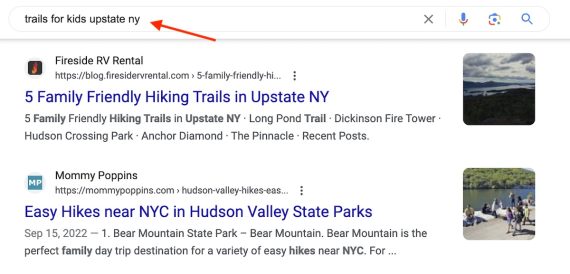
And searching for “kids trails in New York state” returns organic results for “family hikes in Albany” and “easy hikes near New York,” both of which likely satisfy the searcher’s intent.
Searching for “kids trails in upstate New York” returns results for “family friendly hikes in Albany” and “easy hikes near New York.”
Google’s How Search Works portal explains the process:
To return relevant results, we first need to establish what you’re looking for: the intent of your query. To do this, we build language models to try to decipher how the relatively few words you type into the search box match the most useful content available.
This involves steps as seemingly simple as recognizing and correcting misspellings and extends to our sophisticated synonym system that allows us to find relevant documents even if they don’t contain the exact words you’ve used.
Keyword research
Is keyword research important to SEO in 2024?
Although it is no longer based on exact match queries, Google’s algorithm still uses keywords. On the same “How Search Works” page, Google states:
The most basic sign that information is relevant is when the content contains the same keywords as your search query. For example, with web pages, if these keywords appear on the page, or if they appear in headings or body text, the information may be more relevant.
Further down, Google says it also uses “other relevance signals” (presumably beyond keywords), “interaction data to assess whether search results are relevant to queries,” and machine learning to make sense of the data.
Google offers an example:
Just think: when you search for “dogs”, you probably don’t want a page with the word “dogs” hundreds of times. With this in mind, the algorithms evaluate whether a page contains other relevant content beyond the keyword “dogs”, such as pictures of dogs, videos or even a list of breeds.
However, the benefits of keyword research go beyond SEO.
Keywords:
Help understand the needs of target customers. Measure Demand: A high search volume indicates a higher demand for a product or service. Guide site structure: keywords with high search volume could be categories; lower volume subcategories. Identify potential high-traffic content ideas. Report new products or categories.
Keyword optimization
Exact match keyword optimization isn’t just dated. It can backfire due to Google’s helpful content algorithm, which devalues websites that target search engines rather than humans.
However:
Search Google for topics and formats that you find useful for search engines. Ask ChatGPT to create searcher personas using your keywords, including their likely intent and needs. Google similarly uses AI to identify what content serves searchers best. Identify related keywords for products that solve similar problems. Brainstorm content elements for a keyword that will improve engagement, such as a table or checklist.
In short, keywords are still the “most basic signal that information is relevant” to the query, according to Google. Use a primary keyword in a page’s title and meta description, but don’t force it.
[ad_2]
Source link





