


Listen
NEW! Listen to the article
Please login or register to access this audio feature! Don’t worry…it’s FREE!
Many B2B SaaS companies ignore SEO…and they are often right to do so!
For SMBs, especially startups, it rarely makes sense to prioritize SEO. Compared to local marketing efforts and your product development, SEO has too great an opportunity cost.
Unfortunately, mid-sized and enterprise SaaS companies will often ignore SEO as well. And this is the biggest mistake.
Although it may seem mysterious or unproven, the potential of organic search can be easily demonstrated through both internal analysis and basic keyword research.
However, once you commit to improving SEO, what mistakes should you avoid?
SaaS benefits from applying the basics, as most other businesses would. However, most articles on the topic only highlight general SEO principles that they have copied from each other.
Instead, the issues described in this article are specific to B2B SaaS. The information comes from my experience of over a decade helping companies in the industry.
The following are the top 7 SEO mistakes B2B SaaS companies make.
1. There is no link to the marketing site from the login pages
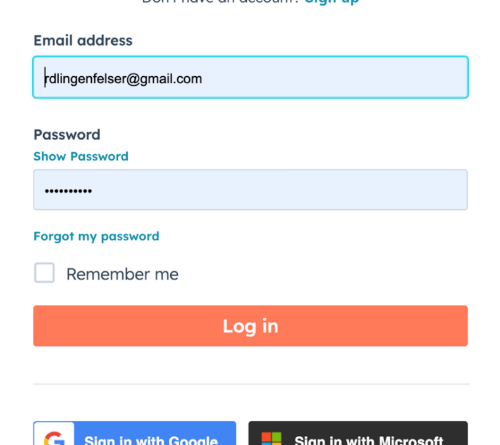
Typically, you’ll have a subdomain that customers use to log into your platform (eg app.hubspot.com/login). It can be customized for the client, but uses the same design as for the generic login page, perhaps with the logo included.
Other sites will often link to your login pages. However, search engines analyze your subdomains separately from your main marketing site (in this example, www.hubspot.com). The authority you get from these login links doesn’t automatically extend to your pages that need it, and it doesn’t benefit your keyword rankings.
The context of a link can be simple, such as “Want to learn more about *short product description*? Visit companyname.com.” Anchor text is the visible URL, which points to your home page. You don’t need to get cute with unbranded keywords here, which just look like junk.
Finally, make sure your login pages are indexable. Doing this is useful, for customers anyway, because many will Google them instead of going to a bookmark.
While this error is most obvious on login pages, the concept applies to all subdomains: those you’ve created for support documentation, customer education, forums, and so on. , they should link to your main marketing site.
2. Sensitive customer data appears in search results
Many versions of web-based applications house customer data under a single subdomain (eg data.companyname.com).
Make sure these pages are not indexed!
In the worst cases I’ve encountered, form fields could be changed due to the lack of password protection on these pages.
Here is a process I wrote about that you can follow remove these pages from Google’s index.
While not a legal issue, exposing your company’s customers to search results could damage a key relationship, potentially revealing a competitive differentiator or vulnerability.
3. Case studies target companies, not industries, in search results
Prospects aren’t looking for results for individual companies, no matter how important those companies are. Instead, they want to see success by type of need and industry.
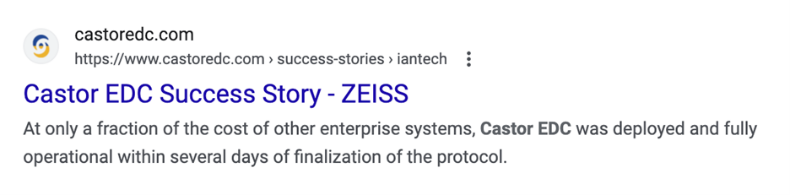
Therefore, in the example above, you should target “Electronic Data Capture Medical Device Case Study” instead of “ZEISS Case Study”. You can also create a general category page that links to multiple brand case studies.
If you’ve helped a major brand thrive, you should emphasize that, but don’t just target that brand in search results.
4. Third party key lists are not optimized for SEO
Many SaaS companies do basic on-page SEO within their own site. However, most don’t consider key profile keywords such as from Capterra.
Optimizing these texts helps you rank within these vertical search engines. It also allows you to provide relevant context for your keyword ranking when linking back to your site (as explained in this Google patent).
Eventually, this type of optimization will become even more important Google Search Generative Experience (SGE) take over, relying on these sources to provide summaries for your business.
5. The site uses JavaScript “Load more” buttons in the resource and blog sections
What happens, in many sites, is that the pages are initially crawled and then indexed from the blog or homepage of the resource.
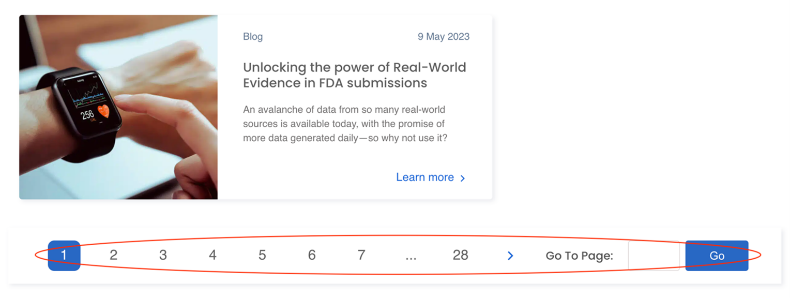
Older content inevitably falls off this page as new content is published. Many blogs and resource centers rely on a JavaScript button to load more pages. Google does not normally interact with these buttonsso you lose those internal links.
Older pages remain indexed as they are in your XML sitemap, but the result is still a huge decrease in keyword rankings for your older content. If you don’t consider content important to your site, why should Google?
The best solution is to use HTML links based on pagination on the blog homepage. If doing so is not possible, you can increase internal links between and among important articles.
6. You don’t scale your backlink “engine” properly
It is not efficient or effective to hire an offshore agency to manually generate backlinks. At best it has no effect; at worst, you get penalized in search results once Google realizes you are artificial link creation.
The best source of backlinks is always your own SaaS product. But you can’t be completely hands-off. I once had a client who got a lot of backlinks PubMedbut he had no standardized process to guide his research partners in how these citations were created (if they even were).
Make sure you use your backlink ‘engine’ to get the most and the most ideal backlinks. This can be done simply by providing guidelines on where to link, the right context based on keywords, which pages, etc. (no need to feel manipulative).
7. SEO best practices are not considered in the content strategy
The typical SaaS B2B content strategy has many and varied problems:
Content is not specific enough on pages when trying to build topical authority. Product teams encourage being too general and using branded product names in vital on-page SEO elements. Headlines focus on copywriting without incorporating keywords. Internal linking to a page does not occur despite repeatedly referencing a topic throughout the content. Keyword cannibalization occurs by covering the same topic over and over again without long keyword variations. A site redesign/migration does not take SEO into account, often losing relevance to the important keyword rankings that were gained.
Mobile indexing is not considered. Outdated content is not redirected or removed. Search intent is poorly addressed, for example, by writing blog posts instead of providing tools or templates that the audience actually wants. Content is distributed to partners without proper canonical tag and reference to the original content. The content has no experience.
And many others.
It goes beyond avoiding SEO mistakes in B2B SaaS
SEO takes more time to improve compared to other channels, nor is it cheap to build great assets. However, the rewards are great when SEO is pursued effectively.
Partnering with an agency or consultant allows your business to benefit from a deep understanding of how search engines work so you can grow organic search organically (through everything you’re already doing that’s good for marketing), but even better.
This article was meant to be specific enough for you to start making positive fixes for better SEO today. However, it should be clear that the effort goes beyond what is stated here. There are a lot of issues to deal with, even when dealing with content strategy, as we’ve seen!
So fix these top seven SEO mistakes. But if you want a true strategy as a B2B SaaS company of sufficient size, partner with experts for a comprehensive SEO approach.
More resources on B2B SEO
How to Get SEO Right for Your SaaS Business: Three Strategic Elements
Unraveling SEO Secrets for B2B Marketers: Kyle Roof on Marketing Smarts [Podcast]
SEO for B2B Marketing: Keywords, Content and Clicks
B2B Search Engine Optimization: Driving Conversion
The (non-technical) marketing guide to SEO
[ad_2]
Source link





