


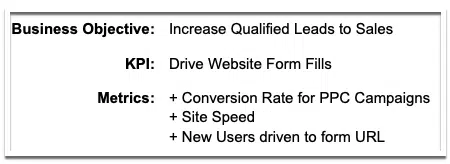
When I work with a new PPC client, I help them set goals that align with their business goals. Surprisingly, many do not have clearly defined campaign goals beyond increasing traffic or conversions.
We explore a framework for establishing key performance indicators (KPIs) and effective metrics aligned with your business goals for each stage of the conversion funnel.
KPIs and PPC metrics: how do they differ?
It is essential to identify goals and KPIs to measure success.
KPIs are your ultimate goals. Although metrics are data points that measure progress toward those goals.
For example, if your goal is to increase qualified leads, metrics would include conversion rate, new users directed to a specific URL, etc.
PPC campaigns can help achieve many goals, so understanding the difference between KPIs and metrics is key to setting yourself up for success. You need to choose the KPIs that are important to your business and link them to relevant metrics.
Clients typically apply uniform goals to all campaigns, regardless of their place in the marketing funnel. However, you should tailor your goals and metrics based on your funnel stage to accurately measure performance.
Why it’s important to align PPC goals with your marketing funnel
While paid search benefits bottom-of-funnel marketing, relying solely on it is a mistake.
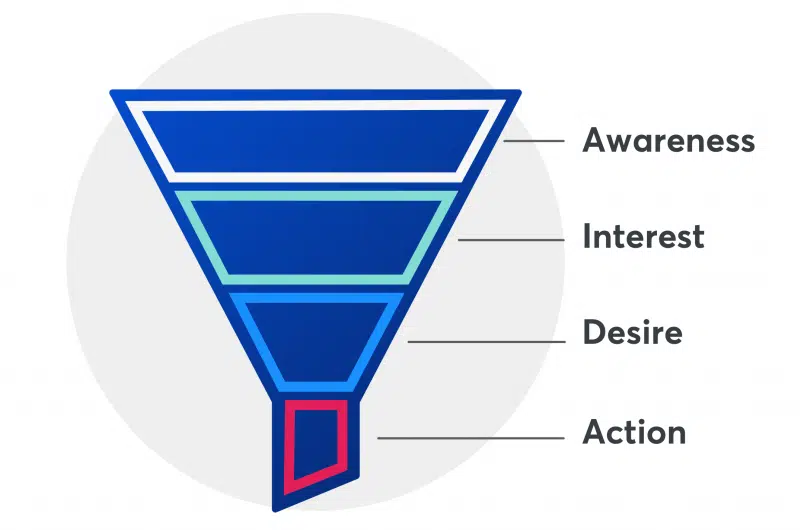
PPC campaigns can help every part of the marketing funnel, as long as you set them up accordingly and measure them with metrics and benchmarks that make sense for that stage.
Often, clients make the mistake of setting identical goals for campaigns at different stages of the conversion funnel. This overlooks the need to align campaigns with specific goals, which require different KPIs and metrics for fair and accurate evaluation.
Dig Deeper: How to use always-on marketing in paid search
Top of the Funnel PPC Campaigns
Top of the funnel campaigns should be designed to build awareness where none exists. You want these campaigns to reach a wide audience of potential and future customers and (hopefully) generate some interest in your product or service.
With reach as a high priority, these types of efforts often use campaign types that provide high visibility at a lower cost.
Because PPC can (incorrectly) be synonymous with lower-funnel marketing, it’s important to differentiate top-of-funnel campaigns from the rest of PPC marketing.
Top-of-funnel campaigns often use the Google Display Network, which has different benchmarks, ad content, and benefits.
Make sure you evaluate top-of-funnel campaigns fairly using the right KPIs and metrics.
KPIs for top of the funnel PPC campaigns
Increase brand awareness. Increase website traffic. Promote participation in social networks. Enhance brand commitment.
Metrics for top-of-funnel PPC campaigns
Impressions Cost per thousand (CPM) Click-through rate (CTR) Interactions (Google Ads)
Dig Deeper: Guide to PPC Top of the Funnel Reporting
Get the daily search newsletter marketers trust.
Mid-funnel PPC campaigns
Mid-funnel campaigns can be complicated because they can include a variety of objectives and campaign strategies. They may include:
What sets these campaigns apart is that they are designed to meet users in the Interest/Consideration phase. This means that your KPIs and metrics should be aligned with that end goal, finding users interested in your product or service and helping them consider whether they should take action.
KPIs for mid-funnel PPC campaigns
Establish authority in the sector. Increase involvement. Promote consideration. Nurture the tracks.
Metrics for mid-funnel PPC campaigns
Bottom of the funnel PPC campaigns
Finally, we come to what many people think of when they talk about PPC campaigns: bottom-of-the-funnel efforts that are extremely effective at driving actions like form fills, phone calls, purchases, and quote requests.
This includes:
Search campaigns with very high intent keywords. Display remarketing campaigns targeting users who have engaged with your conversion funnel efforts to move them down.
KPIs for end-of-funnel PPC campaigns
Acquire new customers. Increase revenue. Generate leads. Increase purchases.
Metrics for end-of-funnel PPC campaigns
Top Conversions (i.e. Form Submissions or Purchases) Conversion Rate Cost Per Acquisition/Conversion (CPA) Return On Advertising Investment (ROAS) Average Order Value (AOV) Cart Abandonment Rate Quantity article
Paid search attribution in GA4
Marketing attribution can change the way you evaluate the performance of your PPC campaigns.
By default, your PPC campaigns on Google and Microsoft Ads use a last-click attribution model unless you manually switch to data-based attribution.
In July 2023, Google announced that it would retire the first-click, linear, time-decay, and position-based attribution models.
GA4, on the other hand, uses the multi-channel data-driven model as the default attribution model. It also offers paid and organic last-click models, and Google’s paid channel last-click models that you can apply to certain property-level reports.
Dig Deeper: How to combine GA4 and Google Ads for powerful paid search results
The intersection of metrics and KPIs with business goals
Sometimes your broader business goals clearly relate to specific KPIs and metrics. Other times, you may need to get creative in aligning PPC efforts with larger business goals.
The worst mistake you can make is to set KPIs and metrics that don’t contribute to business success. The second worst is not explaining clearly and simply how KPIs and metrics contribute to business success.
You’re often trying to get buy-in and budget from key stakeholders who need you to help them connect the dots. Help them see the value by clearly stating how your KPIs support the company’s goal and mission.
Establishing KPIs and metrics for PPC
Ultimately, the KPIs you set for your PPC efforts should relate directly to your business goals, and the metrics you use to measure those KPIs will depend on the nature of your business and how you set up your campaigns
Do your future self a favor and don’t make the mistake of setting blanket KPIs for all your endeavors. You’ll do better (and your boss or client will be even more impressed) if you tailor your KPIs to the stage in the marketing funnel where your campaigns are built.
The views expressed in this article are those of the guest author and not necessarily Search Engine Land. Staff authors are listed here.
[ad_2]
Source link





