


Communicating with expertise and authority is a top priority, and there’s no better place to start than outlining your content with a topic taxonomy as a way to create content that has a better chance of ranking.
A taxonomy is a system for classifying, organizing, and naming things based on shared characteristics. It’s used in science to categorize things, but it’s a word that’s also used to categorize anything, including topics, making it an effective SEO concept to understand.
Topic Taxonomy
In the context of content, a thematic taxonomy refers to the organization of information into different topics and subtopics. Organizing content in this way creates an outline of the inherent topics and subjects covered within a web page of content.
The purpose of a topic taxonomy is to provide a structured framework on which to construct a meaningful document that is semantically relevant to a given topic.
This is a way of looking at content from a high level, seeing the forest, not the trees.
How to create a thematic taxonomy
Technologies like deep learning, neural networks, and RankBrain have helped Google move away from keywords and understand topics in content.
Topic search queries can be sorted by topic like this:
Beauty > Makeup > How to
A web page can be categorized in a similar way. Web pages rarely deal with one topic because there are always subtopics.
So when you think about a theme, you can also think about what the parts of that theme are.
If this is a clothing product page, the parts of this topic (subtopics) are:
size material fit fabric care description comments
These subtopics are the kind of things a consumer expects to see when visiting a clothing web page.
If the web page is about how to build links, the subtopics of that page might be:
research analysis disclosure templates subject lines
Google identifies topics
Google’s John Mueller once commented that headlines are about communicating what the topic is about.
Mueller said:
“And when it comes to text on a page, a heading is a very strong signal that tells us that part of the page is about that topic.
… whether you put it in an H1 tag or an H2 tag or an H5 tag or whatever, that doesn’t really matter.
But rather this general signal that you give us that says… this part of the page is about this topic.
And that other part of the page might be about a different topic.”
Google’s Martin Splitt discussed this process at a 2021 seminar where he introduced Google’s internal concept of web page themes, called the core annotation of a web page.
Martin explains:
“We’re just looking at the content and, I don’t know what we’ve said publicly about it, but I think I brought it up in one of the podcast episodes.
So I can probably say that we have something called the Core Annotation, for example, and there are some other annotations that we have where we look at the semantic content as well as potentially the design tree.
But fundamentally, we can already read it from the content structure in HTML and figure out, “Oh! This looks like from all the natural language processing we did on all the text content here that we have , it seems to be mostly about the A theme…”
In the quote above, Martin says there are additional annotations related to:
The semantic content The design tree
What is important is that Martin Splitt made it clear that Google seeks to identify what the topic of the web page is.
Therefore, your job is to describe the topic of the web page and the subtopics that are relevant to that topic.
Example of importance of topic and subtopics
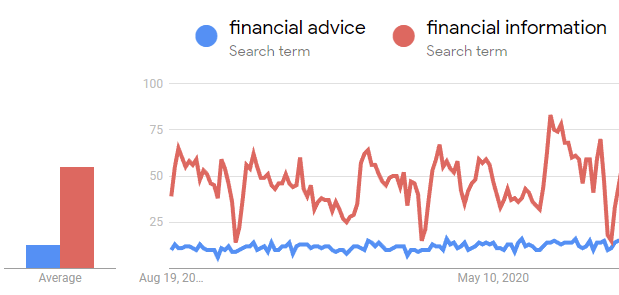
I once did one of those live website audits they do at SEO conferences and this person said their website can’t rank for a search term like financial information.
They had the keyword Financial Information in the title, headers, alt text, everywhere, right?
I looked at the website and the topic is clearly about financial advice, not financial information.
So I asked the publisher of the website why they were trying to rank for financial information if the website was about financial advice?
And the person says, “Because the keyword volume is higher for financial information.”
So the reason the website couldn’t rank for financial information, despite all the links and keywords, was because the topic of the content was about financial advice.
That is why it is very important to start by understanding the topic of the web page and then describe what the subtopics are based on what the user expects to find.
As I think most of us already know, Google no longer matches search queries to keywords. Google is matching search queries with relevant answers, and answers always refer to topics and subtopics.
More than thorough accuracy
Finally, avoid making the mistake of being exhaustive.
Providing a direct answer is always better because brevity offers the benefit of clarity and saves time. When people want an answer, they want it quick and easy to understand.
This is true for the consumer product page or on a review site. Don’t dwell on what is not of immediate importance, be precise.
Google is all about accuracy and being fast. This is one of the reasons they chose the word Hummingbird for their 2013 update because rewriting the core algorithm made it work faster and more accurately. Most subsequent updates had the characteristic of being accurate.
That’s also why it’s important to be accurate, not because Google is accurate but because that’s what users want, that’s why Google focuses on accuracy.
Thinking in terms of a taxonomy of topics will help you stay focused on being precise and comprehensive without going overboard with too much content and deviating from the topic.
Stay on topic with a topic taxonomy.
Featured image by Shutterstock/Dim Tik
[ad_2]
Source link





