


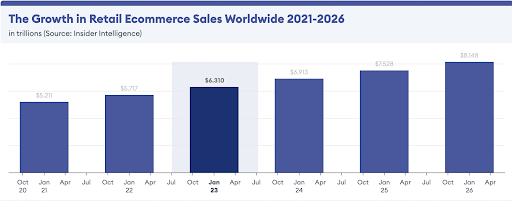
The e-commerce industry has seen double-digit growth every year for the past decade. Worldwide e-commerce sales, which have increased by 31% in just two years $8 trillion by 2026.
(Image source: Forbes Business)
Due to a post-pandemic business boom and a global shift to smartphone-centric shopping, the competition for online deals has never been tougher.
Consumers are more demanding, and with more industry competitors to contend with, your site needs to be in top shape. Your site’s SEO strategy plays a crucial role in your online success in 2023. If you want to improve your search engine visibility and have a chance of getting conversions, every aspect of your store should be optimized -se for a perfect user experience.
Stay with us as we tackle everything from page speed to personalization in the battle to become a leader in the e-commerce industry.
Addressing e-commerce competition in 2023
It’s no secret that e-commerce competition is on the rise. As the high street declines, we find more innovative ways to access omnichannel shopping online. Whether you use e-commerce via the World Wide Web or pop into the TikTok store on your lunch break, the digital evolution makes it easier than ever to buy a product/service online.
The question is, how can small business owners keep up? With industry giants like Amazon and ASOS dominating the field, it’s up to smaller industry players to match their levels of personalization and gratification and prioritize a consumer-led approach to e-commerce.
“If you’re focused on competitors, you have to wait until there’s a competitor doing something. Being customer-focused allows you to be more of a pioneer,” says Amazon founder Jeff Bezos. “We see our customers as guests at a party and we are the hosts. Our job every day is to make every important aspect of the customer experience a little better.”
In fact, a whopping one 91% of consumers they now say they are more likely to shop with a brand that prioritizes their personal preferences and delivers a seamless experience.
Giving your target audience an effortless journey from first impression to purchase is key in 2023. With so many choices at the consumer’s fingertips, it’s up to your site to give them an experience they can’t get anywhere else . This means that all areas of your site should be optimized for personalization, inclusive accessibility, and a fast path to conversion.
Why is site speed so important?
The e-commerce industry has become a space for instant gratification, making site speed a top priority for modern online shoppers.
In fact, fast loading pages are closely linked to e-commerce success. Fast sites not only encourage visitors to stay on the site longer, but only a one-second improvement in site speed could increase your conversion rate by 27%.
The question is, how does site speed affect your SEO? According to Google, page load time is one of the key ranking factors that a search engine’s algorithm considers when scoring site domains.
Google is constantly looking to provide its users with the best possible experience. Therefore, if your page load speed is slow, you will be further down the search chain.
Slow page load speed also encourages a higher bounce rate. Consumers are looking for quick calls to action and an effortless path to purchase.
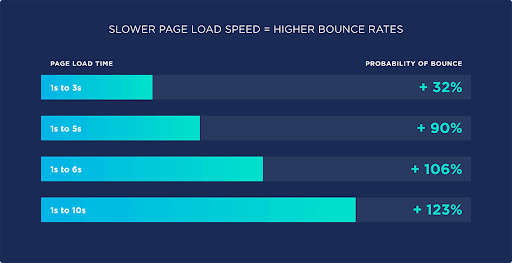
(Image source: Backlinko)
With so many industry competitors to choose from, you could be missing out on up to 100% of your traffic if your page takes just 6 seconds to load.
“Think about your own browsing habits. If you don’t wait for a page to load, why would you expect your customers to? Neither would they,” says Chuck Kim, co-founder of Executive Digital. “That’s why it’s vital to understand that every customer who bounces off your site is potentially a lost sale.”
3 Ways to Control Your On-Page SEO
If you want your e-commerce site to perform well in a competitive environment, you need to regularly review your SEO practices. Not only does an SEO-optimized website provide a more seamless consumer experience. But it is much more likely to be picked up by Google’s algorithm in a search engine.
Here are three ways to control your on-page SEO for a faster-loading website and an e-commerce experience that will keep your consumers coming back.
Removal of traffic bots
In a global e-commerce landscape, online stores are now flooded with traffic from various sources. With the ability to access Google from any country on any device or domain, there is significant room for botnet-style traffic.
This can not only clog up your server. If your site has low bandwidth, traffic bots can slow down load times and even affect analytics metrics. This includes the duration of the session, the pages viewed and the geolocation of the users.
using analytical tools such as Finteza, you can quickly detect and eliminate bot traffic, creating a site that runs more efficiently. As a multi-stage audience quality assessment tool that is enabled to prioritize UTM tracking, Finteza can detect up to 12 types of dangerous or low-quality traffic sources.
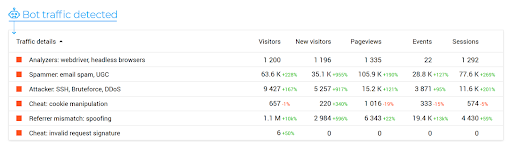
Working as a webmaster’s analytics partner, Finteza produces real-time reports. With the ability to monitor traffic sources 24/7, the system can automatically notify you of suspicious threats and compile live data page-specific charts and graphs.
Tracking
Better yet, Finteza can even track the full path of a potential “bot”, making it easy to map suspicious activity. With its Funnels feature, you can follow a bot’s journey from source to purchase, helping you spot potential false conversions.
If you want to improve your page load speed, it is essential to eliminate bot traffic. Not only will this help you end click fraud sessions, but with an accurate breakdown of your organic traffic, you can quickly spot areas for UX improvement based on audience behavior insights.
To optimize your on-page SEO, it’s important to dig deep into your organic traffic data. The more accurate your analytics, the better your decision making. Knowing your audience’s behavior is key to improving bounce rates. It also ensures that the journey from print to payment is smooth and fast.
Optimizing content for mobile
It’s also important not to forget your mobile consumers when reviewing your on-page SEO. A whopper 91% of all online purchases now they are done with a smart phone device. Therefore, your eCommerce store must be fit to handle mobile demands.
Mobile consumers are all about instant gratification. They want fast-loading content, strong visuals, and a personalized user experience throughout all stages of the funnel.
In fact, 40% of mobile consumers say they’ll quickly move on to a competitor if a site’s smartphone-oriented UX isn’t up to par.
The key here is to start testing all areas of your website in a mobile format. Make sure images are optimized for smartphone screens and potentially larger files are compressed to ensure faster rendering speeds.
Invest in a web host
One of the fastest ways to ensure that your page speed is well optimized is to invest in a web hosting service.
How defined by Tech Radar“Web hosting is a service that provides organizations and individuals with a platform to store their website files and make them accessible online.”
Think of it this way. If you want to access a file on your computer, you can simply open it. But if you want to share this file with a user who isn’t in the room, you’ll need to send it.
Your website is essentially made up of files and your web host is the sender. This allows visitors who interact with your domain to see the files in real time. Therefore, the more powerful your hosting server is, the faster your consumers will receive content.
To optimize your site for ultimate on-page success, it’s important to opt for a web host with high bandwidth. Plus one that can handle large influxes of traffic at once. As your audience grows, your site speed shouldn’t suffer.
Optimizing tomorrow’s e-commerce
The e-commerce sector continues to evolve. Of course, this adds SEO hurdles every step of the way, including things like page speed.
As webmasters and site developers adapt to meet new devices and consumer demands, it’s important to stay ahead of the curve when it comes to on-page SEO. Ensuring that your target consumers receive the best possible user experience could be the difference between conversion and page bounce.

Deanna Ritchie
Managing editor in ReadWrite
Deanna is the managing editor of ReadWrite. She previously served as Editor-in-Chief of Startup Grind and has over 20 years of experience in content management and content development.
[ad_2]
Source link





