


Google’s Gary Illyes answered a question about site structure, explaining why a hierarchical site structure is good for SEO and when it’s okay to use a flat structure.
Gary gives a good reason why a hierarchical site structure is a good choice and why a flat site structure is fine for simple websites.
Flat site structure
A flat site structure is when every page has a link from the home page, so every page is one click away from the home page.
It’s called a flat structure because if you were to visualize the link structure, it would be flat, with everything linked at one level below the home page.
The flat site structure came about during a time when people used to get links from web directories and from reciprocal links (where two sites agree to link to each other).
This type of link building created large amounts of links to the home page, but not so much to the inner pages. SEOs to maximize the amount of PageRank that was distributed to the website was to create the flat structure that distributed the PageRank to each page, giving each page the maximum ability to rank higher during a time when high PageRank pages tend to rank higher.
Not long after this strategy was invented, Google reduced the influence of PageRank as a ranking factor so that sites with lower PageRank scores that were more relevant had a chance to rank. This pretty much eliminated any reason to use a flat file structure.
Hierarchical structure of the site
A hierarchy is a reference to the way something is arranged in order of importance. In the case of a site structure, the organization is at the most general level of the site topic at the top, and web pages become more specific (granular) the lower you go in the site structure .
A hierarchical site structure allows you to create categories that fit a thematic topic.
The home page can be a general theme that represents the entire site, such as Science.
The next lower level are subject categories such as Astronomy, Botany, Geology, Meteorology and Psychology.
The next level below Astronomy can be Astrophysics, Cosmology, Observational Astronomy, Planetary Science, Stellar Astronomy. Each level contains articles that share the theme of each of the categories.
Also known as site taxonomic structure
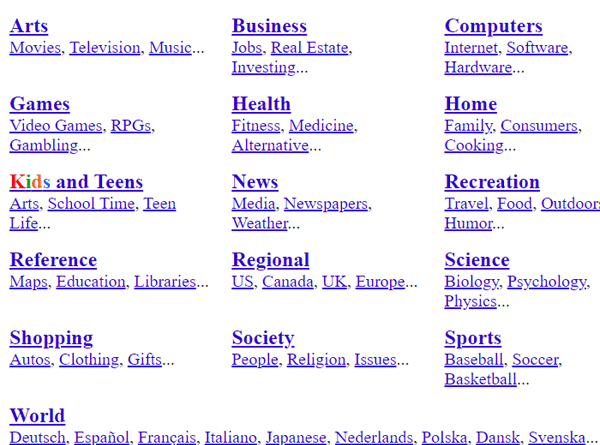
The hierarchical site structure was also known as a taxonomic structure in which things are classified into hierarchical groups. In the early 2000s, web directories were said to be organized in a taxonomic structure of sites, with the home page representing the main topic (web directory) and from there linking to the next level of categories and categories (specific) and successively granular web. pages progressively delving into the site’s taxonomic structure.
Also known as the pyramid site structure
Hierarchical and taxonomic site structures were also known as pyramid site structure. The top of the pyramid represents the home page that is generally categorized by the topic of the entire website and below that are successively granular (specific) categories and web pages as further down the structure of the site a person clicks .
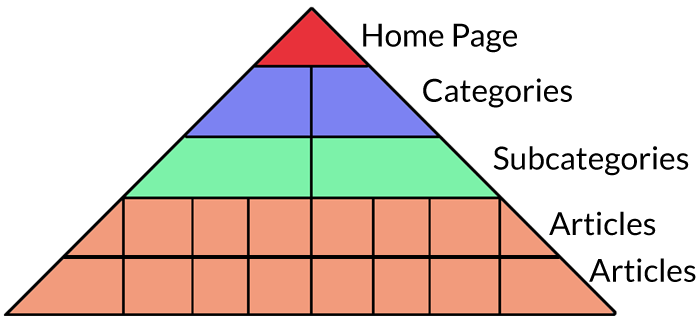
Structure of the silo site
There was a fourth visualization of the site’s architecture that was contemporary to the previous three. Like the three previous site structures, it had a general theme at the top and successively granular (specific) categories and web pages at the bottom of the site structure.
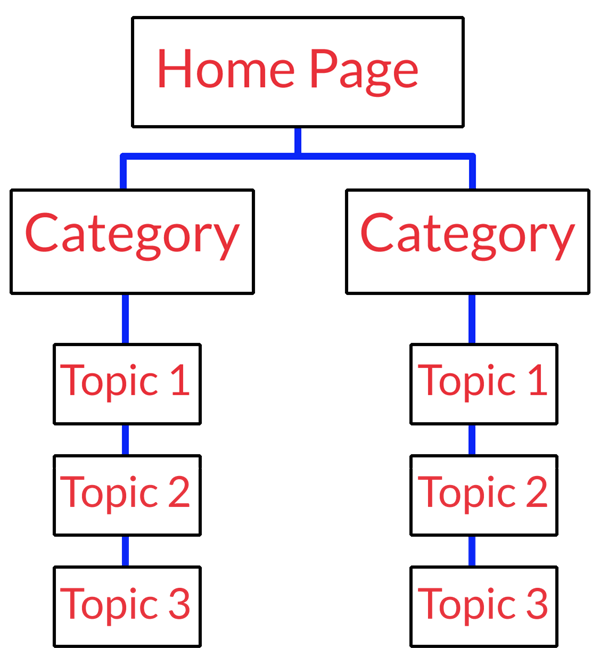
The visualization is different for each form of site structure, but they all describe exactly the same hierarchical way of organizing a website by categories and topics (also known as topics, the same as themes), the general theme in the upper part becomes progressively specific. below goes one.
The person who asked the question asked:
“Which category structure: hierarchical or flat structure for my website?”
Gary Illyes replied:
“I think that depends a lot on the size of the place.
For a large site, it’s probably best to have a hierarchical structure; this will allow you to do funky things in a single section and also allow search engines to treat different sections differently, especially when it comes to crawling.
For example, having a /news/ section for news content and /archives/ for older content would allow search engines to crawl /news/ faster than the other directory. If you put everything in one directory, that’s almost impossible.”
Hierarchical structure of the site
Gary gives a great reason to use a hierarchical site structure, as it gives Google the opportunity to treat different sections differently, including for a section of a website that deals with the topic of news. Each category on a web page can be a different topic which helps Google separate the site into sections and know what each one is about.
The site’s hierarchical structure, so good that SEOs had to give it four names.
Listen to the Office Hours conversation at 1:35 of the second.
Featured image by Shutterstock/NotionPic
[ad_2]
Source link





