


Google’s November 2023 Core Update took about 26 days to fully roll out and was completed on November 28. Now that the update is done, I wanted to share some data on how this November Core Update compares to the October 2023 Core Update data.
In summary, the data shows that the November 2023 core update was more volatile than the October 2023 core update.
Overlapping updates. Although the October 2023 core update had a corresponding October 2023 spam update overlaid on it. The November 2023 core update has a corresponding November 2023 review update that overlaps it. So the data can be a little messy when trying to figure out which update caused which volatility.
Here is the schedule for these two updates:
The core update started on November 2, 2023 and ended on November 28, 2023. The review update started on November 8, 2023 and is still being rolled out
Data providers in the November 2023 Google Core Update
Semrush. In an attempt to target or approximate the core update, Semrush mined data from November 6-8, prior to the release of the review update. Semrush peak volatility was 9.3 on November 7, in terms of its Semrush sensor data volatility tracking tool.
Mordy Oberstein, who presented the Semrush data to me, said that “the overall picture of ranking volatility is relatively similar” when comparing the October core update to the November core update. That’s good because it “makes looking at data points like peak volatility a little more relevant,” he added.
The November core update had higher volatility spikes compared to the October core update. It was 9.3 for the November core update and 7.9 for the October core update.
Here’s a chart showing peak volatility by niche/industry compared from November to October:
You can also break down the data to see the increase in volatility relative to a reference period. Yes, it shows that November is more volatile:
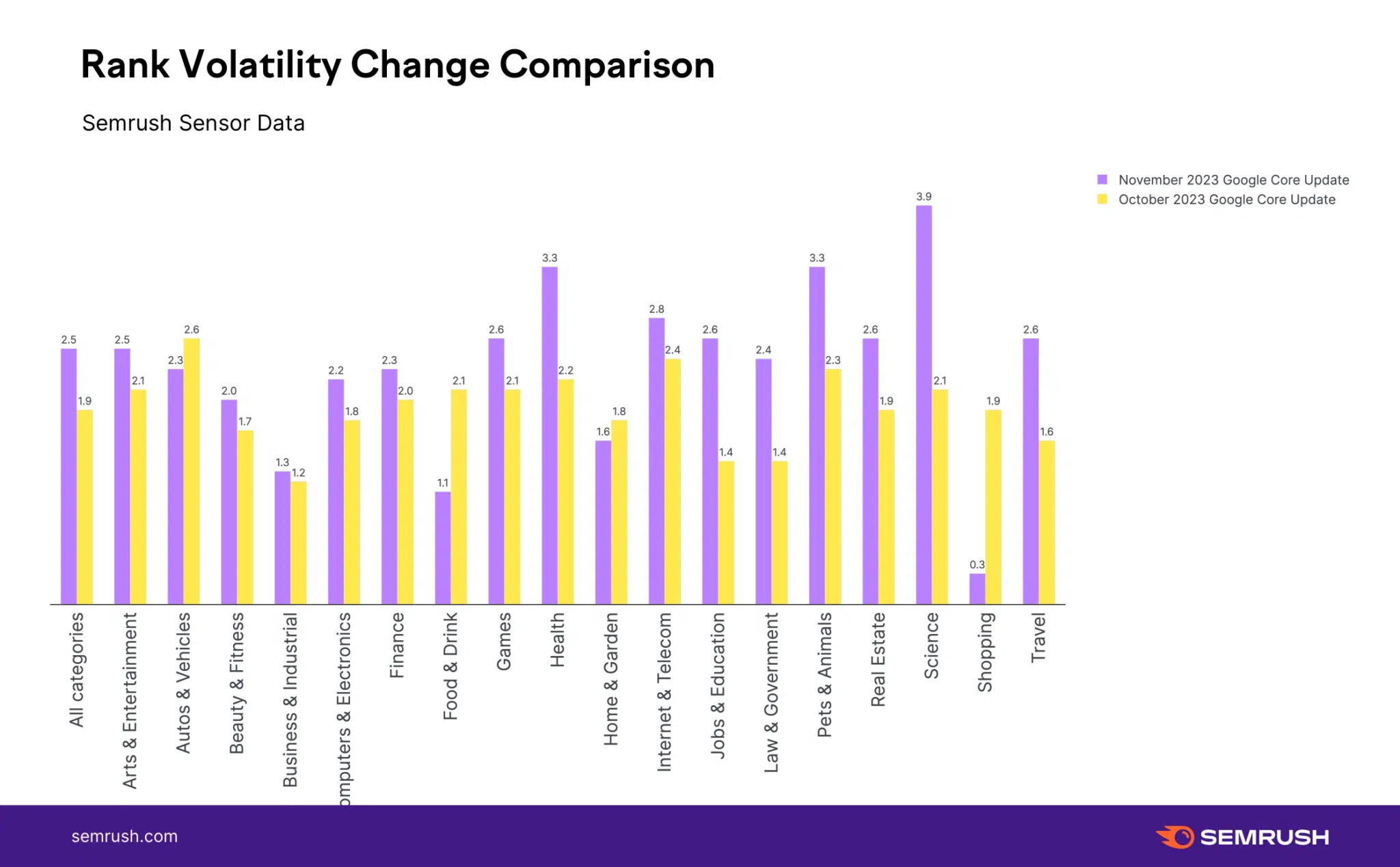
But it’s not that simple, “it’s not kind of a one-to-one match between the two updates,” Mordy Oberstein told us. “So to me, the difference in peak volatility data between the two updates is not necessarily ‘otherworldly,'” he added. Just look at this chart showing the trend comparison:

Additionally, the percentage of new (not seen before) ranking URLs in the top 10 locations on Google Search that were not in the top 20 positions prior to the November update looked like this. By comparison, in August, Semrush saw 10.85% of top 10 results not in the top 20 before the update, while in March 2023 it was 8.7%. We are now at 12.75%, here is this chart:

SimilarWeb. SimilarWeb’s Seismometer SERP also showed a spike in volatility on November 7th, with the number at 71 on its scale of 100. SimilarWeb’s Shay Harel said: “On November 5th, 3 days after Google announced the core update, Similarweb SERP Seismometer began to identify an increase in SERP fluctuations.”
You can see in the graph that the levels rose until day 7 and then calmed down over time:

They then calculated an average change of 4.43 positions in the SERPs when looking at overall ranking changes. To put this into perspective, Similarweb plotted the average position changes for all core updates since June 2021. When we look at the average fluctuations for the November update, we see that it has the highest average position changes since June 2021.
Here is the chart that shows it:

When looking at ranking volatility for the top three, top five and top ten positions in Google search results, the November update was more volatile than the October update. The retail niche was the most volatile, while the healthcare niche was the least volatile, Shay Harel told us.

seoClarity. The people at seoClarity gave us data from another perspective, how much search functions changed. It’s not clear if core updates have an impact on the appearance of a search feature, so that’s interesting. They charted the biggest gainers and losers for Google’s search results features by comparing the week before the update began with the end of last week.
Again, I don’t think the core update affects a feature that shows up or not, but it does affect some sites that show up in some of those features (like Discover, top stories, etc.). Here are the charts that Mark Traphagen sent me from seoClarity:


Sistrix Sistrix’s Steve Paine told us, “The overlapping changes in November are impossible to separate.” “You can no longer see big changes in the SERPs, but there are continuous increases in some websites that could be related to the ongoing revisions update,” he added.
He shared an example chart based on data from rosefieldwatches.com performance during this core update.
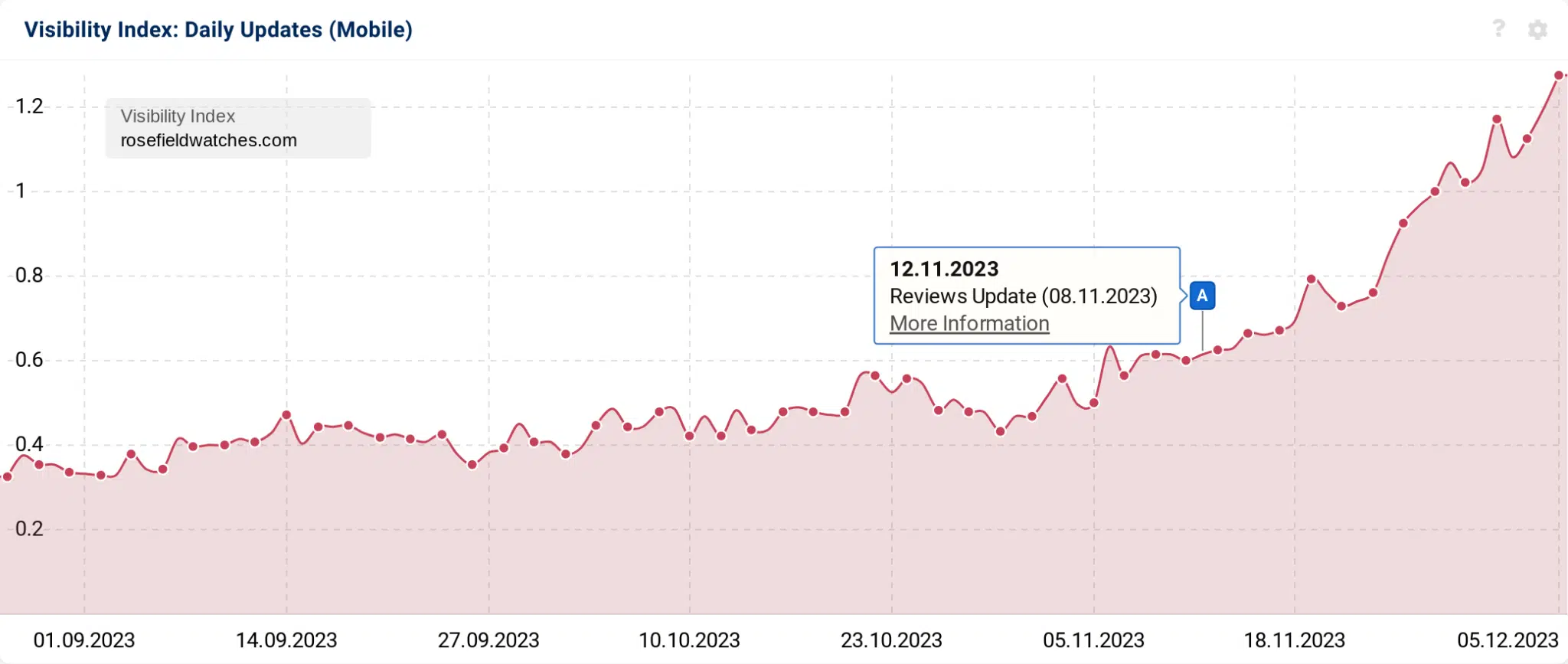
Other tools There are a lot of volatility tools for Google search rankings, here’s what they looked like after the core update just rolled out over the course of the update:


Cognitive SEO (seems stuck):


Learn more about the November 2023 Core Update
community In the search engine roundtable, I did a a little detour about what the community noticed in several different stories. From what I see from the community, this update was a big one and the SEO industry was buzzing about it in a big way
Previous core updates. Here’s a timeline and our coverage of recent core updates:
What to do if you get hit. Google has given advice on what to look out for if you’ve been adversely affected by a core update in the past. There are no specific actions to take to recover, and in fact, a negative impact on rankings may not indicate a problem with your pages. However, Google has offered a list of questions to consider if your site is affected by a core update. Google said you might see some recovery between core updates, but the biggest change you’d see would be after another core update.
Why we care It’s often hard to isolate what you need to do to reverse any algorithmic hits your site has taken. When it comes to basic Google updates, it’s even harder to do. What this data, experience, and previous advice has shown us is that these core updates are broad, broad, and cover many general quality issues. Previous data has reinforced that this is true. So if your site has been affected by a basic update, it’s often recommended that you take a step back, take a broader view of your overall website, and see what you can do to improve it overall.
Hopefully, your company and your customers did well with this update.
Learn more about Google updates
You can read more about our coverage in Search Engine Land’s Google algorithm update history.
[ad_2]
Source link





