


Staying ahead of the curve is imperative to long-term success in B2B. As we end 2023 and look ahead to 2024, now is the time to evaluate our marketing strategies to ensure we are fully prepared for what’s to come. This article discusses six key areas that B2B marketers should focus on to start 2024 proactively.
1. Get real with upper funnel expectations
We need to rethink how we approach the early stages of marketing traditionally focused on brand awareness. Building awareness with B2B buyers has never been more important.
Up to 90% of buyers have a set of sellers in mind before doing any research, and 90% of them will choose a seller from the list on day one, according to a poll from Bain and Google.
You’re unlikely to win customers if buyers don’t know you before they’re in the market.
Tracking upper funnel and B2B activities is difficult but doable. Many media platforms offer brand augmentation studies. Ask your representative or customer support for guidance.
You can also perform advanced analysis such as halo studies or incrementality tests to better understand the lift.
Halo analysis allows us to look for a correlation between the independent variables and the dependent variable to determine if there is a positive relationship between them (ie, the tactic positively affects revenue or leads). Incremental testing measures the impact of your entire marketing campaign and the individual campaign components that help drive traffic.
Deeper: Guide to PPC Top of the Funnel Reporting
2. Adopt the role of content in the upper funnel
When considering the upper funnel, focus on quality content. A strategic content approach helps create lasting connections with your audience.
Tailor content to deliver value, attract and keep prospects engaged through formats like blog posts, videos, webinars and interactive experiences.
Many B2B marketers struggle with poorly done and unattractive creative elements such as website design and functionality. Use heat mapping and behavioral analysis tools like Microsoft Clarity to help identify any opportunities for improvement.
Also, review your value proposition. Many B2B marketers pay too little attention to the message they are delivering.
3. Build and maintain investment in off-market buyers
Ninety-five percent of B2B buyers are not in the market at any given time, LinkedIn Research suggests. Targeting only those “ready to talk to sales” means missing out on 95% of your addressable market (SAM).
Building and committing to investing in this important group is the only way to ensure that you build top-of-mind, meaning your brand will be remembered without the need for a sign. Mindset is achieved by creating unique experiences that are memorable, exciting and directly tailored to the needs of your target audience.
The most critical factor for marketing success is creativity (47%), followed by media (38% which includes reach, targeting, recency and context), according to Nielsen.
However, a significant portion of B2B content is boring and uninspiring, and does not speak to the audience as real humans.
Here are some examples of inspirational B2B messaging:
Get the daily search newsletter marketers trust.
4. Personalization: Personalization of experiences for maximum impact
Improving the customer experience (CX) should be a priority for B2B marketers. Slow load times are the biggest frustration factor, affecting 18% of B2B visitor sessions, a Content square the study reveals.
Additional issues include rage clicks and multi-use targets. This further highlights the need to optimize website performance and user-friendly design to improve customer satisfaction.
Every customer interaction is important, whether on a computer or mobile device. We must provide a consistent and positive experience at every touchpoint.
Making mobile interactions enjoyable can be a great way to attract more B2B customers. Deliver personalized and positive experiences to shoppers browsing on their phones. This can also help create mental availability in media other than the desktop.
5. Value-based offerings: drive efficiency and ROI
Let’s switch gears and discuss what could be the most important launch for B2B marketers: Google Ads Value-Based Bidding (VBB).
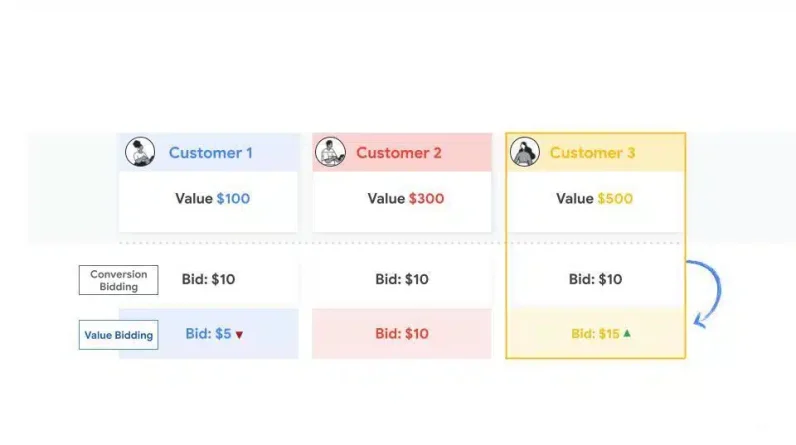
Essentially, VBB lets you tell Google which customers are most valuable to your business, allowing the algorithm to bid higher or lower based on that insight.
Source: Optmyzr
You can use tags or online conversions to tell Google about customers who submit forms, request demos, or make purchases.
While many B2B transactions still happen offline through business development representatives, Google has simplified the process, offering direct integration with CRMs like Salesforce or HubSpot.
If you’re not using VBB, you’re missing out on significant improvements, as a Tinuiti case study demonstrates:
A 38% increase in conversion rates. A 48% increase in the opportunity rate rating. A -23% reduction in cost per qualified opportunity.
6. Stay away from hypertargeting
While hyper-targeting strategies such as account-based marketing (ABM) are popular in B2B, they are not without their drawbacks.
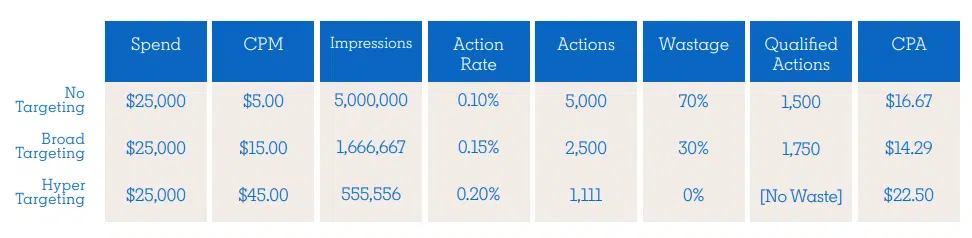
A strong argument against hypertargeting is its impact on costs; the more granular and specific the targeting, the higher the associated costs.
This can strain marketing budgets, and in some cases the return on investment may not justify the increased expenses.
Even if no waste is assigned to hyper-targeting, the cost per acquisition is still higher than trying to go for broader targeting, as LinkedIn describes in its B2B Trends Report 2030:
Also, hyper-targeting overlooks important blind spots.
Assuming that the narrow definition of an audience guarantees accuracy ignores the fact that more than 40% people are expected to change jobs, industries or titles in the next four years.
This constant change introduces unpredictability, making hyper-targeting less effective as it does not adapt to these dynamic changes.
Given these challenges, there is growing interest in a flexible approach that recognizes the changing nature of career paths and the limitations of third-party data.
Adopting a broader targeting strategy with some flexibility allows B2B advertisers to navigate the changing landscape more effectively, striking a better balance between accuracy and adaptability and potentially achieving more sustainable and profitable results.
Reflect, prepare and plan
As we look toward 2024, it’s clear that the B2B marketing landscape is ripe for transformation. From optimizing the upper funnel to improving personalization and changing targeting strategies, we can evolve our approaches to achieve greater efficiency and sustainability.
By taking the time now to reflect on these key trends and their implications for your business, you can make informed decisions to start the coming year in an optimized and proactive state.
Rethink conventions and consider emerging best practices to drive meaningful results and stay ahead of the curve.
The views expressed in this article are those of the guest author and not necessarily Search Engine Land. Staff authors are listed here.
[ad_2]
Source link





